
Hello my dear friends!
So far, we’ve looked at the Greek alphabet as well as two-letter vowels and consonants. You might think we’ve covered everything by now.
But have we?
We Greeks are crazy, so the answer is definitely no!
There are still two famous vowel combinations we need to talk about: αυ and ευ.
Don’t worry. I promise to keep it short and simple. Once you understand the rule, these two combinations become much easier to pronounce.
So, let’s get started!
The pronunciation of αυ and ευ
The vowel combinations αυ and ευ can be pronounced in two different ways.
They can sound like:
αυ → av or af
ευ → ev or ef
So how do you know which pronunciation to use?
Here’s the rule:
When αυ and ευ sound like av and ev
The αυ and ευ are pronounced as av and ev when a vowel or a voiced consonant follows
(β, γ, δ, ζ, λ, μ, ν, ρ)
When αυ and ευ sound like af and ef
They pronounced as af and ef when a voiceless consonant follows
(κ, π, τ, χ, φ, θ, σ, ξ, ψ).
This might seem a little hard to remember at the beginning but I promise you, once you get a little more experienced with the Greek language, the pronunciation will come to you automatically.
Now let’s expand our vocabulary with words that include these combinations.
ευ → ev or ef
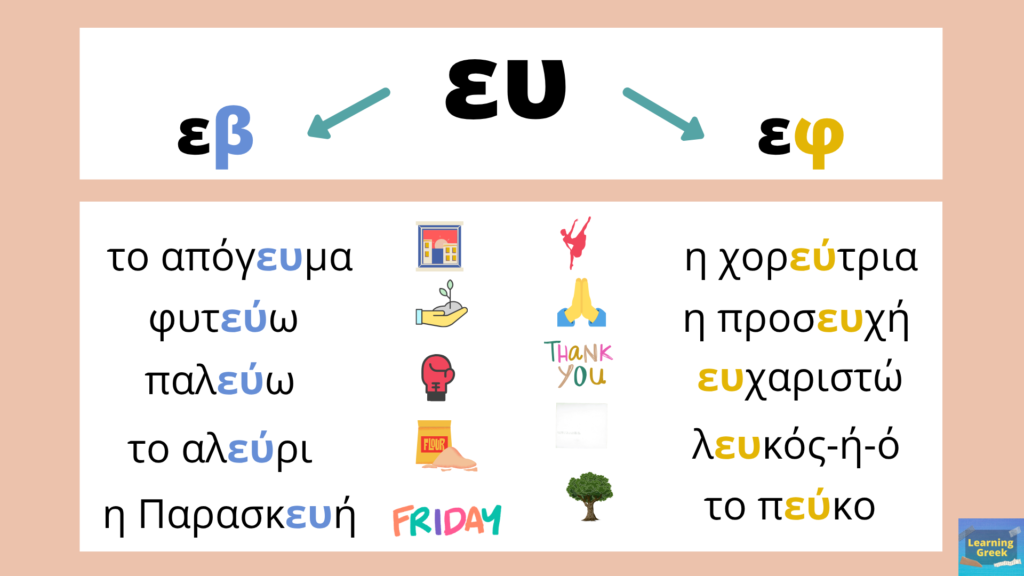
ευ → ev
το απόγευμα (to apógevma) – afternoon
φυτεύω (fitévo) – I plant
παλεύω (palévo) – I fight / struggle
το αλεύρι (to alévri) – flour
η Παρασκευή (i Paraskeví) – Friday
ευ → ef
η χορεύτρια (i horéftria) – female dancer
η προσευχή (i prosefchí) – prayer
ευχαριστώ (efcharistó) – thank you
λευκός/ή/ό (lefkós/l i/ó) – white
το πεύκο (to péfko) – pine tree
αυ → av or af
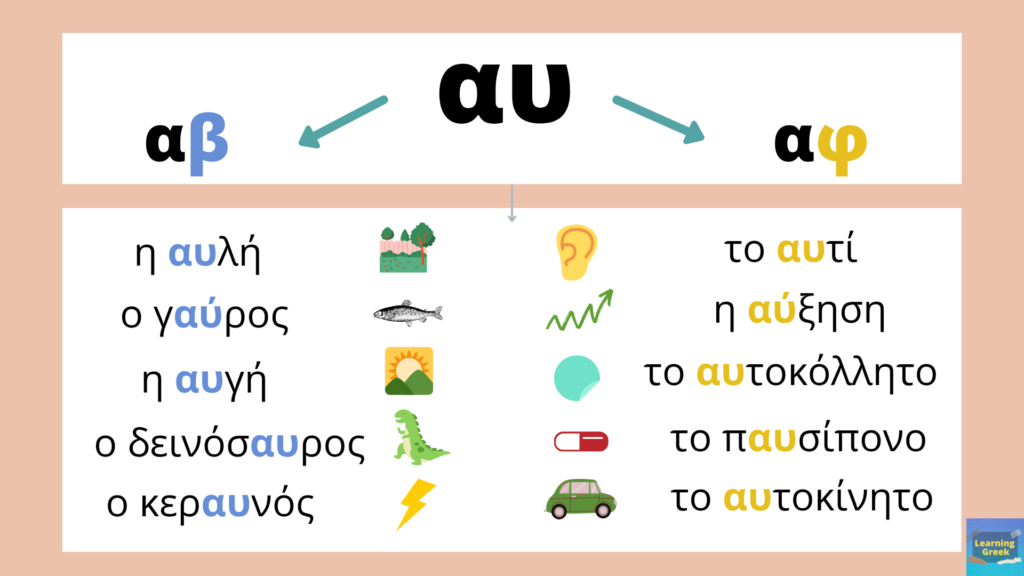
αυ → av
η αυλή (i avlí) – yard / courtyard
ο γαύρος (o gávros) – anchovy
η αυγή (i avgí) – dawn
ο δεινόσαυρος (o dinósavros) – dinosaur
ο κεραυνός (o keravnós) – lightning / thunderbolt
αυ → af
το αυτί (to aftí) – ear
η αύξηση (i áfxisi) – increase / rise
το αυτοκόλλητο (to aftokóllito) – sticker
το παυσίπονο (to pafsípono) – painkiller
το αυτοκίνητο (to aftokínito) – car
Practice reading αυ and ευ
Now that you know how αυ and ευ are pronounced, let’s see them in a few simple sentences. Read each sentence aloud and pay attention to the sound of αυ and ευ.
Το απόγευμα πάω στην αυλή.
In the afternoon, I go to the courtyard.
Eυχαριστώ για το λευκό μπλουζάκι.
Thank you for the white T-shirt.
Το αυτοκίνητο είναι στην αυλή.
The car is in the courtyard.
Aύριο θα φυτέψω ένα πεύκο.
Tomorrow I will plant a pine tree.
Η Παρασκευή είναι η αγαπημένη μου μέρα.
Friday is my favorite day.
Try reading the sentences aloud a few times. Can you identify which αυ and ευ sounds are pronounced with v and which with f?
That’s it!
I kept it short and sweet as I had promised. I’m not sure about the sweet part though…
Once you know the rule, αυ and ευ become much easier to pronounce. The more Greek you hear and read, the more naturally these sounds will come to you.
If you have any questions, don’t hesitate to leave a comment. I’ll do my best to help!
Until the next lesson!

Hi Marina, your way of teaching makes learning Greek language a lil bit easier. Efharisto poli for sharing your language!
Thank you so much! 😊
I’m really happy to hear that my posts are making learning Greek a little easier.
Ευχαριστώ πολύ for your kind words! ❤️