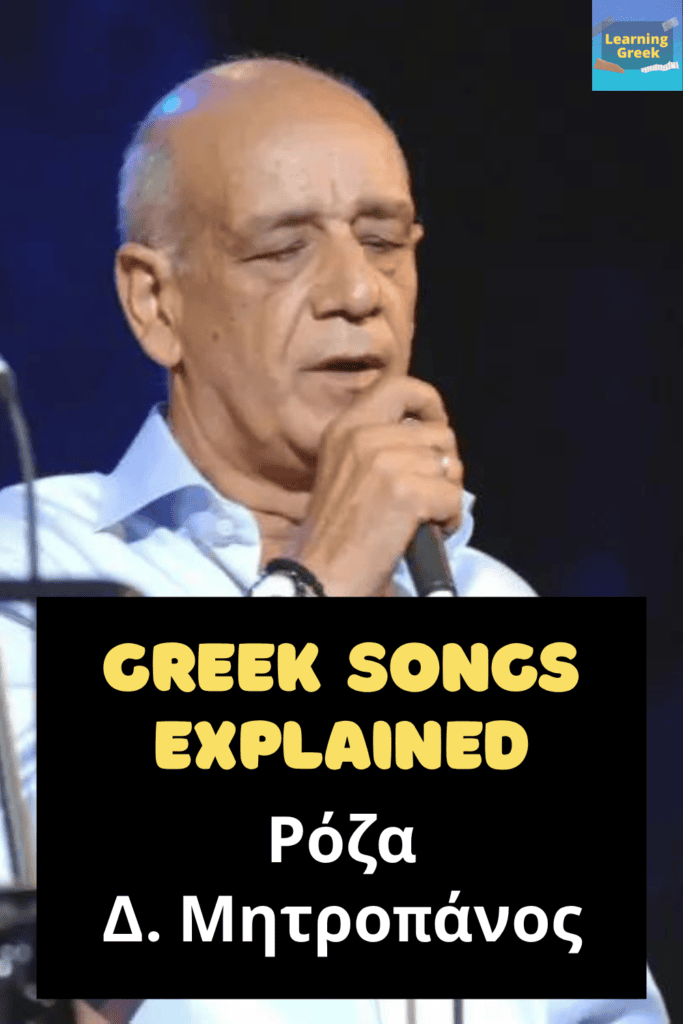

Hello my lovely Greek learners! Some Greek songs are more than songs. They become part of the country’s collective memory. The legendary track Roza by Mitropanos is certainly one of them.
If you have spent any time listening to Greek music, you have probably heard this song. Its powerful melody, Μητροπάνος’s unmistakable voice and the poetic, sometimes mysterious lyrics of Άλκης Αλκαίος have made it iconic.
But here’s something you might not know: Roza by Mitropanos almost didn’t become famous at all. In fact, the song spent years hidden away in a drawer before reaching the right singer.
So, let’s listen to it, learn some Greek along the way, and discover the fascinating story behind the story behind Roza by Mitropanos.
Listen to Roza
Before we look at the lyrics, listen to the track first. Don’t worry if you don’t understand everything or try to translate every word yet. Just feel the music and the emotion in the voice.
The story behind Roza by Mitropanos
The story of Roza by Mitropanos is almost as fascinating as the song itself. Written by Alkis Alkaios with music by Thanos Mikroutsikos in 1985, Mikroutsikos composed it at the piano in one go. However, his initial rough tape recording—made quietly with a piano damper to avoid disturbing neighbors—sounded terrible. When he played it for Haris Alexiou while working on an album, she passed on it after just 30 seconds.
The song was shelved for ten years until 1996, when Mikroutsikos was preparing Stou aiona tin paraga with Dimitris Mitropanos. While reviewing old tapes, Mikroutsikos went to fast-forward past the track. Mitropanos stopped him, grabbing his hand and shouting, “As’ to!” (Leave it!). That pivotal moment saved the track, leading to its release and making Roza by Mitropanos a defining milestone in modern Greek music.
That small moment tells us something important about the recording. Μητροπάνος didn’t simply agree to sing a song that had been offered to him. He heard something in it immediately.
And after all those years sitting in a drawer, Ρόζα finally found the singer who could make people listen.
But Who Was the Real Inspiration for Roza?
This is one of the great mysteries surrounding the song.
One widespread theory is that the title refers to Rosa Luxemburg, as the imagery of history, struggle, and silence suggests political themes. Mikroutsikos believed Alkaios had Luxemburg in mind, though Alkaios never confirmed this publicly. Others suggest rebetiko singer Rosa Eskenazi, or simply a fictional figure. The mystery only adds to the magic of Roza by Mitropanos.
Why Roza by Mitropanos Became so Iconic?
Mitropanos brought extraordinary weight to the track. While he was already a master of laiko singing, this collaboration pushed him into deeper, literary territory without losing his emotional authenticity.
The lyrics jump from wet asphalt and passing vehicles to prison cells, roulette, insects, fog, and silence. It is a zeibekiko without a conventional chorus, yet Mitropanos made the dense poetry feel deeply personal and accessible to everyone.
Lyrics Breakdown
| Greek | English |
|---|---|
| Τα χείλη μου ξερά και διψασμένα | My lips, dry and thirsty |
| Γυρεύουνε στην άσφαλτο νερό | Are searching for water on the asphalt |
| Περνάνε δίπλα μου τα τροχοφόρα | Vehicles pass by me |
| Και ’συ μου λες μας περιμένει μπόρα | And you tell me a storm is waiting for us |
| Και με τραβάς σε καμπαρέ υγρό | And you pull me into a wet cabaret |
| Βαδίζουμε μαζί στον ίδιο δρόμο | We walk together on the same road |
| Μα τα κελιά μας είναι χωριστά | But our cells are separate |
| Σε πολιτεία μαγική γυρνάμε | We wander through a magical city |
| Δε θέλω πια να μάθω τι ζητάμε | I don’t want to know anymore what we’re looking for |
| Φτάνει να μου χαρίσεις δυο φιλιά | It’s enough for you to give me two kisses |
| Με παίζεις στη ρουλέτα και με χάνεις | You gamble with me at roulette and lose me |
| Σε ένα παραμύθι εφιαλτικό | In a nightmarish fairy tale |
| Φωνή εντόμου τώρα είν’ η φωνή μου | My voice is now the voice of an insect |
| Φυτό αναρριχώμενο η ζωή μου | My life is a climbing plant |
| Με κόβεις και με ρίχνεις στο κενό | You cut me down and throw me into the void |
| Πώς η ανάγκη γίνεται ιστορία | How does need become history? |
| Πώς η ιστορία γίνεται σιωπή | How does history become silence? |
| Τι με κοιτάζεις Ρόζα μουδιασμένο | Why are you looking at me, Rosa, numb and dazed? |
| Συγχώρα με που δεν καταλαβαίνω | Forgive me for not understanding |
| Τι λένε τα κομπιούτερς κι οι αριθμοί | What the computers and numbers are saying |
| Αγάπη μου από κάρβουνο και θειάφι | My love made of coal and sulfur |
| Πώς σ’ έχει αλλάξει έτσι ο καιρός | How has time changed you like this? |
| Περνάνε πάνω μας τα τροχοφόρα | Vehicles pass over us |
| Κι ’γω μες στην ομίχλη και τη μπόρα | And I, in the fog and the storm |
| Κοιμάμαι στο πλευρό σου νηστικός | Sleep by your side, hungry |
Learning Greek through Roza
One of the things I love about learning Greek through music is that songs don’t always use the Greek you find in a beginner textbook. You hear everyday words, poetic expressions, shortened forms and sometimes phrases that make much more sense once you understand the imagery behind them.
Ρόζα has all of these.
Let’s start with the opening:
Τα χείλη μου ξερά και διψασμένα
Γυρεύουνε στην άσφαλτο νερό
The word χείλη means lips. Notice that it is the plural of το χείλος, and it is one of those Greek words whose plural doesn’t look exactly like what you might expect from the singular.
Then we have ξερά – dry – and διψασμένα – thirsty. The verb διψάω means to be thirsty, while διψασμένος is literally someone who is thirsty.
But then the image becomes much more poetic. The lips are looking for water on the asphalt:
Γυρεύουνε στην άσφαλτο νερό
Γυρεύω means to look for or to seek. You will also hear ψάχνω used for to look for, which is much more common in everyday Greek. Γυρεύω has a more literary or poetic feeling, which fits the song perfectly.
And if you know the word άσφαλτος, you may already have guessed that it means asphalt. So literally, the lips are searching for water on the road.
Then come the τροχοφόρα:
Περνάνε δίπλα μου τα τροχοφόρα
This is an interesting word for learners. Τροχοφόρο literally means something that has wheels, from τροχός – wheel. In the song, it refers to vehicles passing by.
Then comes one of the words that I particularly like:
Και ‘συ μου λες μας περιμένει μπόρα
Μπόρα means a storm or heavy rain. Greek has several words connected with rain, but μπόρα has a more sudden, dramatic feeling than the simple βροχή – rain.
And there is a nice little grammar point here too. Μας περιμένει literally means it is waiting for us. The pronoun μας means us, while περιμένει comes from περιμένω – to wait.
So the storm is not simply coming. In the poetic world of the song, the storm is waiting for them.
Same road, different worlds
The next verse begins:
Βαδίζουμε μαζί στον ίδιο δρόμο
Μα τα κελιά μας είναι χωριστά
Βαδίζω means to walk, although in everyday conversation you’re much more likely to hear περπατάω. Once again, the choice of verb gives the lyrics a more literary tone.
The striking word here is κελιά – cells.
A κελί is a cell, particularly a prison cell. So when the song says τα κελιά μας είναι χωριστά, it literally gives us the image of two people whose cells are separate.
They are walking together on the same road, but their cells are separate.
That contrast is what makes the line so powerful. The two people are physically together, yet somehow they are still isolated from one another.
The song then takes us into a completely different world:
Σε πολιτεία μαγική γυρνάμε
Πολιτεία can mean a city, but it can also have a more poetic meaning such as a realm or state. Here, together with μαγική – magical – it creates the feeling of an imaginary world.
And then:
Δε θέλω πια να μάθω τι ζητάμε
Φτάνει να μου χαρίσεις δυο φιλιά
Δεν θέλω πια means I don’t want anymore, while τι ζητάμε literally means what we are looking for or what we are asking for.
The verb ζητάω / ζητώ is extremely useful in Greek. Depending on the context, it can mean to ask for, to request, to seek or to want.
And φτάνει is another lovely everyday word. Here it means that’s enough. So Φτάνει να… has the sense of it’s enough if… or all I need is for you to…
In this case:
Φτάνει να μου χαρίσεις δυο φιλιά
All I need is for you to give me two kisses.
Roulette, a nightmare and a climbing plant
The next verse becomes even more surreal:
Με παίζεις στη ρουλέτα και με χάνεις
Σε ένα παραμύθι εφιαλτικό
The verb παίζω normally means to play, but here με παίζεις στη ρουλέτα creates the image of someone gambling with the speaker as though he were a bet.
Then comes με χάνεις – you lose me. Both με and μου are extremely common little words in Greek, but they do different jobs. Here με is the object of the verb: you lose me.
And then we get παραμύθι, one of those wonderfully useful Greek words that learners encounter everywhere. It means fairy tale or story, but it doesn’t necessarily refer only to children’s stories.
Here it is a παραμύθι εφιαλτικό – a nightmarish fairy tale.
The imagery becomes even stranger:
Φωνή εντόμου τώρα είν’ η φωνή μου
Φυτό αναρριχώμενο η ζωή μου
Έντομο means insect. The speaker says that his voice has become the voice of an insect.
Then φυτό αναρριχώμενο means a climbing plant. Αναρριχώμαι means to climb, and αναρριχώμενος describes something that climbs or grows upward.
So η ζωή μου είναι ένα φυτό αναρριχώμενο is essentially the image of a life that grows and climbs, before the next line suddenly cuts it down:
Με κόβεις και με ρίχνεις στο κενό
Κόβω means to cut, while ρίχνω means to throw or to drop. Το κενό is the void or emptiness.
The imagery is deliberately dramatic. The speaker’s life becomes a climbing plant, and then the other person cuts it and throws it into the void.
This is not a song where translating every word gives you the whole meaning. You have to let the images work together.
The lines everyone remembers
And then comes the heart of the song:
Πώς η ανάγκη γίνεται ιστορία
Πώς η ιστορία γίνεται σιωπή
These two lines are particularly interesting for Greek learners because of the verb γίνομαι – to become.
Γίνομαι is an extremely useful Greek verb. In the third-person singular, it becomes γίνεται – becomes.
So literally:
Πώς η ανάγκη γίνεται ιστορία
How does need become history?
Πώς η ιστορία γίνεται σιωπή
How does history become silence?
The words themselves are quite simple: ανάγκη is need, ιστορία is history or story, and σιωπή is silence.
But the combination is anything but simple.
This is one of those moments where the language learner has to stop looking for a literal explanation and start thinking about the image and the emotion behind it.
The next lines bring us back to Ρόζα:
Τι με κοιτάζεις Ρόζα μουδιασμένο
Συγχώρα με που δεν καταλαβαίνω
Κοιτάζω means to look at, so τι με κοιτάζεις; is literally why are you looking at me?
Μουδιασμένο comes from μουδιάζω, to become numb. Here it can suggest someone who is numb, stunned or emotionally dazed.
And συγχώρα με means forgive me. The verb is συγχωρώ – to forgive.
Finally:
Τι λένε τα κομπιούτερς κι οι αριθμοί
Τι λένε means what they say, from λέω – to say. Οι αριθμοί are numbers.
The word κομπιούτερς is simply the Greek use of the English-derived word computers, adapted to Greek pronunciation and spelling.
And this is another interesting feature of the song: it brings together very old, poetic imagery with something distinctly modern – computers and numbers.
Coal, sulfur, fog and rain
The final verse begins:
Αγάπη μου από κάρβουνο και θειάφι
Πώς σ’ έχει αλλάξει έτσι ο καιρός
Κάρβουνο means coal and θειάφι means sulfur. Again, this is not ordinary romantic language. Calling someone αγάπη μου – my love – and then describing that love through coal and sulfur creates a dark, almost hellish image.
The word καιρός is also worth noticing. Greek learners usually first learn it as weather, but καιρός can also mean time or the times, depending on the context.
Here, ο καιρός is connected to change:
Πώς σ’ έχει αλλάξει έτσι ο καιρός
How has time changed you like this?
Then the song returns to the vehicles:
Περνάνε πάνω μας τα τροχοφόρα
Earlier, the vehicles were passing beside the speaker:
Περνάνε δίπλα μου
Now they pass over us:
Περνάνε πάνω μας
That small change in the preposition completely changes the image.
And finally:
Κι ‘γω μες στην ομίχλη και τη μπόρα
Κοιμάμαι στο πλευρό σου νηστικός
Ομίχλη means fog, while μπόρα brings back the storm from the opening of the song.
Μεσ’ / μες is a shortened form of μέσα – inside, in. So μες στην ομίχλη και τη μπόρα means in the fog and the storm.
And then comes the final image:
Κοιμάμαι στο πλευρό σου νηστικός
Νηστικός means hungry, literally someone who has not eaten. Στο πλευρό σου means by your side.
So the speaker is sleeping beside the person he loves, surrounded by fog and storm, yet still hungry.
And then the chorus returns.
The song ends where it began: with the same questions about need, history, silence, Ρόζα, computers and numbers.
That repetition is part of what makes Ρόζα so memorable. You don’t necessarily understand everything the first time you hear it, and perhaps you’re not supposed to. But once you start noticing the Greek words, the strange images and the contrasts in the lyrics, the song opens up little by little.
A few words you may recognize differently
There are also some forms in the lyrics that are worth pointing out because learners may not immediately recognize them:
γυρεύουνε → γυρεύουν
περνάνε → περνούν / περνάνε
γυρνάμε → γυρίζουμε / γυρνάμε
ειν’ → είναι
σ’ → σε
κι ‘γω → κι εγώ
These shortened forms are very common in songs and spoken Greek. That’s one reason learning Greek through music can be useful: you don’t always hear the neat textbook version of a sentence.
Why learn Greek with Roza by Mitropanos?
“Ρόζα” is a great song for learning Greek because it gives you real, expressive Greek in context. You’ll hear useful verbs and vocabulary, see how Greek sentences are naturally put together, and get familiar with expressions you’re likely to encounter in other Greek songs and texts.
It’s also a good way to practice listening and pronunciation. When you listen while following the lyrics, you can hear how the words flow together and start recognizing familiar words more quickly. And because the words are connected to a melody and a story, they’re much easier to remember than a random vocabulary list.
Final thoughts
I’ve always loved using Greek music to help learners get closer to the language, and “Ρόζα” is a perfect example of why. There’s so much Greek in this song beyond the individual words – the way the language flows, the emotion behind the lyrics, and the story it tells.
So my advice is simple: listen to it again, sing along if you feel like it, and don’t worry about understanding every word. Let the Greek become familiar little by little. That’s one of my favorite things about learning a language through music.
And if you want to explore more Greek songs, take a look at my Greek Music section!