Hello, my brave Greek learners! If you are learning Greek, you’ll quickly come across grammatical gender. But what exactly does that mean?
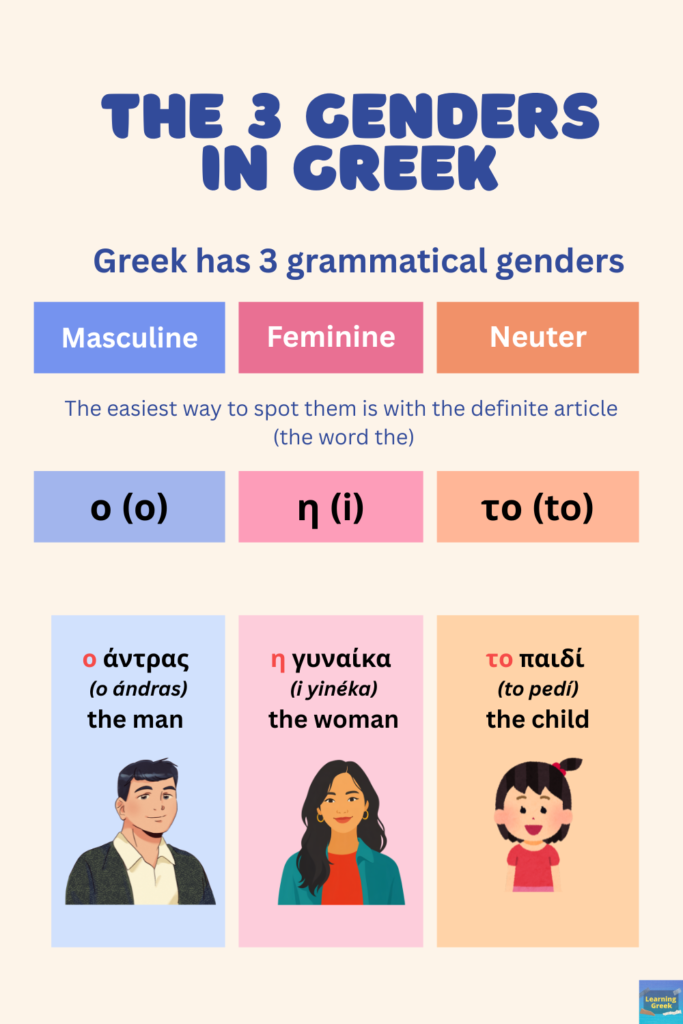
In Greek, gender is simply a way of categorizing words. Every noun belongs to one of three groups:
Masculine, Feminine, Neuter
Think of these as three main “families” for words. When a noun belongs to a family, other words attached to it, like articles (the, a), adjectives (good, big), and pronouns (this, they), change their forms to match that same family.
If you are coming from English, this might feel unusual at first. However, don’t worry! You don’t need to master everything at once.
Let’s break down how Greek gender works and how you can spot it easily.
Understanding the Three Genders in Greek
The fastest way to navigate Greek gender is by looking at the definite article (the word for the).
For example:
Masculine: ο (o) → ο φίλος (o fílos) – the friend
Feminine: η (i) → η φίλη (i fíli) – the friend
Neuter: το (to) → το παιδί (to pedí) – the child
Greek Gender Isn’t Always About Biological Sex
Grammatical Greek gender does not always reflect biological gender. For example, while many words for people align naturally, like ο άντρας (o ándras) for the man and η γυναίκα (i yinéka) for the woman, there are major exceptions.
In fact, two of the best examples are the words for boy and girl:
το αγόρι (to agóri) – the boy (neuter)
το κορίτσι (to korítsi) – the girl (neuter)
Even though they refer to male and female people, the words themselves take the neuter article το (to). And if you need to find more about this, I have written a detailed guide on why το κορίτσι uses το and how to spot neuter nouns in Greek!
The same goes for
το παιδί (to pedí) – the child,
which stays neuter whether you are talking about a boy or a girl!
Grammatical gender also applies to everyday objects and places:
ο δρόμος (o drómos) – the road (masculine)
η πόλη (i póli) – the city (feminine)
το σπίτι (to spíti) – the house (neuter)
Because these are grammatical categories, a house is not inherently neuter and a city is not feminine. These are simply their grammatical forms.
How to Spot Greek Gender
Clue 1: Look at the article first
Your absolute best clue for identifying Greek gender is always the article (ο, η, το). If you see ο (o), it is masculine. If you see η (i), it is feminine. If you see το (to), it is neuter. The article never lies!
Clue 2: Look at the ending
When you see a new word in the singular without an article, its ending gives you a fast hint about its Greek gender:
| Gender | Typical Endings | Examples |
| Masculine | -ος, -ης, -ας | ο δρόμος (o drómos) – the road ο μαθητής (o mathitís) – the student ο άντρας (o ándras) – the man |
| Feminine | -α, -η | η θάλασσα (i thálassa) – the sea η φίλη (i fíli) – the female friend |
| Neuter | -ο, -ι, -μα | το βιβλίο (to vivlío) – the book το παιδί (to pedí) – the child το όνομα (to ónoma) – the name |
Pro-tip: Endings are helpful clues, but articles are the final rule. For instance, some words ending in -ος can be feminine, like η οδός (i odos) – the street, or neuter, like το έδαφος (to édafos) – the ground. Relying on the article is always your safest bet.
How Greek Gender Works in the Plural
When a noun becomes plural, both the article and the word ending change. The biggest shortcut to remember is that masculine and feminine words share the exact same plural article: οι (i).
Masculine: ο δρόμος (o drómos) → οι δρόμοι (i drómi) – the roads
Feminine: η θάλασσα (i thálassa) → οι θάλασσες (i thálasses) – the seas
Neuter: το βιβλίο (to vivlío) → τα βιβλία (ta vivlía) – the books
How Greek Gender Affects Other Words Too
Adjectives and pronouns also change to match the Greek gender of the noun they describe.
Adjectives
Adjectives always agree with the noun in gender. Notice how the adjective ο καλός, η καλή, το καλό (o kalós, i kalí, to kaló) – good shifts its ending:
Singular:
ο καλός φίλος (o kalós fílos) – the good friend (male)
η καλή φίλη (i kalí fíli) – the good friend (female)
το καλό παιδί (to kaló pedí) – the good child
Plural: οι καλοί, οι καλές, τα καλά (i kalí, i kalés, ta kalá)
οι καλοί φίλοι (i kalí fíli) – the good friends (male),
οι καλές φίλες (i kalés fíles) – the good friends (female),
τα καλά παιδιά (ta kalá pediá) – the good children
Pronouns
Pronouns work in a similar way:
Singular: αυτός, αυτή, αυτό (aftós, aftí, aftó) – he/she/it (or this one)
Plural: αυτοί, αυτές, αυτά (aftí, aftés, aftá) – they (these ones)
Indefinite Articles
Greek indefinite articles (the words for a or an) also reflect Greek gender:
Masculine: ένας (énas) → ένας φίλος (énas fílos) – a friend
Feminine: μία / μια (mía / mia) → μία φίλη / μια φίλη (mía fíli / mia fíli) – a friend (female)
Neuter: ένα (éna) → ένα παιδί (éna pedí) – a child
Plural nouns do not use an indefinite article: φίλοι (fíli) simply means friends.
So Greek gender is something you will see throughout the entire language, not just when you are learning nouns!
The best habit for You
If there is one thing I recommend, it is this:
Always learn new vocabulary together with its article. Instead of memorizing δρόμος, memorize ο δρόμος (o drómos). This may seem like a small difference, but it will make things much easier later when you start using adjectives, pronouns and other parts of Greek grammar.
Final thoughts
Greek gender may seem confusing at first, especially when the endings don’t always follow a clear pattern. But you don’t need to memorize everything at once.
Start by recognizing ο, η and το, and make the article part of every new noun you learn. With practice, grammatical gender will become much more natural.
Keep going, my brave Greek learners, you’ve got this!