
Hello, my lovely Greek learners! Have you ever looked at a Greek word and wondered whether you should use η, ο or το? Today, we’re going to focus on feminine nouns in Greek and their endings, so you can start recognizing them more easily.
In Greek, every noun has a grammatical gender: masculine, feminine or neuter. If you’ve already read my guide to Greek gender, you know that the ending of a noun can give you a useful clue about its gender.
But which endings are common in feminine nouns? How do these nouns change in the plural? And are there any exceptions?
Let’s find out!
How to Recognize Feminine Nouns in Greek
The easiest way to recognize a feminine noun is to look at its article.
In the singular, feminine nouns use η (i) in the nominative case, which is the basic form you usually find in a dictionary.
If you need a refresher, read my guide to Greek Articles.
For example:
η γυναίκα (i yinéka) – the woman
η φίλη (i fíli) – the female friend
η θάλασσα (i thálassa) – the sea
η πόλη (i póli) – the city
If you see η before a noun, you know that the noun is feminine.
But what if you come across a new word without an article? This is where noun endings can help!
Let’s take a look at the most common feminine noun endings and see how you can recognize them!
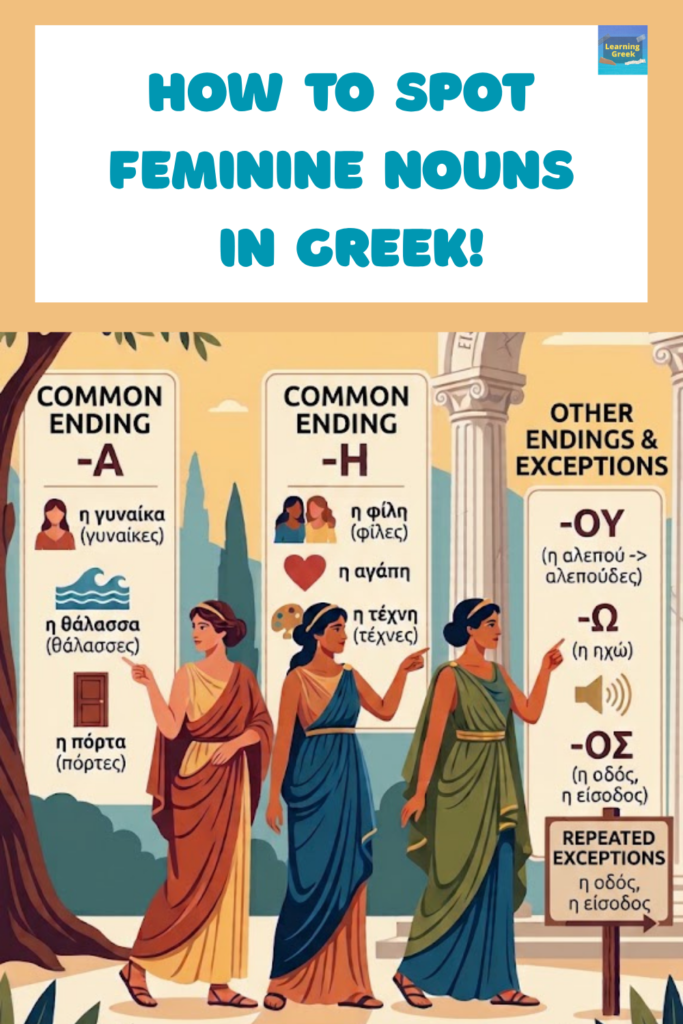
1. Feminine Nouns Ending in -α
One of the most common endings of feminine nouns in Greek is -α.
Here are some everyday examples:
η γυναίκα (i yinéka) – the woman
η ημέρα (i iméra) – the day
η θάλασσα (i thálassa) – the sea
η πόρτα (i pórta) – the door
η γλώσσα (i ylóssa) – the language, the tongue
η Ελλάδα (i Elláda) – Greece
You’ll notice that all these words end in -α.
What happens in the plural?
Many feminine nouns ending in -α form their plural by changing -α to -ες.
For example:
η γυναίκα (i yinéka) → οι γυναίκες (i yinékes) – the woman → the women
η θάλασσα (i thálassa) → οι θάλασσες (i thálasses) – the sea → the seas
η πόρτα (i pórta) → οι πόρτες (i pórtes) – the door → the doors
η ημέρα (i iméra) → οι ημέρες (i iméres) – the day → the days
Notice that the plural definite article for feminine nouns is οι (i). It is pronounced exactly like the singular article η, although the spelling is different.
However, some feminine nouns ending in -α form their plural in -άδες, such as:
η μαμά (i mamá) → οι μαμάδες (i mamádes) – the mum → the mums
η γιαγιά (i yiayá) → οι γιαγιάδες (i yiayádes) – the grandmother → the grandmothers
But let’s move on to the next ending.
2. Feminine Nouns Ending in -η
Another very common ending is -η.
Here are some examples you will encounter frequently:
η φίλη (i fíli) – the female friend
η ζωή (i zoí) – life
η αγάπη (i agápi) – love
η μουσική (i musikí) – music
η ζάχαρη (i záhari) – sugar
η τέχνη (i téhni) – art
If you see a noun ending in -η, there is a good chance it is feminine.
What happens in the plural?
Many feminine nouns ending in -η change to -ες in the plural.
For example:
η φίλη (i fíli) → οι φίλες (i fíles) – the female friend → the female friends
η αγάπη (i agápi) → οι αγάπες (i agá pes) – love → loves
η τέχνη (i téhni) → οι τέχνες (i téhnes) – art → the arts
Other nouns end in -εις
For example:
η πόλη (i póli) → οι πόλεις (i pólis) – the city → the cities
η δύναμη (i dinami) → οι δυνάμεις (i dinámis) – the force → the forces
The accent can also change when a noun becomes plural. For this reason, it is useful to learn both the singular and plural forms of new words.
3. Feminine Nouns Ending in -ού
Although -α and -η are very common feminine noun endings, some feminine nouns end in -ού.
For example:
η αλεπού (i alepú) – the fox
η μαϊμού (i maimú) – the monkey
Their plural forms are:
η αλεπού (i alepú) → οι αλεπούδες (i alepúdes) – the fox → the foxes
η μαϊμού (i maimú) → οι μαϊμούδες (i maimúdes) – the monkey → the monkeys
These examples show why it is useful to learn a noun together with its article rather than relying entirely on its ending.
4. Feminine Nouns Ending in -ω
A few feminine nouns in Greek end in -ω, although this is an uncommon pattern. Here are three examples:
η ηχώ (i ihó) – the echo
η πειθώ (i pithó) – persuasion
η φειδώ (i fidó) – restraint, frugality
These nouns are mainly used in the singular. Their plural forms are rarely needed in everyday Greek, especially for η πειθώ and η φειδώ, which refer to abstract concepts. Unlike nouns ending in -α or -η, they do not follow a simple plural pattern that learners can easily apply.
5. The Exception: Feminine Nouns Ending in -ος
Here is something that may surprise you!
Nouns ending in -ος are often masculine, such as:
ο δρόμος (o drómos) – the road
ο φίλος (o fílos) – the male friend
However, some feminine nouns also end in -ος.
For example:
η οδός (i odós) – the street, the road
η μέθοδος (i méthodos) – the method
η είσοδος (i ísodos) – the entrance
η έξοδος (i éxodos) – the exit
Although these nouns end in -ος, their plural forms end in -οι. This is a common plural pattern for masculine nouns, but these feminine nouns follow it too. Remember to learn their plural forms, as the ending alone does not tell you the gender.
οι οδοί (i odí) – the streets, the roads
οι μέθοδοι (i méthodi) – the methods
οι είσοδοι (i ísodi) – the entrances
οι έξοδοι (i éxodi) – the exits
This is why you should not rely entirely on a noun’s ending to determine its gender. Endings can offer helpful clues, but there are exceptions.
Quick Reference: Feminine Noun Endings in Greek
Here is a quick recap of the patterns we have covered:
| Singular ending | Plural ending |
|---|---|
| -α | -ες |
| -η | -ες, -εις |
| -ού | -ούδες |
| -ος | -οι |
| -ω | No common plural pattern |
Remember that these are common patterns, not absolute rules. The article is the most reliable clue to a noun’s gender.
My Tip for Learning Feminine Nouns in Greek
If you want to recognize feminine nouns more easily, here is my advice: always learn a new Greek noun together with its article.
Instead of memorizing just γυναίκα, learn η γυναίκα (i yinéka).
Instead of memorizing just φίλη, learn η φίλη (i fíli).
This simple habit will help you remember the gender of each noun and use it correctly when speaking Greek. It will also help you choose the correct articles and adjectives when you start building longer sentences.
And remember, feminine nouns do not necessarily refer to women or female beings. Grammatical gender is a feature of the Greek language, and it applies to objects, places and abstract ideas too.
Final Thoughts
I hope this guide helps you feel more confident when spotting feminine nouns in Greek! 😊 Remember, the endings can give you a helpful clue, but there are always a few exceptions.
When you learn a new Greek noun, try to remember its article η and its plural form, too. The more Greek you read and practice, the easier these patterns will become. Keep going, and don’t worry about memorizing everything at once.
Keep going, my lovely Greek learners! One Greek word at a time. 💙
And if you want to learn more about Greek nouns, read my guide on how to spot neuter nouns in Greek and why το κορίτσι uses το.