
Hello, future Greece traveler! Heading to Greece soon and want to learn some Greek before you go? Greek for Travelers is all about learning the words and phrases you’re actually likely to use on your trip, without trying to squeeze an entire Greek course into the weeks before your holiday.
Good news: you don’t need to become fluent before you arrive.
If you’re traveling to Greece for a holiday, your goal shouldn’t be to work your way through a grammar book from beginning to end. You need enough practical Greek to order a coffee, check into your hotel, ask for directions, understand a sign, buy something, and have a few simple interactions with locals.
In fact, you can learn a surprising amount of useful Greek in a short time.
This guide focuses on exactly that: practical Greek for Travelers meaning what Greek to learn before your trip, what to prioritize, and how to practice it so you can actually use it when you arrive.
So, let’s skip the unnecessary stuff and concentrate on the Greek that can make your holiday easier, more enjoyable, and a little more Greek.
How Much Greek Do You Need for a Trip to Greece?
Probably less than you think.
English is widely spoken in places that regularly welcome visitors, particularly hotels, restaurants, tourist attractions, airports, and popular destinations. You can have a perfectly good holiday in Greece without speaking Greek.
But knowing even a little Greek can make your trip more enjoyable.
In addition, knowing a few Greek expressions gives you an easy way to start small interactions with locals.
Imagine walking into a bakery and saying:
Καλημέρα! Έναν καφέ, παρακαλώ.
Kaliméra! Énan kafé, parakaló.
Good morning! One coffee, please.
You don’t need to speak fluent Greek to use that sentence.
And if someone answers you in Greek and you don’t understand, you can always switch to English.
The goal isn’t to prove that you speak Greek.
The goal is to have a few useful Greek phrases ready when you need them.
Do You Need to Speak Greek in Greece?
No.
You can travel around Greece without speaking Greek. But that doesn’t mean learning a little Greek is pointless.
Quite the opposite.
A simple Καλημέρα! (Kaliméra!) – Good morning or Ευχαριστώ! (Efcharistó!) – Thank you, can make an interaction warmer. Being able to read a Greek sign can help you find your way around. And ordering your coffee in Greek is simply more fun when you’re sitting in a café in Greece.
You don’t need perfect Greek.
You just need enough Greek to use it when the opportunity comes up. In other words, the aim is to communicate, not to perform perfect Greek.
That’s the basic idea behind Greek for travelers: learn what you are likely to use, practice it, and don’t worry about knowing everything.

What Greek Should You Learn Before Your Trip?
If you’re preparing for a trip, don’t try to learn everything at once.
Start with situations you’re actually likely to encounter:
greetings
cafés and restaurants
shopping
prices and numbers
hotels
directions
public transportation
airports and ferries
asking for help
situations where you don’t understand
You don’t need hundreds of words.
A small collection of useful phrases can take you surprisingly far. For this reason, it makes sense to focus on phrases you can use immediately.
Learn Phrases, Not Just Words
Instead of memorizing:
νερό
neró
water
learn:
Νερό, παρακαλώ.
Neró, parakaló.
Water, please.
Instead of learning only:
εισιτήριο
isitírio
ticket
learn:
Ένα εισιτήριο, παρακαλώ.
Éna isitírio, parakaló.
One ticket, please.
A complete phrase gives you something you can actually say.
It also helps you remember vocabulary in context, which is much more useful when you’re standing at a café counter or ticket office.
Essential Greek Phrases for Travelers
If you learn nothing else before your trip, learn the basic polite expressions.
Καλημέρα
Kaliméra
Good morning / Good day
Καλησπέρα
Kalispéra
Good evening
Καληνύχτα
Kaliníhta
Good night
Γεια σας
Ya sas
Hello / Hi / Goodbye
This is the polite form you can use when speaking to one person or to several people.
Ευχαριστώ
Efcharistó
Thank you
Παρακαλώ
Parakaló
Please / You’re welcome
Συγγνώμη
Signómi
Excuse me / Sorry
This is particularly useful for getting someone’s attention, apologizing, or politely interrupting.
Ναι
Ne
Yes
Be careful: Greek ναι is pronounced ne, not like the English word “nay.”
Όχι
Óchi
No
The χ has the rough Greek sound mentioned above.
Εντάξει
Endáxi
Okay / All right
You’ll hear εντάξει very often in everyday Greek.
Learn One Very Useful Polite Pattern
One of the most useful patterns in Greek for travelers is:
Θα ήθελα…
Tha íthela…
I would like…
You can use it in cafés, restaurants, bakeries, shops, and many other situations.
For example:
Θα ήθελα έναν καφέ, παρακαλώ.
Tha íthela énan kafé, parakaló.
I would like a coffee, please.
Θα ήθελα ένα νερό, παρακαλώ.
Tha íthela éna neró, parakaló.
I would like a water, please.
Θα ήθελα μια μπύρα, παρακαλώ.
Tha íthela mia bíra, parakaló.
I would like a beer, please.
Θα ήθελα μια σαλάτα, παρακαλώ.
Tha íthela mia saláta, parakaló.
I would like a salad, please.
You don’t need to understand all the grammar behind έναν, ένα, and μια yet.
Learn the expression as a useful pattern.
Later, when you study Greek more seriously, you can learn why these forms change.
In other words, you can start communicating before you understand all the grammar behind what you’re saying.
Greek for Travelers at a Café
Cafés are perfect places to practice because you can use the same phrases repeatedly.
Useful words include:
ο καφές
o kafés
coffee
το νερό
to neró
water
ο χυμός
o chimós
juice
η μπύρα
i bíra
beer
το κρασί
to krasí
wine
You might simply say:
Έναν καφέ, παρακαλώ.
Énan kafé, parakaló.
One coffee, please.
Or:
Ένα νερό, παρακαλώ.
Éna neró, parakaló.
One water, please.
You may hear:
Τι θα θέλατε;
Ti tha thélate?
What would you like?
When you’re ready to pay:
Τον λογαριασμό, παρακαλώ.
Ton logariasmó, parakaló.
The bill, please.

Greek at a Taverna or Restaurant
You don’t need to learn an entire Greek menu before your trip.
Start with foods you’re likely to encounter:
η χωριάτικη
i choriátiki
Greek salad
το ψωμί
to psomí
bread
το τυρί
to tyrí
cheese
το κρέας
to kréas
meat
το ψάρι
to psári
fish
το κοτόπουλο
to kotópoulo
chicken
η πατάτα
i patáta
potato
η σαλάτα
i saláta
salad
You can combine these with Θα ήθελα…
For example:
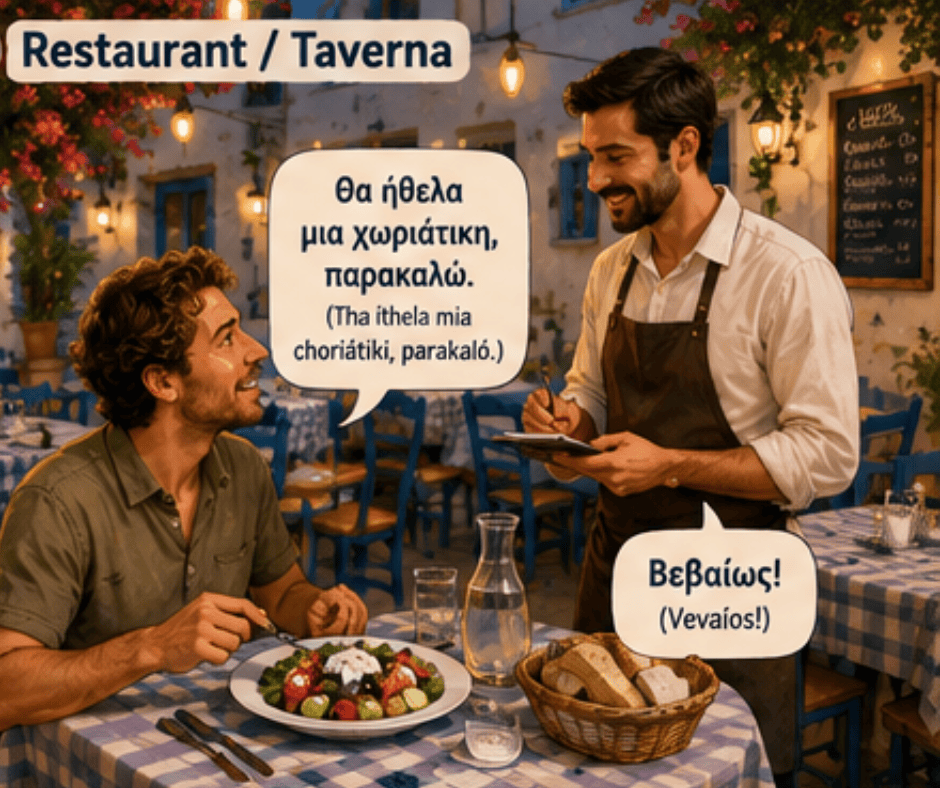
Θα ήθελα μια χωριάτικη, παρακαλώ.
Tha íthela mia choriátiki, parakaló.
I would like a Greek salad, please.
If you don’t know what something on the menu is:
Τι είναι αυτό;
Ti íne aftó?
What is this?
And when you’re finished:
Τον λογαριασμό, παρακαλώ.
Practice the Whole Restaurant Sequence
Don’t just repeat individual phrases. Imagine the whole interaction:
Γεια σας.
Hello.
Θα ήθελα μια χωριάτικη και ένα νερό, παρακαλώ.
I would like a Greek salad and a water, please.
Ευχαριστώ.
Thank you.
Later:
Τον λογαριασμό, παρακαλώ.
The bill, please.
This kind of practice is much closer to real travel than memorizing vocabulary lists.
Numbers, Prices and Shopping
Numbers become much more useful when you connect them to real situations.
Start with 1–10:
ένα – éna – one
δύο – dío – two
τρία – tría – three
τέσσερα – téssera – four
πέντε – pénte – five
έξι – éxi – six
επτά – eptá – seven
οκτώ – októ – eight
εννέα – enéa – nine
δέκα – déka – ten
You don’t need to memorize every number before your trip. For example, knowing how to recognize prices and basic numbers is much more useful than memorizing a long list.
You can learn larger numbers if your trip requires them, but don’t let numbers become another huge study project.
Shopping in Greece
Shopping gives you another easy opportunity to use Greek.
Πόσο κάνει;
Póso káni?
How much is it?
You can use this in shops, markets, cafés, bakeries, and many other situations.
You may also hear:
Πόσο έχει;
Póso échi?
How much is it?
If you don’t understand the answer, ask:
Μπορείτε να το γράψετε;
Boríte na to grápsete?
Can you write it down?
In a shop, you can also ask:
Έχετε…;
Échete…?
Do you have…?
For example:
Έχετε αυτό σε άλλο χρώμα;
Échete aftó se állo chróma?
Do you have this in another color?
And if you don’t want something:
Όχι, ευχαριστώ.
Óchi, efcharistó.
No, thank you.
Greek for Travelers: Asking for Directions
Two expressions can get you surprisingly far.
Πού είναι…;
Pou íne…?
Where is…?
For example:
Πού είναι η τουαλέτα;
Pou íne i tualéta?
Where is the bathroom?
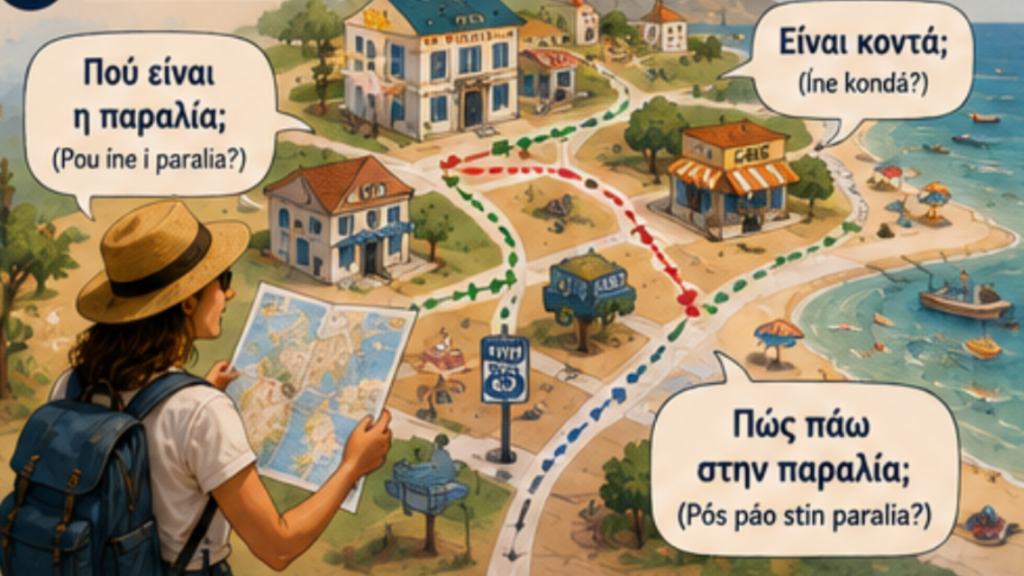
Πού είναι η παραλία;
Pou íne i paralía?
Where is the beach?
Πού είναι το ξενοδοχείο;
Pou íne to xenodochío?
Where is the hotel?
Another useful expression is:
Πώς πάω…;
Pos páo…?
How do I get to…?
For example:
Πώς πάω στην Ακρόπολη;
Pos páo stin Akrópoli?
How do I get to the Acropolis?
You can also ask:
Είναι κοντά;
Íne kondá?
Is it near?
Είναι μακριά;
Íne makriá?
Is it far?
A Few Direction Words
αριστερά – aristerá – left
δεξιά – dexiá – right
ευθεία – efthía – straight ahead
κοντά – kondá – near
μακριά – makriá – far
If someone gives you a complicated answer, you can ask:
Αριστερά ή δεξιά;
Aristerá i dexiá?
Left or right?
Πόσα λεπτά;
Pósa leptá?
How many minutes?
Essential Transportation Greek
If you’re using buses, trains, taxis, or ferries, these words are useful to recognize:
το λεωφορείο – to leoforío – bus
το μετρό – to metró – metro
ο σταθμός – o stathmós – station
το τρένο – to tréno – train
το ταξί – to taxí – taxi
το πλοίο – to ploío – ship
το λιμάνι – to limáni – port
το αεροδρόμιο – to aerodrómio – airport
η στάση – i stási – stop
If you’re taking a ferry, practice the name of your actual destination.
For example:
Ένα εισιτήριο για Νάξο, παρακαλώ.
Éna isitírio gia Náxo, parakaló.
One ticket to Naxos, please.
Replace Νάξο with your destination.
And if you’re looking for the port:
Πού είναι το λιμάνι;
Pou íne to limáni?
Where is the port?
Useful Greek at Your Hotel
You probably won’t need much Greek at your hotel, especially if you’re staying somewhere accustomed to international visitors.
Still, a few phrases are useful:
Έχω κράτηση.
Écho krátisi.
I have a reservation.
Πού είναι το δωμάτιό μου;
Pou íne to domátió mou?
Where is my room?
Πού είναι το ασανσέρ;
Pou íne to asansér?
Where is the elevator?
Πού είναι το πρωινό;
Pou íne to proinó?
Where is breakfast?
If something isn’t working:
Δεν λειτουργεί.
Den leitourgí.
It doesn’t work.
For example:
Το κλιματιστικό δεν λειτουργεί.
To klimatistikó den leitourgí.
The air conditioning doesn’t work.
A Few Greek Words You’ll See on Signs
You don’t need to learn the Greek alphabet before your trip.
If you have time and want to learn it, great. Being able to read Greek is useful, especially for place names and signs.
But if your holiday is coming up soon, don’t feel that you need to master 24 letters before you can start learning travel Greek.
Instead, you can simply learn to recognize a few common words.
Είσοδος
Ísodos
Entrance
Έξοδος
Éxodos
Exit
Αφίξεις
Afíxis
Arrivals
Αναχωρήσεις
Anachorísis
Departures
Τουαλέτα
Tualéta
Toilet
Ανοιχτά
Anichtá
Open
Κλειστά
Kleistá
Closed
Κέντρο
Kéntro
Center
Παραλία
Paralía
Beach
Στάση
Stási
Stop
You may notice that some Greek place names also look completely different from their English versions.
For example:
Αθήνα – Athína – Athens
Πειραιάς – Pireás – Piraeus
Ελλάδα – Elláda – Greece
Seeing the Greek spelling can help you connect what you see on a sign with the place you’re looking for.
But again, don’t feel that you need to master Greek reading before your holiday.
What to Say When You Don’t Understand
This may be the most important part of your Greek for Travelers vocabulary.
At some point, someone will probably speak Greek to you and you’ll have absolutely no idea what they just said.
Don’t panic.
That’s normal.
Learn:
Δεν καταλαβαίνω.
Den katalavéno.
I don’t understand.
Μιλάτε αγγλικά;
Miláte angliká?
Do you speak English?
Μπορείτε να μιλήσετε πιο αργά;
Boríte na milísete pio argá?
Can you speak more slowly?
You can also ask:
Μπορείτε να το γράψετε;
Boríte na to grápsete?
Can you write it down?
These phrases give you a way out when a conversation becomes too difficult.
And remember: you don’t have to force the entire conversation to stay in Greek.
Using one or two Greek phrases and then switching to English is perfectly fine.
A Few Greek Words You’ll Hear Often
Some words are useful simply because you’ll hear them frequently.
Βεβαίως
Vevéos
Of course / Certainly
Εντάξει
Endáxi
Okay / All right
Ωραία
Oréa
Great / Nice
Μάλιστα
Málista
Yes / Certainly / Indeed
Τώρα
Tóra
Now
Σήμερα
Símera
Today
Αύριο
Ávrio
Tomorrow
You don’t need to actively use all of these immediately. Being able to recognize them when you hear them is already helpful.
Emergency Greek for Travelers
Hopefully you won’t need these, but they’re worth knowing.
Βοήθεια!
Voítheia!
Help!
Χρειάζομαι γιατρό.
Chriázomai giatró.
I need a doctor.
Καλέστε την αστυνομία.
Kaléste tin astynomía.
Call the police.
Πού είναι το νοσοκομείο;
Pou íne to nosokomío?
Where is the hospital?
For emergencies, don’t hesitate to use English or contact the appropriate emergency service. These phrases are simply useful additions to your travel vocabulary.
For important medical or allergy information, don’t rely on an unverified phrase from the internet. Keep important information written clearly in both English and Greek, and make sure safety-critical translations have been checked by a reliable Greek speaker or professional.
Don’t Try to Learn Greek Grammar Before Your Holiday
If you’re leaving soon, this probably isn’t the time to memorize every Greek verb conjugation.
Greek grammar is fascinating, but you don’t need to understand all of it to communicate.
Learn useful phrases first.
You don’t need to stop and analyze every word.
Later, when you decide to continue learning Greek, you can learn why έναν is used here and how the sentence works grammatically.
For travel, useful communication comes first.
How to Practice Greek Before Your Trip
There’s one mistake many travelers make:
They read Greek but never say it.
Don’t do that.
Choose perhaps 10–15 phrases that you’re most likely to use and say them aloud whenever you have a few spare minutes.
Practice while imagining the situation.
If you’re learning:
Ευχαριστώ
say it aloud.
If you’re learning:
Πού είναι η παραλία;
say it aloud.
If you’re learning:
Θα ήθελα έναν καφέ, παρακαλώ.
say it aloud several times.
You don’t need to sound perfect. You’re training your mouth and brain to work together.
You don’t need a complicated study schedule. You don’t even need to spend hours every day.
A few minutes of speaking practice can make the difference between recognizing a phrase and actually being able to say it.
Keep your most useful phrases in your phone so you can glance at them while waiting for a flight, sitting on the ferry, or having a coffee.
And don’t worry about sounding perfect.
The point is to feel comfortable enough to give the language a try.
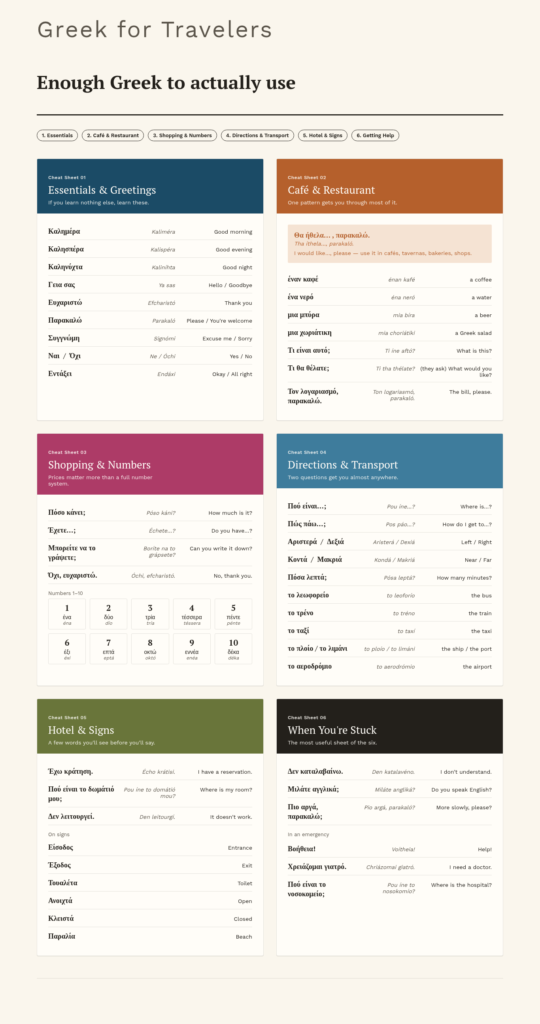
Your Final Greek for Travelers Checklist
Before you leave for Greece, make sure you’re comfortable with these essential phrases.
I’ve put them all together in the six tables below, so you can save them, practice them, or come back to them before your trip.
Tip: The tables are best viewed full-size. Right-click the image and select Open image in new tab to make it bigger.
Also:
– Save your hotel name and address in Greek and English.
– Screenshot your flight, ferry, train, or bus information.
– Learn the Greek spelling of the places you’re visiting.
– Save your most important Greek phrases somewhere easy to access.
– Learn the Greek words for the places you’ll need most: hotel, beach, port, station, airport, bathroom.
– Keep important information available even if your phone battery dies.
Frequently Asked Questions About Greek for Travelers
What is the fastest way to learn Greek for a trip?
Focus on complete phrases for situations you’re actually going to encounter. Start with greetings, ordering food and drinks, prices, directions, transportation, and phrases for dealing with communication problems. Practice them aloud rather than only reading them.
How much Greek can I learn before a trip?
Even a short amount of preparation can give you a useful travel vocabulary. Don’t measure your progress by how much grammar you’ve learned. Measure it by what you can actually say and recognize.
Do I need to learn Greek grammar before visiting Greece?
No. If your trip is soon, prioritize practical phrases. Learn grammar gradually as it becomes useful. Understanding the grammar behind Θα ήθελα έναν καφέ can come later; being able to order the coffee now is more important.
Should I learn the Greek alphabet?
You don’t have to. Knowing some of the alphabet can certainly help you recognize signs, place names, and other information, but it isn’t essential for enjoying a trip to Greece.
If you have time and want to learn it, great. If your holiday is next week and you haven’t learned it yet, don’t panic. Focus on useful phrases instead.
Is Greek difficult for English speakers?
Some parts of Greek will probably feel unfamiliar, especially the alphabet, pronunciation, grammatical gender, and noun endings. But learning useful travel phrases doesn’t require mastering all of those things first.
Will Greeks understand me if my pronunciation isn’t perfect?
Usually, if you’re making a reasonable attempt and the context is clear. Don’t let the fear of making mistakes stop you from speaking. If you’re not understood, try again more slowly, point to what you mean, or switch to English.
Is it okay to speak English in Greece?
Absolutely. You can use Greek for greetings and simple interactions and switch to English whenever you need to. Learning Greek is an opportunity to connect with people, not a test you have to pass.
The Fastest Way to Learn Enough Greek Before Your Trip
You don’t need to learn all of Greek before visiting Greece. Greek for Travelers is about focusing on what you’ll actually use: greetings, ordering food and drinks, numbers and prices, asking for directions, and understanding a few useful signs.
Practice saying these things aloud and use them when you arrive. You might come home knowing a little Greek and wanting to learn a whole lot more.
Want to Learn More Greek for Travelers?
If you want to go beyond the essentials, here are a few beginner-friendly Greek lessons to continue with:
– The Greek Alphabet
– Numbers in Greek
– Days of the Week in Greek


That was very informative
I’m glad you found it helpful 🙂
This document would make a great pdf for new learners. You should add it to the ones you sell.
Thank you for the suggestion! 😊 I’ve actually been thinking about turning this particular article into a PDF, so your comment is great timing!