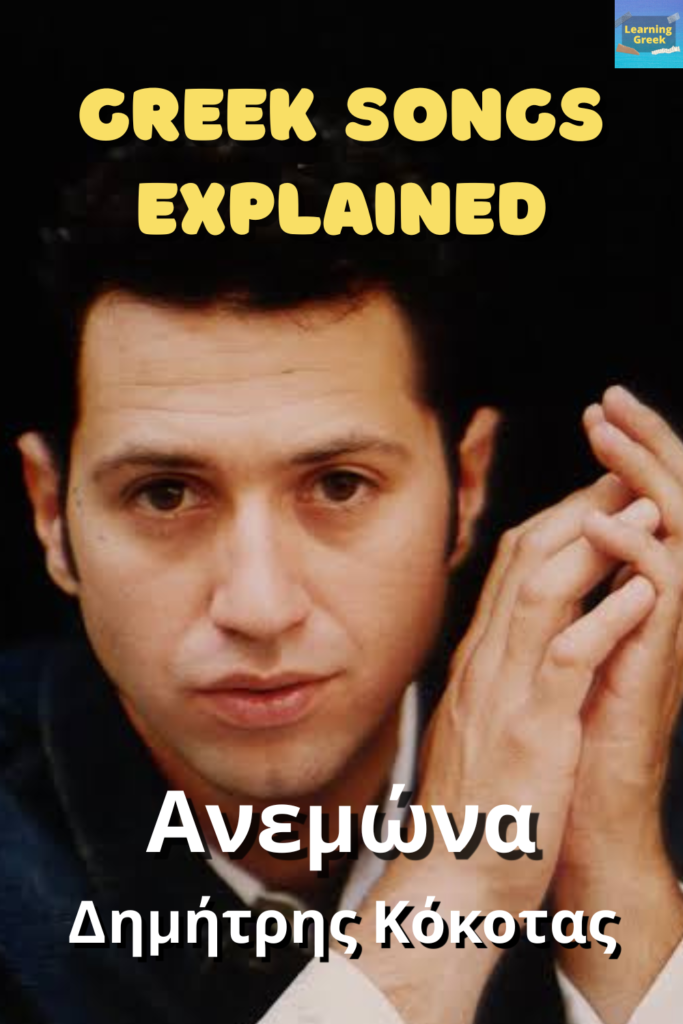

Hello, my Greek music enthusiasts! Following the sad news of Dimitris Kokotas’ passing yesterday, I felt that the least I could do was remember one of his most loved songs and introduce it to those who may not know it yet: Anemona.
When Anemona was released on his album Συνείδηση (synídisi) – consciousness, it quickly became a huge success in Greece and helped establish Dimitris Kokotas as one of the country’s most beloved pop-laïko singers. The magic touch of Foivos, who wrote both the music and lyrics for all the songs on the album, was undoubtedly an important part of its success.
Dimitris was not only a talented singer but also a very well-liked person. He was also the son of the great Greek singer Stamatis Kokotas, so music was very much part of his family.
I didn’t choose Anemona by chance. It’s my favorite song by Dimitris Kokotas. It reminds me of my youth, but it’s also a great song for you to learn Greek with. The lyrics are simple, and many of the phrases in the song are useful expressions that you can actually use in everyday Greek.
But before we start breaking down the lyrics, let’s listen to the song first and get a feel for it.
Did you like it?
Now let’s take a closer look at the lyrics and see what each line means in English. One of the things I love about this song is how it expresses such strong emotions using relatively simple Greek. You’ll find phrases and structures that are not only beautiful in the context of the song, but also useful for learning Greek.
Anemona Lyrics: Greek and English
| Greek | English |
|---|---|
| Κάποιοι με είπανε ακόμα αθώο | Some called me still innocent |
| πως έχω στην καρδιά λευκό μητρώο | saying that I have a clean record in my heart |
| κάποιοι με είπανε ονειροπόλο | Some called me a dreamer |
| που θέλω ν’ αγαπώ εσένα μόνο | because I want to love only you |
| Τα όνειρά μου σαν τα πέταλα μιας ανεμώνας | My dreams are like the petals of an anemone |
| που τη σκόρπισες φυσώντας σαν να ‘σουν χειμώνας | which you scattered by blowing on it as if you were winter |
| πες μου τη ζωή μου πώς να συνεχίσω | Tell me how I can go on with my life |
| που δεν έχω πια τα δυο σου χείλη να φιλήσω | when I no longer have your two lips to kiss |
| που δεν έχω πια τα δυο σου χέρια να κρατήσω | when I no longer have your two hands to hold |
| Κάποιοι με είπανε παιδί ακόμα | Some called me still a child |
| και η ζωή μου πως θ’ αλλάζει χρώμα | and said that my life would change color |
| πως αρκετές φορές θα γίνει γκρίζα | that many times it would turn gray |
| σαν ορφανή από ζωγραφιά κορνίζα | like an empty frame without a painting |
| Τα όνειρά μου σαν τα πέταλα μιας ανεμώνας | My dreams are like the petals of an anemone |
| που τη σκόρπισες φυσώντας σαν να ‘σουν χειμώνας | which you scattered by blowing on it as if you were winter |
| πες μου τη ζωή μου πώς να συνεχίσω | Tell me how I can go on with my life |
| που δεν έχω πια τα δυο σου χείλη να φιλήσω | when I no longer have your two lips to kiss |
| που δεν έχω πια τα δυο σου χέρια να κρατήσω | when I no longer have your two hands to hold |
Why Is the Song Called Anemona?
So, why is the song called Anemona?
η ανεμώνα (i anemóna) – anemone
The title refers to the anemone flower mentioned in the lyrics. The singer compares his dreams to the delicate petals of an anemone:
Τα όνειρά μου σαν τα πέταλα μιας ανεμώνας
(Ta ónirá mou san ta pétala mias anemónas)
My dreams are like the petals of an anemone.
He then says that the person he loved scattered those petals by blowing on them as if she were winter. The flower becomes a metaphor for his dreams and hopes, which were fragile and which the end of the relationship destroyed.
That’s what makes the title more meaningful than it might seem at first. Anemona isn’t simply the name of a flower mentioned in the song. It represents the dreams that were once there but have now been scattered.
The Meaning Behind Anemona
At first, Anemona sounds like a simple song about heartbreak, but there is a beautiful image at the center of it.
The singer describes himself as someone who is still innocent and idealistic, someone who people have called a dreamer because he wants to love only one person. Then comes the image of the anemone flower.
He compares his dreams to the delicate petals of an anemone, scattered by the person he loved, as if she were the winter wind. It is a poetic way of saying that the relationship has destroyed the dreams and hopes he had built around it.
And then comes the question that really captures the sadness of the song: how is he supposed to continue with his life when he no longer has the person he loved beside him?
The second verse takes the idea a little further. People have called him a child and told him that life will eventually change. Some of those changes will make his life grey, like a picture frame left without a painting.
It’s a very simple image, but a powerful one. A frame is supposed to hold a picture, just as his life was supposed to hold the love and dreams he had imagined for himself. Without them, there is simply an empty space.
Useful Greek from Anemona
One of the reasons I chose this song for this series is that the lyrics contain several expressions that are useful beyond the song itself. Let’s see some of them.
αθώος (athóos) – innocent
Αθώος is an adjective meaning innocent. Like other Greek adjectives, it changes depending on gender and number:
αθώος (athóos) – masculine
αθώα (athóa) – feminine
αθώο (athóo) – neuter
αθώοι (athói) – masculine plural
αθώες (athóes) – feminine plural
αθώα (athóa) – neuter plural
In the song, αθώο is used because it describes a masculine person in the accusative case: με είπανε αθώο (me ípane athóo) – they called me innocent.
ονειροπόλος (oniropólos) – dreamer
Ονειροπόλος means dreamer. It is used for someone who tends to dream or imagine rather than focus only on reality.
It can be positive, negative, or somewhere in between depending on the context.
The forms are:
ονειροπόλος (oniropólos) – masculine
ονειροπόλα (oniropóla) – feminine
ονειροπόλο (oniropólo) – neuter singular
ονειροπόλοι (oniropóli) – masculine plural
ονειροπόλες (oniropóles) – feminine plural
ονειροπόλα (oniropóla) – neuter plural
In the song, ονειροπόλο is the accusative masculine form after με είπανε: με είπανε ονειροπόλο (me ípane oniropólo) – they called me a dreamer.
το όνειρο (to óniro) – dream
You’ll hear όνειρο used all the time in Greek. It can mean a dream you have while sleeping, but it can also mean a dream, ambition, or something you hope to achieve.
For example:
Το όνειρό μου είναι να ταξιδέψω σε όλο τον κόσμο.
(To óniró mou íne na taxidépso se ólo ton kósmo.)
My dream is to travel around the world.
In the song, τα όνειρά μου means my dreams.
η καρδιά (i kardiá) – heart
Of course, καρδιά means heart, but just like in English, Greeks use it constantly when talking about feelings and emotions.
Expressions with καρδιά are everywhere in Greek songs, so learning this word will take you a long way when you start understanding Greek music.
να συνεχίσω (na synechíso) – to continue / to carry on
Συνεχίζω means to continue. In the song, we hear πώς να συνεχίσω (pós na sinechíso) – how to continue / how to carry on.
The structure να + verb is extremely common in Greek, so this is a useful one to notice.
For example:
Θέλω να συνεχίσω.
(Thélo na sinechíso.)
I want to continue.
Πρέπει να συνεχίσω.
(Prépi na synechíso.)
I have to continue.
φιλάω / φιλώ (filáo / filó) – to kiss
The verb φιλάω (filáo) means to kiss. You will also see the form φιλώ (filó), which is another form of the same verb.
You may already know the noun:
το φιλί (to filí) – kiss
κρατάω (kratáo) – to hold / to keep
Κρατάω has several meanings depending on the context. It can mean to hold something, keep something, or even last or continue in some expressions.
In the song, it has the very literal sense of holding someone’s hands.
It is a useful verb to learn because you will encounter it constantly in everyday Greek.
το χέρι (to chéri) – hand
The plural is:
τα χέρια (ta chéria) – hands
This is a good example of a Greek word whose plural form changes quite a bit from the singular, so it is worth learning both forms together.
In the song:
τα δυο σου χέρια (ta dío sou chéria) – your two hands.
γκρίζος (grízos) – grey
Γκρίζος means grey or gray. It is an adjective, so its form changes according to gender and number:
γκρίζος (grízos) – masculine singular
γκρίζα (gríza) – feminine singular
γκρίζο (grízo) – neuter singular
γκρίζοι (grízi) – masculine plural
γκρίζες (grízes) – feminine plural
γκρίζα (gríza) – neuter plural
In the song, γκρίζα describes η ζωή (i zoí) – life, which is feminine: η ζωή μου θα γίνει γκρίζα (i zoí mou tha yíni gríza) – my life will become grey. The word is used metaphorically to describe a life that has lost its color and happiness.
Why Anemona Is Great for Learning Greek
You don’t need to understand every word in a Greek song to learn from it. In fact, songs can be particularly useful because they give you the same words and structures again and again, but in a memorable context.
Anemona is especially useful for learners because the lyrics are relatively simple and the emotional meaning is easy to follow.
You can practice:
Vocabulary about emotions and relationships, including words such as καρδιά (kardiá) – heart and όνειρο (óniro) – dream.
Useful verbs, such as συνεχίζω (synechízo) – to continue, φιλάω (filáo) – to kiss, and κρατάω (kratáo) – to hold.
The να + verb structure, which is one of the most important structures in Greek.
Adjectives and agreement, such as γκρίζος (grízos) – grey and its different forms.
Greek pronunciation, because listening to the same phrases repeatedly helps you become more familiar with the rhythm and sounds of the language.
And there is another advantage: when you learn a word through a song you actually enjoy, you’re much more likely to remember it.
Listen to Anemona Again
Now that you know what the lyrics mean, listen to the song one more time.
This time, don’t worry about understanding every single word. Try to recognize the words and phrases you’ve just learned. Notice how αθώος, ονειροπόλος, όνειρα, καρδιά, συνεχίσω, χείλη, χέρια, and γκρίζα sound when they are part of the song.
That’s one of my favorite things about learning Greek through music: the second or third time you hear a song, you suddenly start catching words that you completely missed before.
The Last Note
For me, Anemona will always be connected with a particular time in my life. That’s one of the reasons I wanted to include it in this series, especially now.
But even if you are hearing Dimitris Kokotas for the first time, I think this song is worth discovering. It gives you a glimpse into the Greek pop-laïko sound of the 1990s while also giving you plenty of simple, useful Greek to learn.
The album Συνείδηση was released in 1995, with Anemona as one of its tracks, and both the music and lyrics were written by Foivos.
Dimitris Kokotas passed away on August 25, 2026, at the age of 57, after a long hospitalization. He leaves behind many songs that are still remembered by Greek audiences, and Anemona is certainly one of them.
So if you are learning Greek, don’t just listen to Greek songs in the background. Pick one you love, look at the lyrics, learn a few phrases, and then listen again.
You might be surprised by how much Greek you can pick up from a song. And if you want to keep learning through music, you can explore more songs in my Learn Greek Through Music series.
What Greek song should we explore next? Let me know in the comments!