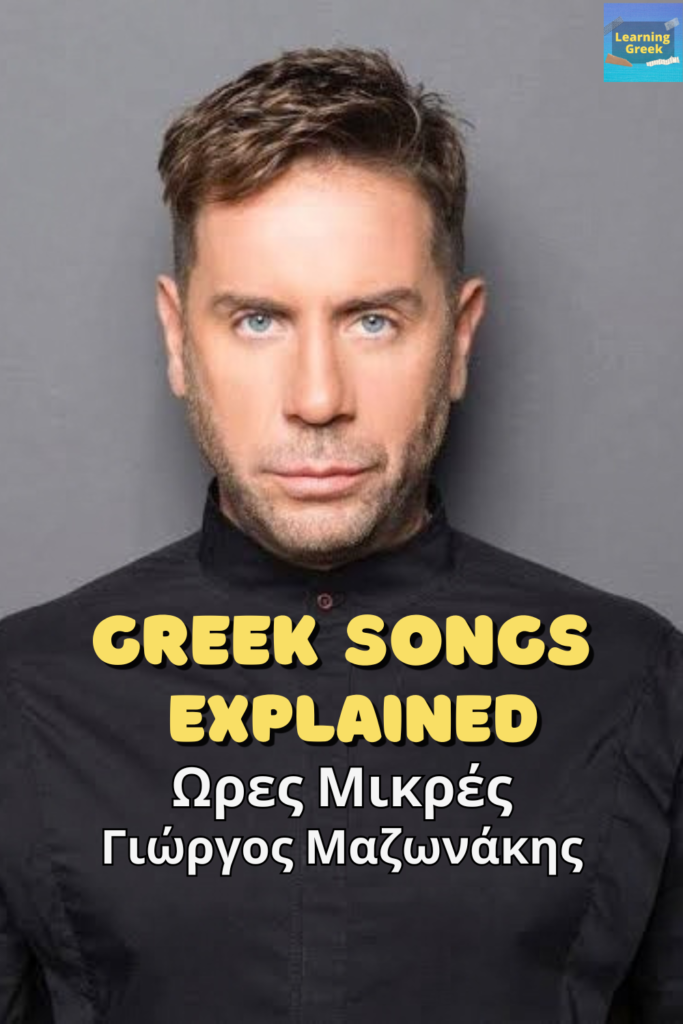

Hello, my lovely Greek learners! It’s been a little over a month since we lost Γιώργος Μαζωνάκης (Giórgos Mazonákis), but Greece is still mourning. Today, we are going to learn Greek with the great song Ores Mikres as a tribute to his legacy. His voice and style were so unique that you’d recognize him anywhere.
Ώρες Μικρές (Ores Mikres) felt like the most fitting choice for this lesson. You’ll find so much real emotion and beautiful imagery in this track, making it a super fun way to build your Greek vocabulary..
But, let’s listen to the song first!
Listen to Ores Mikres
Before we jump into the grammar, take a moment to listen to the song and get a feel for its rhythm!
The song is a zeibekiko, with the bouzouki playing an important role in its sound. The music was composed by Γιώργος Σαμπάνης, and the lyrics were written by Ελένη Γιαννατσούλια. It was released in 2020 as part of the album Αγαπώ Σημαίνει.
Listen once just to enjoy the song, and then listen again while following the lyrics. You might recognize more Greek than you expect!
Lyrics Breakdown of Ores Mikres
Here are the lyrics with their English translations. Since some of these phrases are quite poetic, I translated them to capture their real meaning rather than just word-for-word.
| Greek | English |
|---|---|
| Από παιδί | Since I was a child |
| Είμαι ένα σώμα που ‘χει ρίζα στον αέρα | I am a body with roots in the air |
| Σώμα φυγής | A body made for escape |
| Μα εγώ παρέμεινα κι εσύ πήγες πιο πέρα | But I stayed while you went further away |
| Μάταια σ’ αναζητώ | I search for you in vain |
| Ό, τι και να θέλησα, άγρια μέλισσα | Whatever I wanted, a wild bee |
| Και μου ‘χει μείνει το κεντρί, στο χέρι βέρα | And all that remains is the sting, a wedding ring on my hand |
| Ώρες μικρές στα σκοτεινά | In the small hours of the night, in the darkness |
| Του πόνου πιάνω τη συχνότητα σε θέλω τραγικά | I tune in to the frequency of pain; I want you desperately |
| Στη ταραγμένη μου ψυχή | In my troubled soul |
| Θα είσαι πάντα εκκρεμότητα σαν πόρτα ανοιχτή | You will always be unfinished business, like an open door |
| Που λείπεις, μου ‘πεσε βαρύ | Your absence has weighed heavily on me |
| Με αναμνήσεις σιγοκαίγομαι και λιώνω σαν κερί | I slowly burn with memories and melt like a candle |
| Κι αφού Θεός που συγχωρεί εγώ δε λέγομαι | And since I am no forgiving God |
| Να καίγεσαι, όπως καίγομαι | May you burn as I burn |
| Το ξέρω πως | I know that |
| Το μπλε στα μάτια μου δεν είναι ακρογιάλι | The blue in my eyes is not a seashore |
| Λάμπω σαν φως | I shine like a light |
| Μα το σκοτάδι στο σημάδι έχω βάλει | But I have set my sights on darkness |
| Αν με δεις, να θυμηθείς | If you see me, remember |
| Ότι με κατοίκησες κι ότι με νίκησες | That you inhabited me and that you defeated me |
| Δίχτυ πως μ’ έπιασε ο καημός απόψε πάλι | As if sorrow had caught me in its net again tonight |
The Story and Meaning Behind Ores Mikres
To really get the most out of learning Greek with this song, it helps to understand what it’s all about. At its heart, it’s a story about heartbreak, pride, and feelings that just won’t fade.
For example, he talks about feeling stuck in thin air, ready to run away, but somehow frozen while the other person just walks off. Plus, he compares love to a wild bee (άγρια μέλισσα): even when the sweetness is gone, you’re still left with the sting (κεντρί).
And instead of just letting it go, he admits how much it hurts. He’s angry and wants the other person to feel that exact same sting.
Κι αφού Θεός που συγχωρεί εγώ δε λέγομαι / Να καίγεσαι, όπως καίγομαι
And since I am no forgiving God, may you burn just as I burn.
What Does “Ώρες Μικρές” Mean?
In Greek, ώρες μικρές (literally small hours) refers to the late-night hours right after midnight, usually between 1:00 AM and 4:00 AM.
These are the quiet hours when everyone else is asleep, but if you’re dealing with a broken heart or missing someone, they’re actually the loudest hours of the day.
Learning Greek through Ores Mikres
Studying Greek through lyrics is amazing because you get to see how words are actually used in real life. For example, you get to see everyday conversational words blended with poetic expressions.
Let’s look at some groups of lyrics and explore the words and grammar behind them.
A body with roots in the air
Από παιδί
Είμαι ένα σώμα που ‘χει ρίζα στον αέρα
Σώμα φυγής
Μα εγώ παρέμεινα κι εσύ πήγες πιο πέρα
Apo pedí / Íme éna sóma pou ‘hi ríza ston aéra / Sóma fiyís / Ma egó parémina ki esí píyes pio péra
The song begins with the image of someone who seems unable to put down roots, yet stays while the other person moves further away. The contrast between staying and leaving sets the tone for the rest of the song.
The expression από παιδί (apo pedí) means since childhood or since I was a child.
Notice παρέμεινα (parémina) – I remained and πήγες (píyes) – you went. Both verbs are in the past tense, but they describe two different choices.
Παραμένω (paraméno) means to remain or to stay. In everyday Greek, you will also hear μένω (méno), which can mean either to stay or to live somewhere.
A wild bee and a wedding ring
Μάταια σ’ αναζητώ
Ό, τι και να θέλησα, άγρια μέλισσα
Και μου ‘χει μείνει το κεντρί, στο χέρι βέρα
Mátea s’ anazitó / Ó,ti ke na thélisa, ágria mélissa / Kai mou ‘hi míni to kentrí, sto chéri vera
The lyrics bring together a wild bee, its sting, and a wedding ring. It’s an unusual, poetic image that suggests pain and something left behind, although the precise meaning is open to interpretation.
The verb αναζητώ (anazitó) has a slightly more literary feel than ψάχνω (psáhno), which is very common in everyday Greek and also means to look for.
You will also notice σ’ αναζητώ (s’ anazitó), where σ’ is a shortened form of σε (se) – you, as the object of the verb.
Similarly, μου ‘χει μείνει (mou ‘chi míni) is a shortened form of μου έχει μείνει (mou échi míni), meaning it has remained with me or I have been left with.
The small hours and an open door
Ώρες μικρές στα σκοτεινά
Του πόνου πιάνω τη συχνότητα σε θέλω τραγικά
Στην ταραγμένη μου ψυχή
Θα είσαι πάντα εκκρεμότητα σαν πόρτα ανοιχτή
Óres mikrés sta skotiná / Tou pónou piáno ti sychnótita, se thélo trayiká / Stin taragméni mou psichí / Tha íse pánta ekkremótita san pórta anichtí
This passage describes someone alone in the darkness, overwhelmed by pain and unable to close the door on a relationship. The other person remains an unresolved part of their life.
The phrase πιάνω τη συχνότητα (piáno ti sychnótita) literally means I catch the frequency. Here, the speaker seems to tune in to pain as if it were a radio frequency.
The word εκκρεμότητα (ekkremótita) is useful outside music, too. It describes something that hasn’t been settled or completed. Comparing someone to μια πόρτα ανοιχτή (mia pórta anichtí) – an open door, suggests that the relationship has never really reached an ending.
Burning memories and a candle
Που λείπεις, μου ‘πεσε βαρύ
Με αναμνήσεις σιγοκαίγομαι και λιώνω σαν κερί
Κι αφού Θεός που συγχωρεί εγώ δε λέγομαι
Να καίγεσαι, όπως καίγομαι
Pou lípis, mou ‘pese varí / Me anamnísis sigokegome kai líono san kerí / Ki afoú Theós pou synchorí egó de légome / Na keyese, ópos kegome
The speaker describes memories that slowly burn him, comparing his suffering to a candle melting. The passage ends with a bitter wish that the other person should experience the same pain.
One expression worth learning as a whole is μου λείπεις (mou lípis) – I miss you. Greek expresses this differently from English: literally, the structure is closer to you are missing to me.
You will also hear μου ‘πεσε βαρύ (mou ‘pese varí). Literally, it means it fell heavily on me, but it is used to describe something emotionally difficult to bear.
The words σιγοκαίγομαι (sigokaígome) and καίγομαι (kaígome) both relate to burning. The first suggests burning slowly or smouldering, which fits the image of memories that continue to cause pain.

Light, darkness, and blue eyes
Το ξέρω πως
Το μπλε στα μάτια μου δεν είναι ακρογιάλι
Λάμπω σαν φως
Μα το σκοτάδι στο σημάδι έχω βάλει
To xéro pos / To ble sta mátia mou den íne akroyáli / Lámpo san fos / Ma to skotádi sto simádi ého váli
The song now contrasts light and darkness. The speaker says he shines like a light, yet darkness is what he has set his sights on. The image of blue eyes that are not a seashore is poetic, so I wouldn’t reduce it to one definitive interpretation.
Notice σαν (san), meaning like or as, in λάμπω σαν φως (lámpo san fos) – I shine like a light. You’ll encounter σαν in many Greek comparisons.
And μα (ma) means but. Another common word with the same meaning is αλλά (allá).
A sorrow that catches you again
Αν με δεις, να θυμηθείς
Ότι με κατοίκησες κι ότι με νίκησες
Δίχτυ πως μ’ έπιασε ο καημός απόψε πάλι
An me dis, na thimithís / Óti me katikises ki óti me níkises / Díhti pos m’ épiase o kaimós apópse páli
In this passage, the speaker asks the other person to remember how deeply they affected him. The image of sorrow catching him in a net suggests that he has become trapped in the same feelings once again.
The verbs κατοίκησες (katoíkises) and νίκησες (níkises) mean you inhabited and you defeated. Using them together gives the relationship a powerful sense of emotional impact.
The word καημός (kaimós) is particularly interesting. It describes a deep emotional ache, longing, or sorrow. There isn’t always a single English word that captures its meaning, making it a useful word to recognize when listening to Greek songs.
And απόψε πάλι (apópse páli) means again tonight. You’ll hear πάλι (páli) – again, all the time in everyday Greek.
Why learn Greek with Ores Mikres?
Songs are a wonderful way to learn vocabulary in context. In Ores Mikres, you encounter familiar verbs, expressions that work differently in English, shortened forms, and more poetic words such as εκκρεμότητα and καημός.
Listening while following the lyrics can also help you recognize how Greek words flow together. Try listening again after reading the explanations and see how many expressions you can now understand without looking at the translation.
And, of course, music gives you another way to connect with Greek culture. Songs can reveal how people express emotions through language in ways that a textbook doesn’t always capture.
Final thoughts
I wanted this article to be both a Greek lesson and a little tribute to Giorgos Mazonakis. His music continues to mean a lot to many people in Greece, and Ores Mikres gives us plenty to explore, from useful expressions to its poetic imagery.
My advice? Listen to the song again, follow the lyrics, and don’t worry about understanding every word straight away. Let the Greek become familiar little by little.
Now tell me: What’s your favorite Giorgos Mazonakis song, or which Greek song would you like me to explain next? I’d love to hear your suggestions!
And if you’d like to discover more Greek songs while learning the language, visit my Greek Music section.