
Hello dearests! In a previous post, we talked about the Greek alphabet and we analyzed each of the twenty-four letters. Building on that, today we will talk about the letter combinations.
Yes, yes, I know what you are thinking.
Twenty-four letters aren’t enough?
I’m afraid for Greeks the answer is no.
But please do not panic and look on the bright side!
Letter combinations are a vital part of the Greek alphabet and they will help you create and understand even more words and phrases.
Let’s get started then, shall we?
A quick note about pronunciation: The English examples below are only approximations to help you get a feel for the Greek sounds. They are not exact English equivalents, and some Greek sounds don’t have a perfect match in English.
Greek Letter Combinations
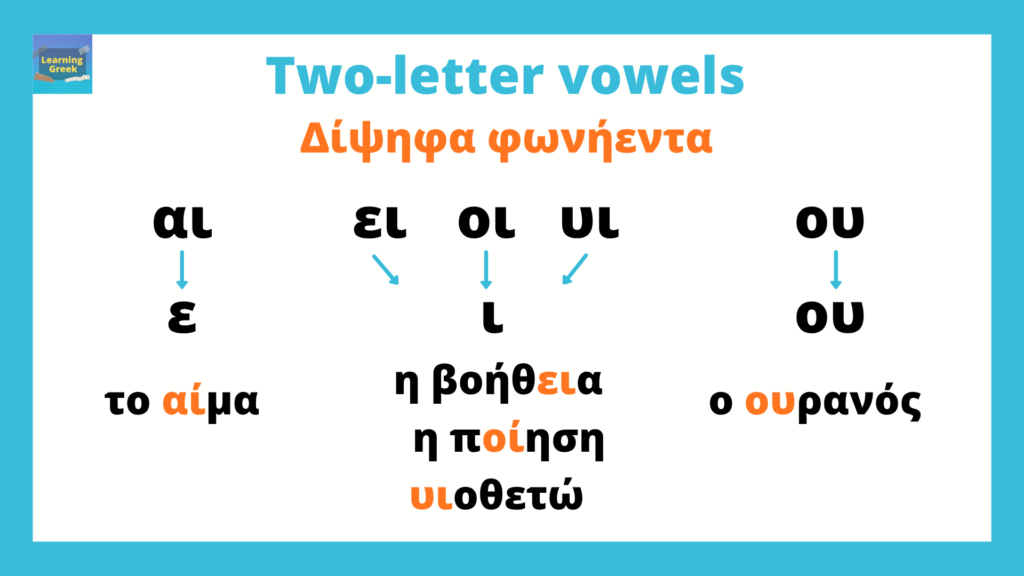
Two-letter vowels – Δίψηφα φωνήεντα
We have already seen that the Greek alphabet consists of 7 vowels:
α, ε, η, ι, ο, υ, ω
Greek also uses combinations of two vowels to represent a single sound. These are called δίψηφα φωνήεντα (dipsifa fonienta) – two-letter vowels.
The main combinations you will come across are:
αι, ει, οι, ου
You may also see υι, but it is very rare in Modern Greek.
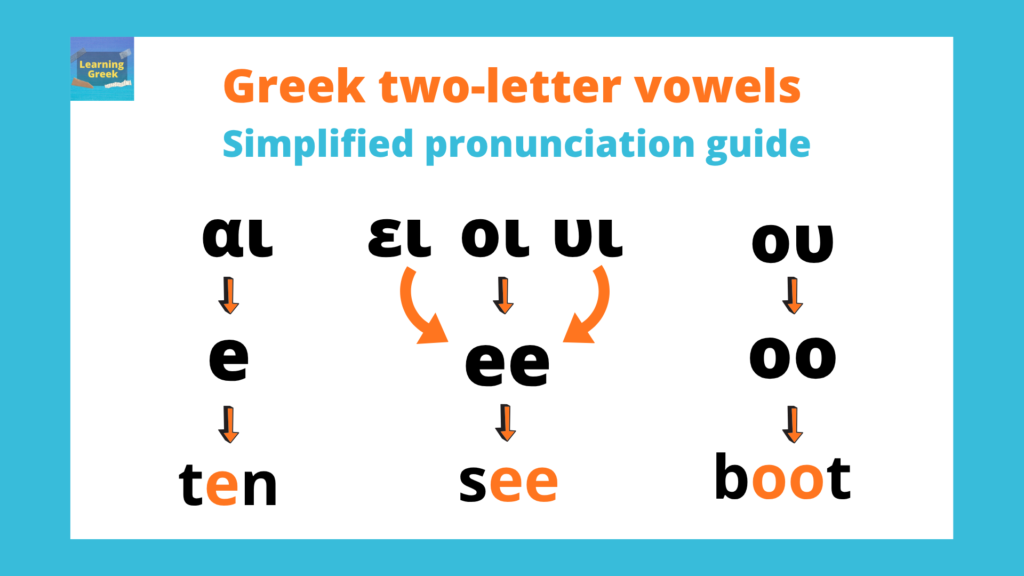
ΑΙ / αι → sounds like the e in bed or ten.
Examples:
το παιδί (pedi) – child
το αίμα (ema) – blood
κλαίω (kleo) – I cry
ΕΙ / ει → sounds like the ee in see.
Examples:
η ειρήνη (irini) – peace
το εισιτήριο (isitirio) – ticket
οι ειδήσεις (idisis) – news
ΟΙ / οι → has the same sound as ει: the ee sound in see.
Examples:
η οικογένεια (ikoyenia) – family
ο οικοδεσπότης (ikodespotis) – host
η οικονομία (ikonomia) – economy
ΥΙ / υι → is also pronounced like ee.
However, you won’t see this combination very often in Modern Greek. It mainly appears in a small number of words.
Examples:
ο υιός (ios) – son
η υιοθεσία (iothesia) – adoption
ΟΥ / ου → sounds like the oo in boot or food.
Examples:
το βουνό (vuno) – mountain
το λουλούδι (luludi) – flower
η τούρτα (turta) – cake
The images below will help you understand two-letter vowels better.
Two-letter consonants – Δίψηφα σύμφωνα
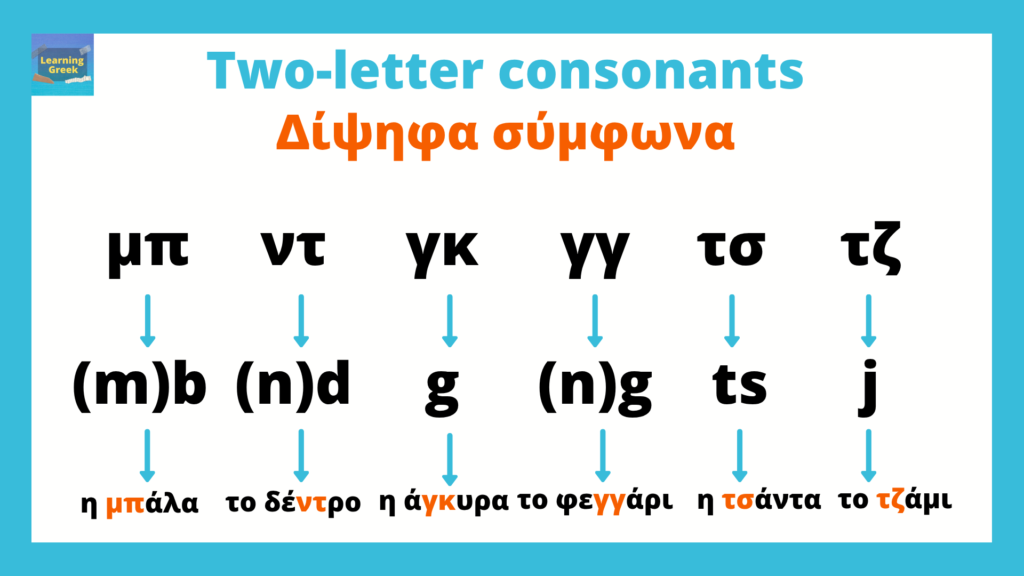
Greek also has combinations of two consonants that work together to produce a particular sound.
The six main two-letter consonant combinations are:
μπ, ντ, γκ, γγ, τσ, τζ.
Let’s look at them one by one.
ΜΠ / μπ
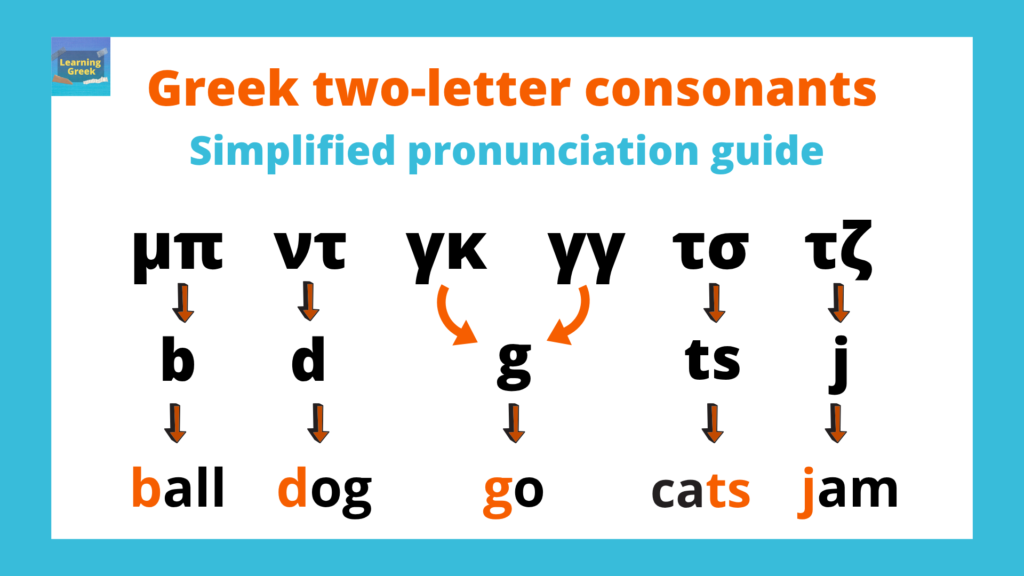
μπ is generally pronounced like the English b sound.
Although the μ is part of the spelling, it is not always heard as a separate m sound. You may hear a slight m sound in some words or from some speakers.
Examples:
ο μπαμπάς (babas) – father
το μπαλόνι (baloni) – baloon
το μπισκότο (biscoto) – biscuit
ΝΤ / ντ
ντ is generally pronounced like the English d sound.
The ν belongs to the written combination, but it is not necessarily pronounced as a separate n sound. Depending on the word and speaker, you may hear it more distinctly.
Examples:
η ντομάτα (domata) – tomato
το δόντι (thodi) – tooth
ο ελέφαντας (elefadas) – elephant
ΓΚ / γκ
γκ usually represents a hard g sound, as in go.
Examples:
η πριγκίπισσα (prigipissa) – princess
η αγκαλιά (agalia) – hug
το σαλιγκάρι (saligari) – snail
ΓΓ / γγ
γγ generally produces an ng sound, similar to the sound in sing.
The n may not always be clearly heard as a separate sound.
Examples:
το αγγούρι (aguri) – cucumber
το φεγγάρι (fegari) – moon
ο άγγελος (agelos) – angel
ΤΣ / τσ
τσ represents a ts sound.
A useful English comparison is the sound at the end of cats.
Examples:
η κάλτσα (kalcha) – sock
η τσάντα (chanda) – bag
το παπούτσι (paputsi) – shoe
So don’t think of τσ as exactly the same as English ch. It is a ts sound.
ΤΖ / τζ
τζ represents a dz sound, similar to the j in juice. For English speakers, the English j sound is a useful approximation.
Examples:
το τζάμι (jami) – glass
ο ταξιτζής (taxijis) – taxi driver
το τζάκι (jaki) – fireplace
Again, the images below will help you understand two-letter consonants better.
Why Are These Letter Combinations Important?
At first, seeing two letters together can make Greek words look more complicated than they really are.
But once you recognize the common combinations, you don’t have to stop and pronounce every individual letter separately.
For example:
μπαμπάς
Instead of trying to pronounce μ + π + α + μ + ά + ς, you can immediately recognize μπ as a single sound:
μπ + α + μπ + ά + ς → μπαμπάς
The same idea applies to combinations such as αι, ει, οι, ου, ντ, γκ, τσ and τζ.
Learning these letter combinations is one of the steps that will help you move from simply knowing the Greek alphabet to actually reading Greek words.
What About ΑΥ and ΕΥ?
There are two more important vowel combinations you will come across:
αυ and ευ
They are a little different because their pronunciation changes depending on the sound that follows them.
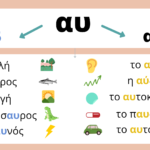
I’ve given them their own lesson, so you can learn exactly when αυ and ευ sound like av/af and ev/ef.
👉 Learn how to pronounce αυ and ευ in Greek here.
A Final Note on Letter Combinations
Greek letters might look tricky at first, but don’t worry!
Once you get used to these combinations, reading Greek will start to feel much more natural. The secret is not to memorize everything at once. Learn a few combinations, practice them in real words, and you’ll gradually start recognizing them without even thinking about it.
Keep practicing, have fun with it, and soon those Greek letters will start dancing off the page all on their own!
If you haven’t already, you can also go back to the Greek alphabet and practice the individual letters before moving on to more Greek reading lessons.
Well, that was it for today. See you at our next lesson! 🙂

Thank you!!! This is very helpful!!!
Hey! I’m glad I could help! 🙂
Thank you very much
Hi there, Grecophile since I was nine years old. Don’t have the money to go to school. Would love to know if there is a community of free learning and interacting in the Greek language. Good job on teaching and thank you
Hello, you can always join our facebook group https://www.facebook.com/groups/681017825336889 I’m researching right now best apps for learning Greek and I’ll make posts about them. Stay tuned!
Pingback: Greek Punctuation Marks and Orthographic Points