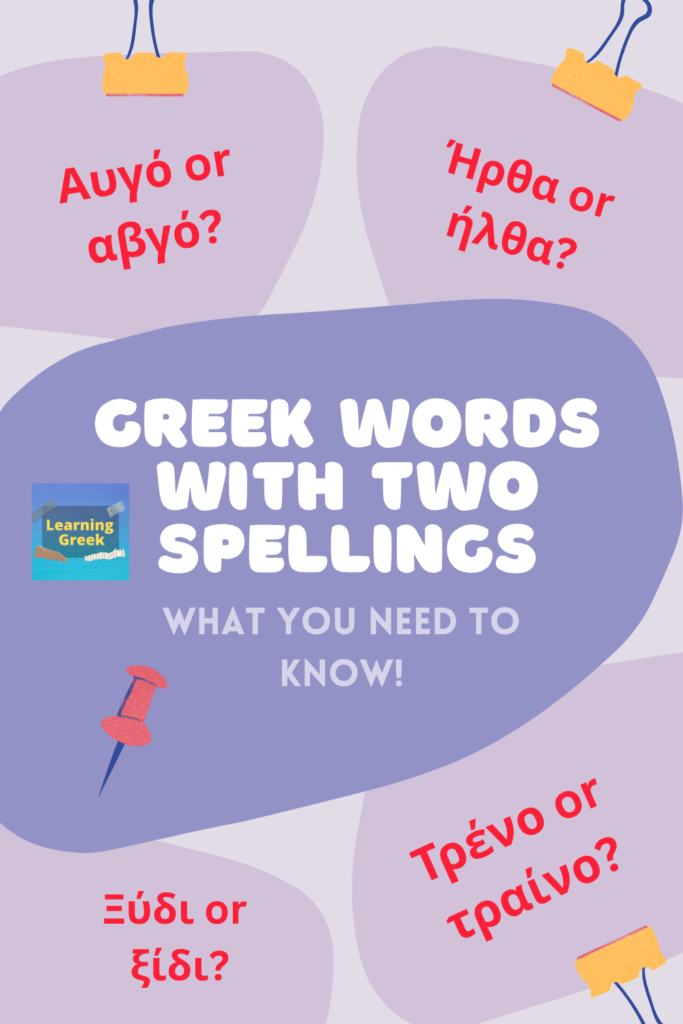

Hello, my fellow Greek learners! Have you ever come across Greek words with two spellings and wondered which one is correct? Or perhaps you’ve been learning Greek for a while and suddenly discovered that a word you thought you knew has another spelling!
For example, should you write αυγό or αβγό? And what about ήρθα or ήλθα? Are both forms correct? And why does Greek sometimes give us two ways to express exactly the same thing?
Don’t worry! Even native Greek speakers have questions about these words.
Let’s look at some examples and discover why these differences exist.
Why Do Greek Words with Two Spellings Exist?
There isn’t just one explanation. Some Greek words have two spellings because of changes in the language over time. Sometimes, the spelling changed but the older version remained in use. In other cases, different spellings developed and both are still used today.
Let’s look at some common Greek words with two spellings and see what makes each pair interesting.
1. Greek Words with Two Spellings: Nouns and Everyday Words
Αυγό or αβγό? (Egg)
Let’s start with a word we use all the time!
You’ve probably seen both αυγό and αβγό. They refer to exactly the same thing, but why are there two spellings?
The word comes from Ancient Greek ᾠόν (ōón), meaning egg. Over the centuries, its pronunciation and spelling developed into the modern form.
The spelling αβγό reflects the word’s pronunciation, while αυγό is the traditional spelling that remains widely used and is also correct today.
For example:
Θέλω ένα αβγό για πρωινό.
(Thélo éna avgó ya proinó.)
I want an egg for breakfast.
Έβρασα δύο αβγά.
(Évrasa dío avgá.)
I boiled two eggs.
Αυτί or αφτί? (Ear)
Here’s another word you may have seen written in two ways!
Both αυτί and αφτί are correct and pronounced exactly the same way. The difference comes from the evolution of the Greek language. The spelling αυτί preserves the traditional spelling, while αφτί reflects the way the word is pronounced in Modern Greek.
Over time, the pronunciation of the combination αυ came to be represented more directly by αφ in some words, but the older spelling remained in use too.
For example:
Δεν άκουσα καλά. Μίλα μου στο αφτί!
(Den ákusa kalá. Míla mu sto aftí!)
I didn’t hear properly. Speak into my ear!ere’s another familiar word with two spellings!
Με πονάει το αφτί μου.
(Me ponái to aftí mu.)
My ear hurts.
Συγγνώμη or συγνώμη? (Sorry / Excuse me)
Have you noticed that some people write συγγνώμη, while others write συγνώμη?
The traditional spelling is συγγνώμη, with two gammas. However, you will often see συγνώμη, with one gamma.
Why?
The word comes from Ancient Greek συγγνώμη, and the spelling with two gammas preserves its historical form. The shorter spelling reflects a simplification in pronunciation.
The Dictionary of Standard Modern Greek records συγγνώμη as the main form and συγνώμη as a pronunciation-based alternative.
So, if you’re writing a formal email or an article, I would recommend sticking with συγγνώμη.
For example:
Συγγνώμη για την καθυστέρηση.
(Syngnómi ya tin kathystérisi.)
Sorry for the delay.
Συγγνώμη, μπορείτε να με βοηθήσετε;
(Syngnómi, boríte na me voithísete?)
Excuse me, can you help me?
Ορθοπεδικός or ορθοπαιδικός? (Orthopedic)
This is a particularly interesting example because both spellings are accepted by the Dictionary of Standard Modern Greek!
You may see ορθοπεδικός and ορθοπαιδικός on medical websites, signs outside doctors’ offices, and hospital documents.
The word refers to a doctor who specialises in orthopaedics. The spelling ορθοπαιδικός is connected to the Greek word παιδί (pedhí – child), because the medical specialty originally focused on correcting bone and posture problems in children..
The spelling ορθοπεδικός, however, developed under the influence of the French spelling orthopédie and is also accepted.
Both forms are correct.
For example:
Πρέπει να κλείσω ραντεβού με τον ορθοπεδικό.
(Prépi na klíso randevú me ton orthopedikó.)
I need to make an appointment with the orthopedic doctor.
Ο ορθοπαιδικός εξέτασε το γόνατό μου.
(O orthopaidikós exétase to gónató mu.)
The orthopaedic doctor examined my knee.
Τρένο or τραίνο? (Train)
You may have come across both τρένο and τραίνο in Greek writing. Both spellings are used, and both are accepted, although τρένο is the more common modern spelling.
The word τρένο came into Greek through Italian treno. The spelling τραίνο may look familiar because it resembles the English word train..
For example:
Το τρένο φεύγει στις έξι.
(To tréno févgi stis éksi.)
The train leaves at six.
Θα πάω στη Θεσσαλονίκη με το τρένο.
(Tha páo sti Thessaloníki me to tréno.)
I’ll go to Thessaloniki by train.
So, if you see τραίνο, it isn’t necessarily a mistake. You can use τρένο in your own writing, as it is the usual modern spelling.erstand why it looks familiar. For your own modern Greek writing, use τρένο.
Ξύδι or ξίδι? (Vinegar)
Have you ever wondered whether to write ξύδι or ξίδι?
The spelling ξίδι is the standard form recommended on etymological grounds. The word comes from the ancient Greek οξίδιον, related to ὄξος, meaning vinegar.
You’ll still see ξύδι in everyday writing, but if you want to follow the standard spelling, choose ξίδι.
For example:
Βάλε λίγο ξίδι στη σαλάτα.
(Vále lígo xídhi sti saláta.)
Add a little vinegar to the salad.
Το ξίδι έχει έντονη μυρωδιά.
(To xídhi éhi éndoni mirodiá.)
Vinegar has a strong smell.
Κτήριο or κτίριο? (Building)
Have you seen both κτήριο and κτίριο? This is one of those Greek spelling questions that can spark quite a debate!
The spelling κτήριο is preferred by the linguist Georgios Babiniotis, who connects the word to the ancient Greek εὐκτήριον, meaning a place of prayer. However, κτίριο is also widely used in modern Greek.
You’ll come across both forms, but it’s useful to know that they are not viewed equally by everyone.
For example:
Το κτήριο είναι πολύ παλιό.
(To ktírio íne polí palió.)
The building is very old.
Χτίζουν ένα καινούριο κτίριο.
(Htízun éna kenúrio ktírio.)
They are building a new building.
Εταιρεία or εταιρία? (Company)
Both εταιρεία and εταιρία are used to mean a company.
The spelling εταιρεία is the more established standard form and is the one I recommend using in your writing. The spelling εταιρία is also common, so you may see it in everyday texts and documents.
For example:
Εργάζεται σε μια μεγάλη εταιρεία.
(Ergázetai se mia megáli etería.)
He/She works for a large company.
Η εταιρεία έχει πολλά γραφεία.
(I etería éhi pollá grafía.)
The company has many offices.
Αντιπροσωπεία or αντιπροσωπία? (Representation or dealership)
You may see both αντιπροσωπεία and αντιπροσωπία in Greek.
The word can refer to representation, a delegation, or a business representing another company, such as a car dealership. Both spellings are recorded, although αντιπροσωπεία is a familiar form in everyday use.
For example:
Πήγα στην αντιπροσωπεία αυτοκινήτων.
(Píga stin antiprosopeía aftokiníton.)
I went to the car dealership.
Η αντιπροσωπεία έφτασε στο ξενοδοχείο.
(I antiprosopeía éftase sto xenodohío.)
The delegation arrived at the hotel.
2. Greek Words with Two Spellings: Verb Forms
Nouns aren’t the only words that can surprise us. Greek verbs can have alternative forms, too!
Sometimes, these forms come from different historical developments. In other cases, Greek allows more than one way to form a particular tense or grammatical construction.
Ήρθα or ήλθα? (I came)
Let’s start with one of the clearest examples.
Both ήρθα and ήλθα are correct past-tense forms of the verb έρχομαι (érhome), meaning to come.
You will hear ήρθα much more often in everyday conversation. Ήλθα is also correct and may sound more formal or literary in certain contexts.
For example:
Χθες ήρθα αργά στο σπίτι.
(Chthes írtha argá sto spíti.)
I came home late yesterday.
Ήλθα για να σας δω.
(Íltha ya na sas do.)
I came to see you.
The meaning is the same. You don’t need to learn two different verbs!
The same thing happens with έρθει and έλθει.
Γλυτώνω or γλιτώνω? (To escape, to avoid)
You’ll find both γλυτώνω and γλιτώνω in Greek writing.
The verb means to escape, to avoid something unpleasant, or to be spared something. For example, you might use it when you avoid a fine or escape an accident.
The spelling γλιτώνω is widely used in modern Greek, while γλυτώνω is also found, particularly in spelling discussions that focus on the word’s historical origin.
For example:
Ευτυχώς, γλίτωσα το πρόστιμο.
(Eftihós, glítosa to próstimo.)
Fortunately, I avoided the fine.
Γλίτωσε από το ατύχημα.
(Glítose apó to atíhima.)
He/She escaped the accident.
Νοιώθω or νιώθω? (To feel)
The usual modern spelling is νιώθω, meaning to feel.
You may also see νοιώθω, but νιώθω is the form to use in standard modern writing. The two spellings sound exactly the same.
For example:
Νιώθω πολύ κουρασμένη.
(Niótho polí kurasméni.)
I feel very tired. (female speaker)
Νιώθω χαρούμενος σήμερα.
(Niótho harúmenos símera.)
I feel happy today. (male speaker)
Γλείφω or γλύφω? (To lick or to sculpt)
These two words look and sound the same, but they have different meanings!
Γλείφω (glífo) means to lick, as when you lick an ice cream.
Γλύφω (glífo) means to sculpt or carve, especially by shaping a material such as stone. The related noun γλύπτης (glíptis) means sculptor.
So, the spelling depends on what you want to say!
For example:
Το παιδί γλείφει το παγωτό του.
(To pedhí glífi to pagotó tu.)
The child is licking his/her ice cream.
Ο καλλιτέχνης γλύφει το μάρμαρο.
(O kalitéhnis glífi to mármaro.)
The artist carves the marble.
A Related Note: Μιλώ or μιλάω?
You may also notice that some Greek verbs have two common forms, such as:
μιλώ / μιλάω (miló / miláo) – I speak
αγαπώ / αγαπάω (agapó / agapáo) – I love
ρωτώ / ρωτάω (rotó / rotáo) – I ask
These are not spelling differences. They are alternative verb forms, and both are used in modern Greek. The ending -άω is very common in everyday conversation, while -ώ is also widely used.
For example:
Μιλάω ελληνικά.
(Miláo elliniká.)
I speak Greek.
Μιλώ ελληνικά.
(Miló elliniká.)
I speak Greek.
Both sentences are correct and mean the same thing.
What Do the Dictionaries Say About Greek Words with Two Spellings?
When researching Greek words with two spellings, I consulted the Dictionary of Standard Modern Greek by the Manolis Triantafyllidis Institute and the dictionaries of Georgios Babiniotis.
These dictionaries don’t always recommend the same spelling. For example, one may prefer αυγό, while another recommends αβγό. The same happens with other words, such as αυτί / αφτί and κτήριο / κτίριο.
Some dictionaries list both spellings, while others prefer one form over the other. In certain cases, a spelling may also be considered less standard in modern Greek.
So, if you find different spellings in books, websites, or even dictionaries, don’t be surprised! The important thing is to know which form is recommended for standard modern Greek and to use it consistently in your writing.
A Few Final Words
Greek is full of little surprises, and spelling is one of them! Even native speakers may have different habits when it comes to certain words.
The good news is that you don’t need to know every detail of a word’s history to enjoy learning Greek. Sometimes, discovering these differences is simply another way to get to know the language better.
Have you come across any of these words or noticed different spellings of other Greek words? Share them in the comments!