
Hello, my lovely current and future Greek learners!
If you’re looking for advice for learning Greek, you’ve come to the right place. Over the years, I’ve shared plenty of tips here on Learning Greek to help you make your Greek learning journey a little easier and, hopefully, a lot more enjoyable.
If you’re just starting out or looking for new ways to improve, you might also enjoy my guides on 10 Clever Tips to Help You Learn Greek, Top 25 Strategies for Learning Greek Fluently, and 10 Easy Greek Grammar Tips for Beginners to Master the Basics.
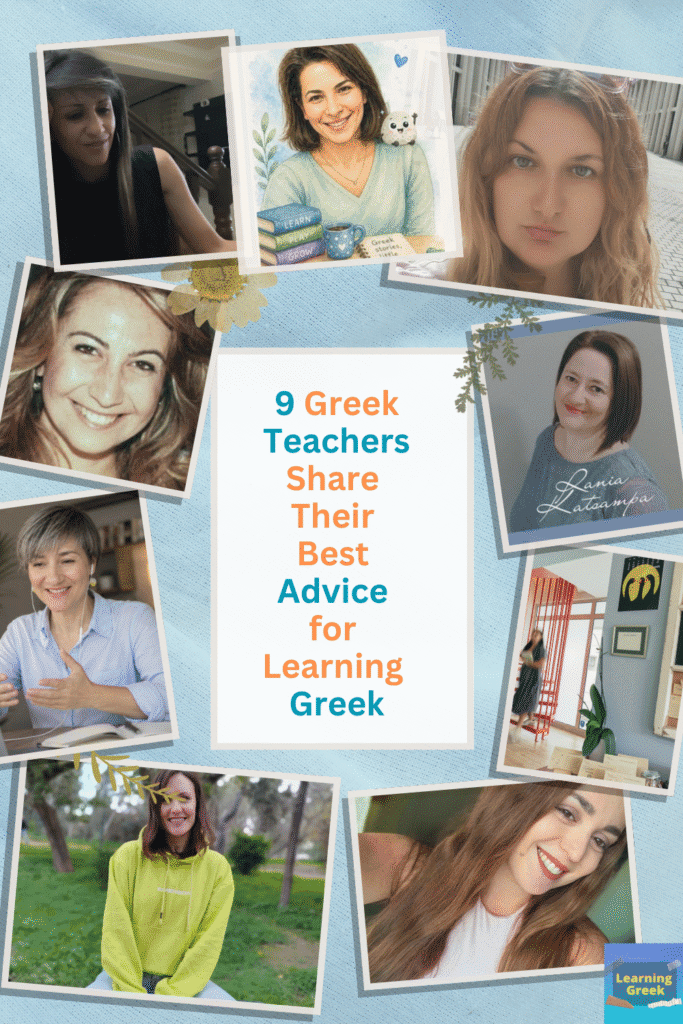
But this time, I wanted to bring you something a little different: advice and insights from 9 other Greek teachers who help learners around the world on their journey to learning Greek.
I asked them one important question:
“If you could give a Greek learner just one piece of advice to make their journey easier, what would it be? And what’s one mistake they should avoid at all costs?”
The answers I received were so interesting that I wanted to share them with you exactly as they were given.
You’ll notice that some teachers focus on consistency, some on speaking, some on mindset, and others on connecting with Greek culture and everyday life. There are also a few themes that come up again and again, and I think that’s something worth paying attention to.
So, let’s hear what these 9 Greek teachers have to say. I’m sure you’ll find at least one piece of advice that will make you think differently about your own Greek learning journey!
9 Greek Teachers Share Their Best Advice for Learning Greek
Kerry Antoniou
Facebook: Kerry Antoniou
Advice
Stop translating from English. Learn Greek in phrases, not individual words. Your goal is to think in Greek, not convert every sentence.
Mistake to avoid
Don’t wait until you feel “ready” to speak. Start speaking early. Even with mistakes. Confidence and fluency come from using the language, not from perfect grammar.
Fotini from Greek Pebbles

instagram: greek_pebbles
Facebook: Greek pebbles
Advice
Read a little Greek every day. Whether it’s a short story, a simple dialogue, or even a few sentences, regular reading helps you build vocabulary, improve comprehension, and become familiar with the natural rhythm of the language. Small daily steps make a big difference.
Mistake to avoid
Don’t feel discouraged by Greek grammar and syntax. Greek can seem challenging at first, but don’t let that stop you. Language learning is a journey, and every mistake is part of the process. Focus on communicating, enjoy the learning experience, and remember that confidence grows with practice.
Anna Gramm

Facebook: Anna Gramm
Advice:
Find a purpose in learning Greek and stick with it!
Mistake to avoid/correct:
Impatience with results
Rena Lazaridou

Facebook: Rena Lazaridou
Advice:
Don’t aim for perfection but aim for consistency. Even 15–20 minutes of Greek every day will help you progress much faster than occasional long study sessions. Listen to the language, speak it whenever you can, and don’t be afraid to make mistakes.
Mistake to avoid:
One mistake to avoid is waiting until you “feel ready” to speak. In reality, speaking early, even with simple sentences and plenty of errors, is one of the fastest ways to build confidence and improve!
Rania Katsampa

Website: Greek Feeling
Advice:
Enjoy your learning. This is a dominant motivation factor to keep going, feeling eager for more
Mistake to avoid:
Don’t miss the connection to the Culture. Understanding the Culture is yet another bridge to a deeper grasp of how language functions and is used by natives.
Ifigeneia Kaloudi

instagram: Ifigenia_kl
Facebook: Ifigeneia Kaloudi
Advice:
My advice? Expose yourself to Greek every day, even for 10 minutes. Listen, repeat, use what you learn, and enjoy the journey.
Mistake to avoid:
The biggest mistake to avoid is translating everything word-for-word from your native language. Greek has its own logic, so take the time to discover it!
Fenia Pardalidou

Website: The Wise Greek Owl Project
Facebook: The Wise Greek Owl Project
Advice:
Change your mind before you change your notebook. Most people come to Greek already convinced it’s impossible, and that belief slows them down far more than any irregular verb ever will. So start there. Greek isn’t hard, it’s simply unfamiliar, and unfamiliar is a problem time solves.
Then train your ear before you train your grammar. I call it the LOR rule: Listen, Observe, Repeat.
Listen to how Greeks actually speak, in the kitchen, at the kiosk, in an argument about football. Observe what the face and the hands are doing while the words come out, because in Greek half the meaning lives there. Then repeat, out loud, badly, until your mouth stops being a stranger to the sounds.
Mistake to avoid:
The mistake to avoid: waiting until your grammar is correct before you open your mouth. That wait has no end. Speak first, feel the language, and let the grammar catch up with you. Discover the language, Embrace the culture!
Dimitra Mcdi

Facebook: Greek it Easy
Advice
My one piece of advice: Make Greek part of your daily routine, even if it’s just for 5–10 minutes. Instead of relying only on textbooks, interact with the language in different ways: listen to a short podcast, follow a yoga or workout video in Greek, cook from a Greek recipe, read a news headline, or watch a YouTube video. Small, consistent moments of exposure add up and make learning feel natural.
Mistake to avoid:
One mistake to avoid: Don’t wait until your Greek is “perfect” before you start speaking. Progress comes from using the language, making mistakes, and learning from them—not from trying to get everything right first.
Katerina Aivazoglou

Website: Ithaki Academics
Advice:
The advice I often give my students, especially at beginner levels, is to allow themselves to keep things simple. They should not expect to express themselves in Greek with the same richness, precision, and ease as they do in their first language.
In fact, the more educated and articulate a learner is, the harder it can be to accept that, for a while, they may speak and write at a much simpler level — almost like a primary school child. But this is not a step backwards. It is a natural and necessary part of learning a new language.
Mistake to avoid
The one mistake I would encourage learners to avoid is being afraid of making mistakes. Mistakes are wonderful learning opportunities and an essential part of progress.
Final Thoughts
After reading all these answers, I think one thing becomes very clear: there is no single perfect way to learn Greek.
But there are a few lessons that come up again and again. Be consistent. Listen to Greek as much as you can. Speak before you feel ready. Don’t be afraid of making mistakes. Don’t expect yourself to express complicated thoughts in Greek from day one.
And perhaps most importantly, enjoy the process and stay connected to the language and the culture behind it.
Learning Greek takes time, and there will definitely be moments when it feels challenging. But you don’t have to be perfect to make progress. Every word you understand, every sentence you manage to say, and every conversation you have is another step forward.
So, take the advice that speaks to you most, make it part of your own learning journey, and keep going. And remember: you don’t have to wait until your Greek is perfect to start using it.
Start where you are, use what you know, and let your Greek grow from there. 🇬🇷💙
A huge thank you to all 9 teachers who took the time to share their advice and be part of this article. I hope their words give you some advice for learning Greek that you can take with you on your own journey.