
Hello, beach lovers!
If you are planning a summer trip, learning essential Greek beach vocabulary will help you feel confident by the sea. Whether you want to find a sun lounger, ask for shade, or order an iced coffee at a beach bar, having these practical words ready makes your trip much smoother.
And Greek beaches come with their own vocabulary.
Some of these words are simple, while others are uniquely useful when you’re actually in Greece. So let’s take a trip to the beach and learn the Greek words and phrases you’ll need for a perfect day by the sea.
This Greek beach vocabulary guide covers everything from the natural features you’ll see around you to the things you’ll pack in your beach bag.
Greek Beach Vocabulary
Essential Greek Beach Vocabulary for the Shore & Sea
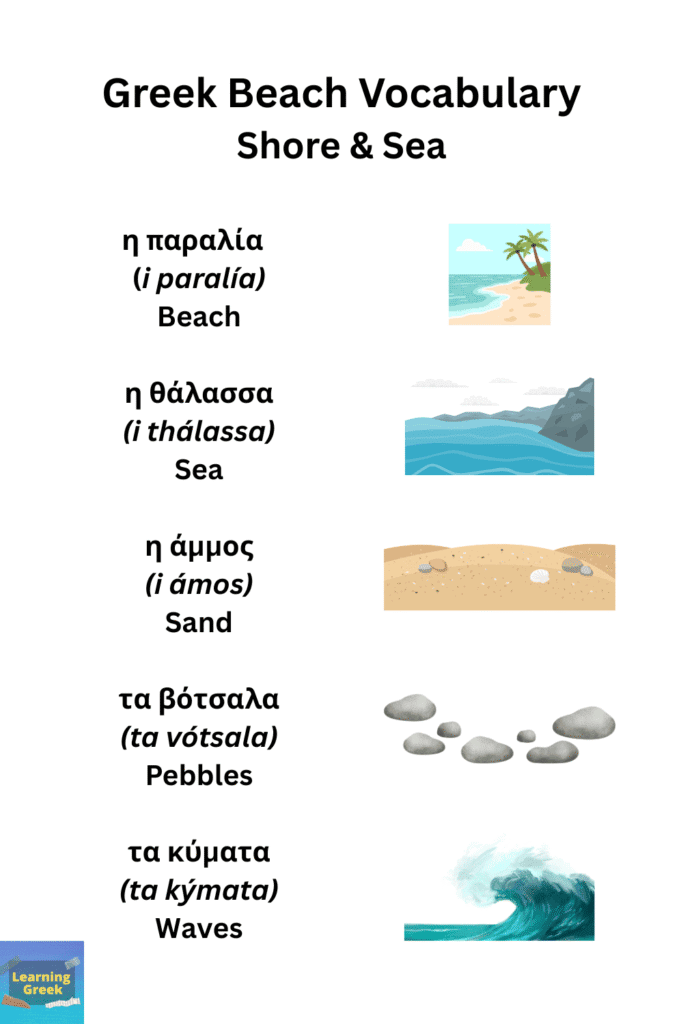
Before setting up your towel, you need the basic Greek beach vocabulary to describe the coast around you. Here are the most common landscape terms:
1. η παραλία
(i paralía)
Beach
You’ll need this word constantly.
Πάμε παραλία;
Páme paralía?
Shall we go to the beach?
Notice that Greeks often say πάμε παραλία rather than πάμε στην παραλία when speaking casually. It’s a very natural way to say you’re heading to the beach.
Of course, παραλία can also refer to the coastline or a beach in general, so you’ll hear it in all kinds of contexts during the summer.
2. η θάλασσα
(i thálassa)
Sea
If there’s one word you’re guaranteed to hear during a Greek summer, it’s θάλασσα.
Πάμε για μπάνιο στη θάλασσα;
Páme ya bánio sti thálassa?
Shall we go for a swim in the sea?
Greeks often talk about the θάλασσα as if it were a destination in itself. You might say πάμε θάλασσα or πάμε για μπάνιο, even when you’re not specifically talking about swimming.
And here’s a beautiful Greek expression you might hear on a calm summer day:
Η θάλασσα είναι λάδι.
I thálassa íne ládi.
The sea is like oil.
Don’t worry, there isn’t actually oil in the water! The expression describes a completely calm sea with a smooth, flat surface.
3. η άμμος
(i ámos)
Sand
If you’re going to a sandy beach, you’ll definitely need this word.
Έχει άμμο παντού!
Éhi ámo pantóu!
There’s sand everywhere!
The word άμμος is feminine, so you’ll hear η άμμος. When you say “in the sand”, it becomes στην άμμο.
Ξαπλώνω στην άμμο.
Xaplóno stin ámo.
I lie down on the sand.
And if you’ve ever spent a day at the beach in Greece, you probably know the next sentence:
Έχω παντού άμμο!
Ého pantou ámo!
I have sand everywhere!
In your shoes, your bag and your towel. And somehow, probably in your car too.
4. τα βότσαλα
(ta vótsala)
Pebbles
Not every Greek beach has soft sand. Many beautiful Greek beaches are covered in βότσαλα.
Η παραλία έχει βότσαλα.
I paralía éhi vótsala.
The beach has pebbles.
If you’ve ever tried to walk into the sea on a pebble beach, you already know why this is useful vocabulary.
You might also hear:
Πρόσεχε τα βότσαλα!
Prósehe ta vótsala!
Watch out for the pebbles!
Beach shoes can be a very good idea.
5. Παραλία με βότσαλα ή με άμμο;
Paralía me vótsala í me ámo?
Pebble beach or sandy beach?
This is a question you might want to ask before choosing where to spend your day.
Προτιμάς παραλία με άμμο ή με βότσαλα;
Protimás paralía me ámo í me vótsala?
Do you prefer a sandy beach or a pebble beach?
There isn’t really a right answer. Some people love soft sand, while others prefer pebbles because they don’t stick to absolutely everything.
6. τα κύματα
(ta kýmata)
Waves
The word κύμα means wave, while κύματα is the plural: waves.
Έχει μεγάλα κύματα σήμερα.
Éhi megála kýmata símera.
There are big waves today.
Or, if the sea is perfectly calm:
Δεν έχει καθόλου κύματα.
Den éhi kathólou kýmata.
There are no waves at all.
You’ll also hear το κύμα in other contexts, such as when talking about a wave of heat or a wave of people, but at the beach, it’s usually the water you’re talking about.
7. τα ρηχά νερά
(ta rihá nerá)
Shallow water
If you’re at the beach with children, ρηχά νερά is a very useful phrase.
Εδώ έχει ρηχά νερά.
Edhó éhi rihá nerá.
It’s shallow here.
The opposite is βαθιά νερά (vathiá nerá), deep water.
Πρόσεχε, εδώ είναι βαθιά!
Prósehe, edhó íne vathiá!
Be careful, it’s deep here!
These phrases are especially useful when choosing where to swim.
Gear & Items: Basic Greek Beach Vocabulary
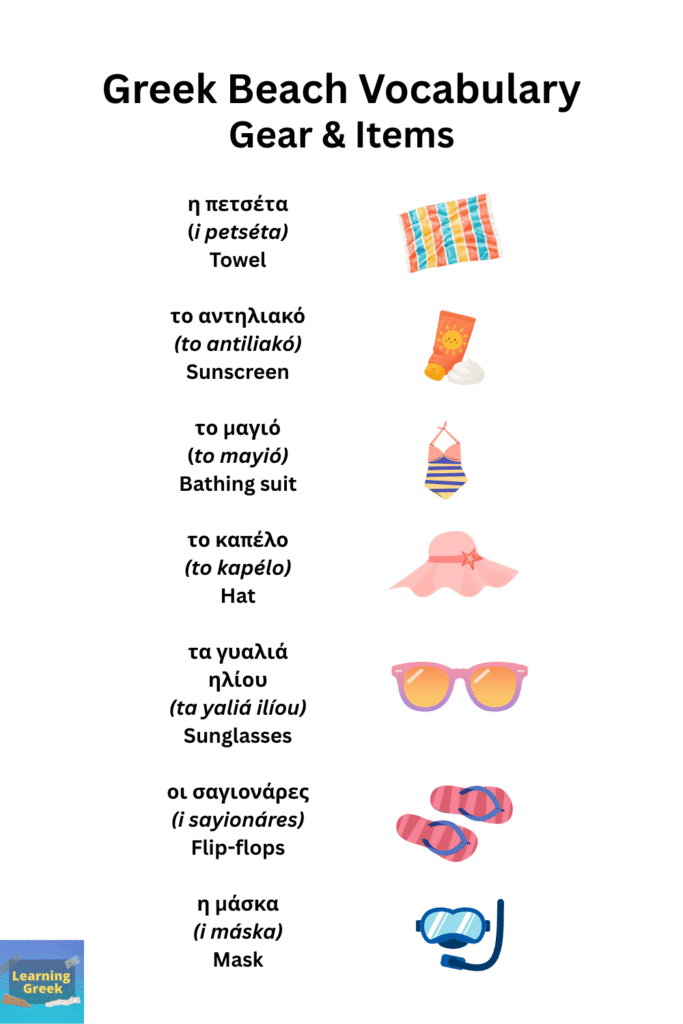
Packing your bag for a swim requires a specific set of words. Master this Greek beach vocabulary for gear so you never forget your essentials:
8. η πετσέτα
(i petséta)
Towel
A πετσέτα is one of the first things you’ll pack for a day at the beach. You spread it on the sand, put it on your sun lounger, or use it to dry yourself after a swim.
Πού είναι η πετσέτα μου;
Poú íne i petséta mou?
Where’s my towel?
You might also hear someone say:
Πάρε την πετσέτα σου!
Páre tin petséta sou!
Take your towel!
And if you’re at a busy beach, try to remember where you put yours. When every towel looks the same, finding your spot again can become surprisingly difficult!
9. το αντηλιακό
(to antiliakó)
Sunscreen
This is one word you definitely need in Greece.
The Greek summer sun can be intense, so αντηλιακό is something you’ll hear often at the beach.
Έβαλες αντηλιακό;
Évales antiliakó?
Did you put on sunscreen?
You can also ask:
Έχεις αντηλιακό;
Éhis antiliakó?
Do you have sunscreen?
The answer might be Ναι, πάρε (Né, páre) – Yes, take it or, unfortunately, Όχι, το ξέχασα (Óhi, to xéhasa) – No, I forgot it.
Either way, it’s a good word to have in your vocabulary.
10. το μαγιό
(to mayió)
Swimsuit / bathing suit
Whether you’re wearing a bikini, swimming trunks, or a one-piece swimsuit, the general Greek word is μαγιό.
Πού είναι το μαγιό μου;
Poú íne to mayió mou?
Where’s my swimsuit?
And if you’re going to the beach directly from somewhere else, you might say:
Φοράω το μαγιό μου από μέσα.
Foráo to mayió mou apó mésa.
I’m wearing my swimsuit underneath.
Very useful when you don’t have access to a changing room!
11. το καπέλο
(to kapélo)
Hat
The Greek sun is not something to underestimate, so a καπέλο is another useful item to have with you.
Πάρε το καπέλο σου.
Páre to kapélo sou.
Take your hat.
You might also hear καπέλο used figuratively in Greece when talking about an unexpected extra charge added to a price. But at the beach, let’s hope you’re only talking about the kind you wear on your head!
12. τα γυαλιά ηλίου
(ta yaliá ilíou)
Sunglasses
Literally, γυαλιά ηλίου means “glasses of the sun.”
Πού είναι τα γυαλιά ηλίου μου;
Poú íne ta yaliá ilíou mou?
Where are my sunglasses?
You’ll notice that the word γυαλιά is plural, so you say τα γυαλιά ηλίου.
And just like your towel, these have a strange habit of disappearing at exactly the moment you need them.
13. η μάσκα
(i máska)
Mask
At the beach, μάσκα usually means a swimming or diving mask.
Πήρες τη μάσκα σου;
Píres ti máska sou?
Did you bring your mask?
If you’re planning to explore the water, a mask can turn an ordinary swim into a completely different experience. Greek waters are often wonderfully clear, and you may see plenty of fish close to shore.
14. οι σαγιονάρες
(i sayionáres)
Flip-flops
You’ll see σαγιονάρες everywhere in Greece during the summer.
Πού είναι οι σαγιονάρες μου;
Poú íne i sagionáres mou?
Where are my flip-flops?
They’re perfect for walking to the beach, although they aren’t always the best choice for beaches covered in pebbles.
And yes, this is another word you’ll usually hear in the plural.
Useful Greek Beach Vocabulary for Amenities & Bars
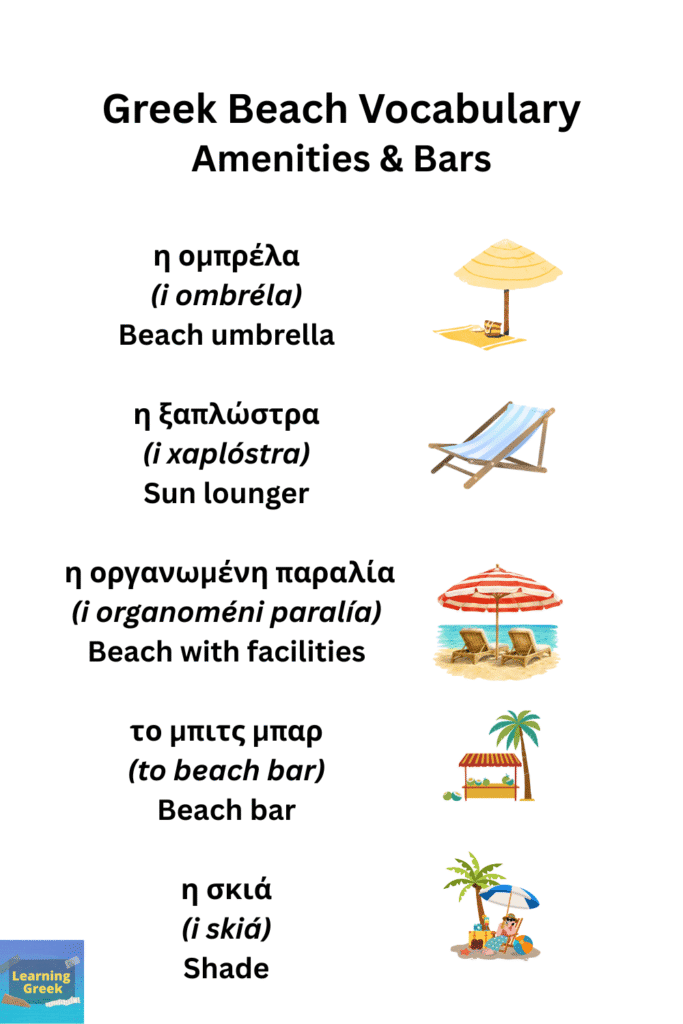
Organized beaches in Greece have plenty of facilities. Use this Greek beach vocabulary when renting gear or ordering refreshing drinks by the shore:
15. η ξαπλώστρα
(i xaplóstra)
Sun lounger
This is one of the most useful words to know if you’re visiting an organized beach in Greece.
A ξαπλώστρα is a sun lounger, usually found under an ομπρέλα, umbrella. You can rent one, sit back, and spend the day enjoying the sun and the sea.
Πόσο κάνει η ξαπλώστρα;
Póso káni i xaplóstra?
How much is the sun lounger?
The word comes from the verb ξαπλώνω (xaplóno), which means to lie down or recline. So a ξαπλώστρα is, quite literally, something for lying down.
You’ll often hear ξαπλώστρα and ομπρέλα mentioned together, especially when people are asking about prices or looking for a place to sit.
Πόσο κάνει το σετ;
Póso káni to set?
How much is the set?
Το σετ usually refers to the combination of 2 sun loungers and an umbrella. It’s a useful phrase to know when you’re at an organized beach and want to ask about the price.
16. η ομπρέλα
(i ombréla)
Beach umbrella
At the beach, an ομπρέλα is usually a beach umbrella rather than the kind you use when it’s raining. You may also hear ομπρέλα θαλάσσης, which literally means beach umbrella.
Θέλω μια ξαπλώστρα κάτω από την ομπρέλα.
Thélo mia xaplóstra káto apó tin ombréla.
I want a sun lounger under the umbrella.
Knowing the phrase κάτω από την ομπρέλα can be particularly useful in July and August, when finding some shade can feel like finding treasure.
Of course, ομπρέλα can also mean a regular umbrella. The context tells you which kind you’re talking about.
17. η οργανωμένη παραλία
(i organoméni paralía)
Organized beach / beach with facilities
An οργανωμένη παραλία is a beach with facilities such as sun loungers, umbrellas, showers, changing areas, or a beach bar.
You might say:
Πάμε σε οργανωμένη παραλία;
Páme se organoméni paralía?
Shall we go to an organized beach?
The alternative is often a more remote or undeveloped beach where you bring everything you need yourself.
Both have their fans. Some people want a comfortable ξαπλώστρα and a coffee within easy reach. Others want nothing but their πετσέτα, αντηλιακό, and the sea.
18. το beach bar
Beach bar
Beach bar
Yes, Greeks use the English phrase beach bar all the time.
At a beach bar, you can usually order coffee, water, soft drinks, snacks, and sometimes cocktails or food.
You might say:
Έναν φραπέ, παρακαλώ.
Énan frappé, parakaló.
A frappé, please.
Or:
Ένα νερό, παρακαλώ.
Éna neró, parakaló.
A water, please.
Because apparently no Greek beach day is complete without a coffee that you can spend several hours slowly drinking.
19. η σκιά
(i skiá)
Shade
When the temperature rises, σκιά becomes one of the most important words at the beach.
Έχει σκιά εδώ;
Éhi skiá edhó?
Is there shade here?
You can also say:
Θέλω να κάτσω στη σκιά.
Thélo na kátsō sti skiá.
I want to sit in the shade.
If you’re looking for a place under an umbrella, this is definitely a useful phrase to know.
Common Verbs & Swimming Phrases in Greek Beach Vocabulary
To put your words into action, blend these useful verbs into your everyday Greek beach vocabulary:
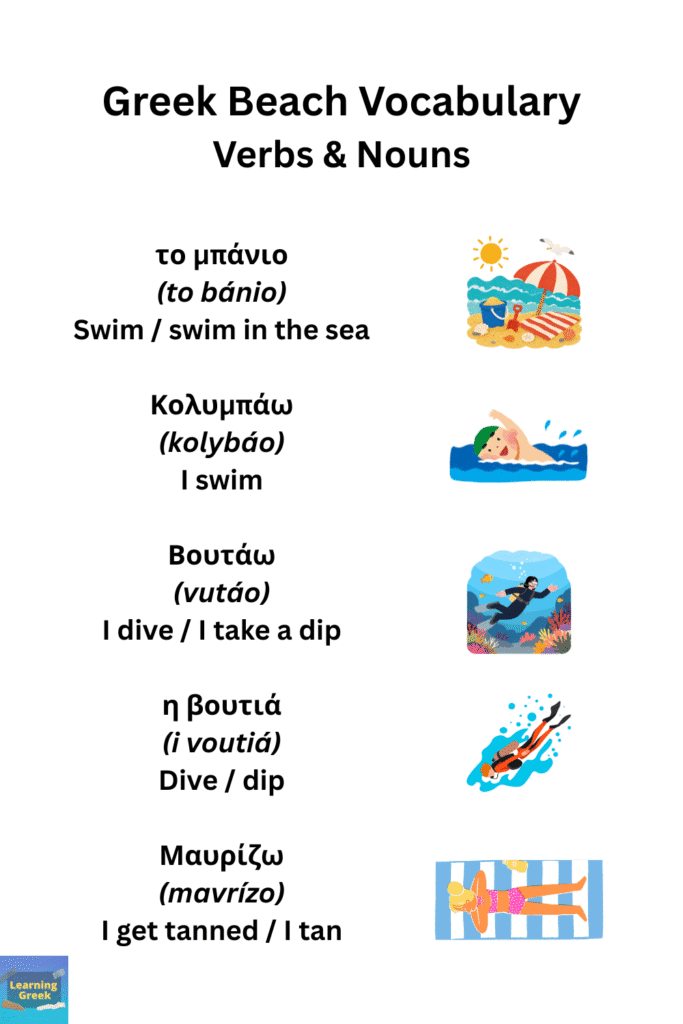
20. το μπάνιο
(to bánio)
Swim / swim in the sea
Here’s a Greek word that can be slightly confusing.
Μπάνιο normally means a bath or bathroom, depending on the context. But when Greeks talk about going to the beach, μπάνιο can also mean swimming or going for a dip.
Πάμε για μπάνιο!
Páme ya bánio!
Let’s go for a swim!
This doesn’t mean “Let’s go take a bath.” It means you’re heading to the sea for a swim.
You might also hear:
Έκανες μπάνιο;
Ékanes bánio?
Did you go swimming?
So if someone asks you this while you’re on holiday in Greece, they’re probably asking whether you’ve been for a swim, not whether you’ve taken a shower!
21. Κολυμπάω
kolybáo
I swim
The verb κολυμπάω means to swim.
Μου αρέσει να κολυμπάω στη θάλασσα.
Mou arési na kolybáo sti thálassa.
I like swimming in the sea.
You can also ask:
Ξέρεις να κολυμπάς;
Xéris na kolybás?
Can you swim?
This is one of those verbs you’ll probably use more often than you expect if you’re spending time in Greece during the summer.
22. Βουτάω
vutáo
I dive / I take a dip
Βουτάω can mean to dive, but in everyday conversation it can also mean to jump or get into the water for a swim.
Πάω να βουτήξω!
Páo na voutíxo!
I’m going for a dip!
You might hear someone say πάμε να βουτήξουμε when they’re suggesting that everyone get into the water.
It’s a very useful word for those moments when you’ve been sitting in the sun for too long and decide it’s time to cool off.
23. η βουτιά
(i voutiá)
Dive / dip
We saw the verb βουτάω earlier. The noun βουτιά means a dive or a dip.
Πάμε για μια βουτιά;
Páme ya mia voutiá?
Shall we go for a dip?
This is a very natural way to suggest getting into the water.
And after sitting under the sun for an hour, the answer is probably going to be yes.
24. Μαυρίζω
mavrízo
I get tanned / I tan
If you’re spending your summer in Greece, you’ll probably hear μαυρίζω sooner or later. It means to get tanned or to tan.
Θέλω να μαυρίσω λίγο.
Thélo na mavríso lígo.
I want to get a little tanned.
You can also say:
Έχω μαυρίσει πολύ!
Ého mavrísi polí!
I’ve gotten very tan!
Or, when talking about someone else:
Έχεις μαυρίσει!
Éhis mavrísi!
You’ve gotten tan!
Just remember that μαυρίζω doesn’t mean that your skin literally becomes black. In this context, it’s the everyday Greek verb for getting a suntan.
And, of course, if you’re going to spend hours trying to μαυρίσεις, don’t forget your αντηλιακό!
25. Καλό μπάνιο!
Kaló bánio!
Enjoy your swim!
Here’s a lovely phrase you’ll hear in Greece.
Καλό μπάνιο! literally means something like “Have a good swim!” or “Enjoy your swim!”
Someone might say it to you as you head down to the beach or into the water.
It’s similar to saying καλή διασκέδαση (kalí diaskédasi), which means have fun or enjoy yourself, when someone is going out to have fun. It’s a simple, friendly wish that you’ll enjoy your time in the water.
A Greek Beach Day in One Conversation
The best way to remember your Greek beach vocabulary is to see how these words work together in a real-life situation.
Imagine you’re getting ready to spend the day at the beach with a Greek friend.
Πάμε παραλία;
Páme paralía?
Shall we go to the beach?
Ναι! Πήρες την πετσέτα σου και το αντηλιακό;
Né! Píres tin petséta sou ke to antiliakó?
Yes! Did you take your towel and sunscreen?
Ναι, τα έχω όλα. Πάμε!
Né, ta ého óla. Páme!
Yes, I have everything. Let’s go!
You arrive and find a nice spot.
Έχει σκιά εδώ;
Éhi skiá edhó?
Is there shade here?
Ναι, αλλά έχει βότσαλα.
Né, allá éhi vótsala.
Yes, but there are pebbles.
You decide to go to an organized beach instead.
Πάμε σε οργανωμένη παραλία. Θέλω μια ξαπλώστρα!
Páme se organoméni paralía. Thélo mia xaplóstra!
Let’s go to an organized beach. I want a sun lounger!
Once you’re settled under your umbrella, you hear the most important question of the day:
Πάμε για μπάνιο;
Páme ya bánio?
Shall we go for a swim?
Of course, you say yes.
Πάμε για μια βουτιά!
Páme ya mia voutiá!
Let’s go for a dip!
And now you have everything you need for a proper Greek beach day.
Ready for the Greek Beach?
Practicing this Greek beach vocabulary before you go will make your trip infinitely more enjoyable. From ordering your first cold iced coffee to renting your umbrella on a sun-drenched coast, these simple words help you blend in and connect with locals effortlessly.
But perhaps the most useful phrase of all is still the simplest:
Πάμε για μπάνιο;
Because once you know that one, you don’t need much more convincing to head to the sea.
Καλό μπάνιο!