
Hello my beautiful Greek Learners! Today, we will talk about where to put accents in Greek and we will see how we can make our life easier by following some simple and easy rules. Lucky for you, Modern Greek uses a monotonic system and has only two diacritics, unlike Ancient or Koine Greek, which follow the polytonic system and have numerous diacritics.
In Modern Greek, all you need to know is the single accent mark, which looks like this (‘), and the diaeresis, which looks like this (¨). The accent mark is the most frequent, while the diaeresis is less common and indicates a diphthong or a hiatus.
Today, we’re going to focus only on the single accent mark to make things easier to understand. If you also want to learn about the diaeresis and other punctuation marks, you can find them in my guide to Greek punctuation marks.
But let’s dive deeper into the wonderful world of Greek accents.
Where to Put Accents in Greek
What Does a Greek Accent Do?
The accent in Modern Greek is used to indicate the stressed syllable within a word. In other words, the accent helps you give the right emphasis to a word. Incorrect placement of the accent can alter the meaning of a word and affect its pronunciation, sometimes resulting in a whole new word with different meaning. We will talk about this phenomenon later in this article.
Where to Put the Accent Mark?
1. On the stressed syllable:
The accent mark (‘) is placed above the vowel of the syllable in the word that is pronounced with more emphasis.
τραπέζι (trapezee) – table
καφές (kafes) – coffee
θάλασσα (thalasa) – sea
2. Only on vowels:
The accent mark is ONLY applied to vowels whether plain (ά, έ, ή, ί, ό, ύ, ώ) or a digraph (εί, αί, οί, αύ, εύ υί).
When the vowel is a digraph, the accent mark is always placed over the second letter.
Here are some examples for both cases:
Plain vowel:
Βιβλίο (vivlio) – book
Καρέκλα (karekla) – chair
Νύχτα (neehta) – night
Digraph vowel:
Χαίρομαι (herome) – I’m happy
Κουλούρι (kuluree) – bagel
Ουρανοί (uranee) – skies
3. On the vowel of the diphthong pronounced more strongly
κορόιδο (koroedo) – fool
νεράιδα (neraeda) – fairy
4. Before and on the capitalized vowel that is emphasized
Άγγελος (aggelos) – angel
Ήλιος (eelios) – sun
Now that we have clarified that only vowels can be accented, it’s time to move on and understand:
Which Words are Stressed?
1. All words that have more than one syllable and are written in lower case need to have an accent mark.
But what is a syllable, you ask? It is a small part of a word and almost always contains a vowel or a diphthong along with the consonant (s).
Examples:
σοκολάτα (sokolata) – chocolate —> 4 syllables: σο – κο – λά – τα
πατάτα (patata) – potato —> 3 syllables: πα – τά – τα
καλό (kalo) – good —> 2 syllables: κα – λό
και (ke) – and —> 1 syllable: και, no accent mark
Fun fact: The word, syllable derives from the Greek word συλλαβή (seelavee). Can you see the resemblance?
Now that we have understood what a syllable is let’s move on to some other basic rules.
2. Only the final three syllables of a word can be stressed.
So, if you see a Greek word with a lot of syllables, you automatically know that the accent mark goes somewhere towards the end of the word. Yep, examples!
περιπέτεια (peripeteea) – adventure
ξεροψημένος (kseropsimenos) – crusty
ψαρόσουπα (psarosupa) – fish soup
3. Words appearing as monosyllabic after elision 1or truncation2.
Examples of elision:
ούτε εσύ ούτε εγώ —> o΄ύτ‘ εσύ o΄ύτ‘ εγώ (ut’ esi ut’ego) – neither you nor I
είναι ανάγκη —> είν‘ ανάγκη (in anagki) – it is necessary
Examples of truncation
φέρε το —> φέρ‘ το (fer to) – bring it
άσε την —> άσ‘ την (as tin) – leave her
4. Enclitic words whose accent is transferred to the last syllable of the proparoxytone words.
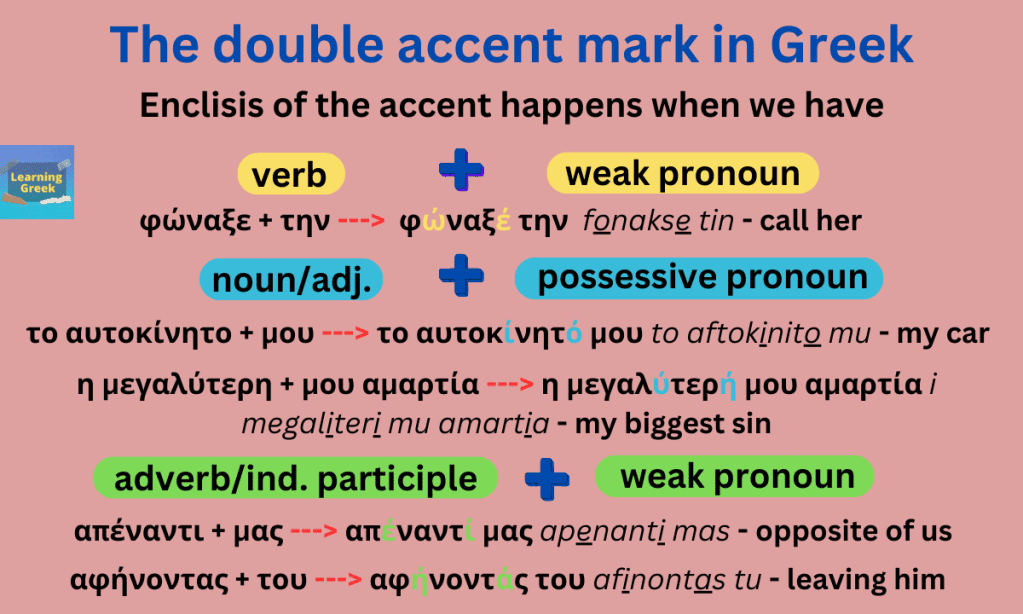
Often, when I combine a word with one or more weak pronouns (enclitics), I add an additional accent that falls either on the last syllable of the first word or on the first of the two pronouns. This is called enclisis of the accent.
This happens when we have:
a) verbs + weak pronouns:
φώναξε + την —> φώναξέ την (fonakse tin) – call her
b) nouns/adjectives + possessive pronouns:
το αυτοκίνητο + μου —> το αυτοκίνητό μου (to aftokinito mu) – my car
η μεγαλύτερη + μου αμαρτία —> η μεγαλύτερή μου αμαρτία (i megaliteri mu amartia) – my biggest sin
c) adverbs/indeclinable participles followed by weak pronouns:
απέναντι + μας —> απέναντί μας (apenanti mas) – opposite of us
αφήνοντας + του —> αφήνοντάς του (afinontas tu) – leaving him
Depending on the syllable that is stressed, a word can be:
Oxytone: Stressed on the last syllable.
ο χειρουργός (ο heerurgos) – the surgeon
η πολιτική (ee politikee) – the politic
το κανονικό (to kanoniko) – the normal
Paroxytone: Stressed on the penultimate syllable.
ο κάμπος (o kampos) – the meadow
η καλοσύνη (ee kalosini) – the kindness
το βιβλίο (to vivlio) – the book
Proparoxytone: Stressed on the antepenultimate syllable.
ο άρχοντας (o arhontas) – the lord
η ακαταμάχητη ( ee akatamahitee) – the irresistible
το όνειρο (to oneero) – the dream
One Syllable Words Don’t Need an Accent Mark Because We Can Understand Where the Stress Falls
But do we have exceptions for that?
We are Greeks, of course he have!
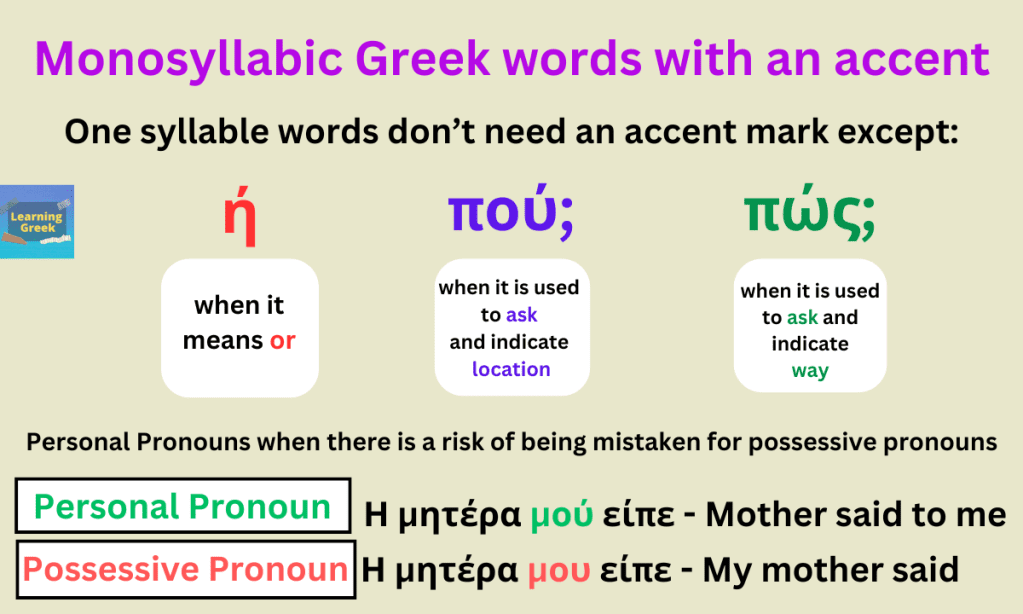
Now let’s analyze the image above and see some examples.
Single Syllable Words That Need an Accent Mark
- The conjuction ή (ee) – or
Τι θέλεις να φας; Κρέας ή ψάρι; (Tee thelis na fas? Kreas i psaree?) – What do you want to eat? Meat or fish?
2. The interrogative pronoun πού (pu) – where
Πού θέλεις να πάμε; (Pu thelis na pame) – Where do you want to go?
3. The interrogative pronoun πώς (pos) – how
Πώς μπορώ να σας βοηθήσω; (Pos boro na sas voithiso?) – How can I help you?
The words πού and πώς are also accented in the following cases:
από πού και ως πού (apo pu ke os pu) – how come?
πού και πού (pu ke pu) – now and then
αραιά και πού (area ke pu) – once in a while
πού να σου τα λέω (pu na su ta leo) – there’s so much to tell you
πώς και πώς (pos ke pos) – look forward
πώς βαριέμαι! (pos varieme) – I’m so bored!
4. The weak forms of personal pronouns are accented when there is a risk of being mistaken for possessive pronouns. The corresponding possessive pronouns, however, are unaccented.
Η μητέρα μού είπε (I mitera mu ipe) in other words Η μητέρα είπε σ’ εμένα (I mitera ipe s’ emena) – Mother said to me
Η μητέρα μου είπε (I mitera mu ipe) in other words Η δική μου μητέρα είπε (I diki mu mitera ipe) – My mother said
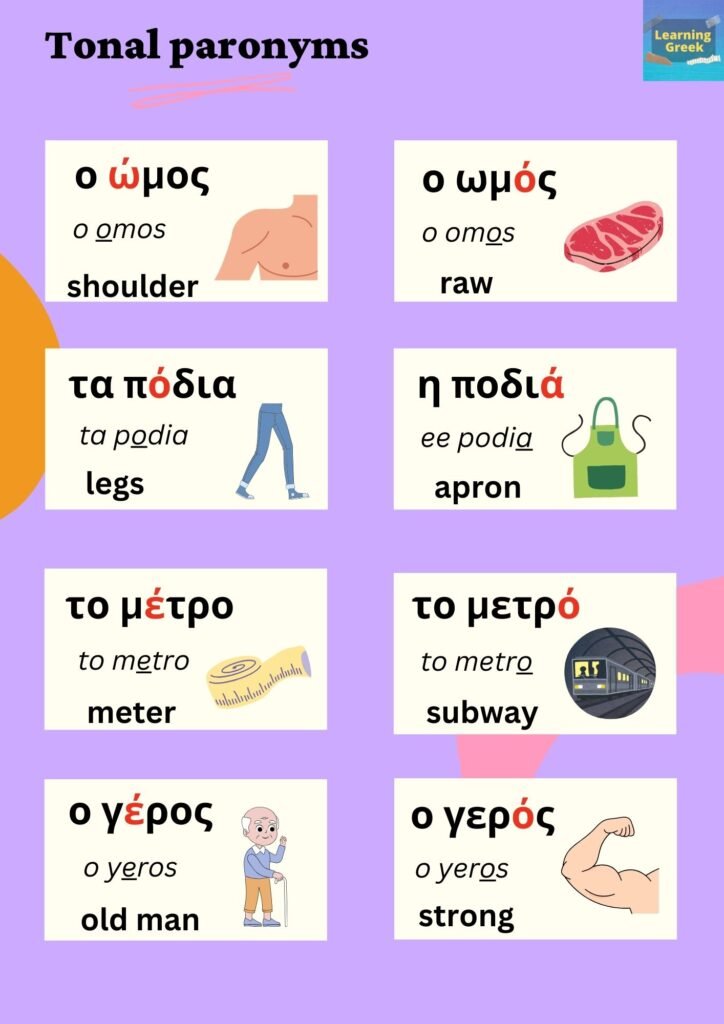
Tonal Paronyms
Sometimes, the accent helps me distinguish words that look alike but have different meanings. These words are called tonal paronyms.
The image below will help you understand them better.

Ready to Master Accents in Greek?
Greek accents may seem confusing at first, but once you understand the basic rules, they become much easier to use correctly.
I hope this guide helps you feel more confident with accents in Greek and understand where and why the accent mark is used.
If you’re still getting confused by words like πού and που, have a look at my guide to Που vs πού: The Simple Rule Even Greeks Mix Up. You might also find my Ultimate Guide to All Greek Grammatical Terms useful if you want to become more familiar with Greek grammar terminology.
And if you want to learn about some of the most common problems Greek learners face, take a look at 7 Common Mistakes Greek Learners Make.
Well, that was it for today!
If you have any questions, don’t hesitate to leave a comment. Hasta la vista! Oh, wait! Wrong language… Τα λέμε στο επόμενο μάθημα!
Footnotes:
- Elision: The phenomenon that can occur in a word ending in a vowel when it is placed in front of a word that begins with a vowel. In the position where the vowel disappears, we use an apostrophe (‘). ↩︎
- Truncation: The phenomenon where the final vowel of a word may undergo when it is placed in front of the initial consonant of the following word. In the position where the vowel disappears, we use an apostrophe (‘). ↩︎



https://teteleste.wordpress.com/2019/05/26/πολιτική-πολιτικοί-και-παραπλάνηση/