Hello, my beautiful Greek learners! Today, we’re going to focus on 20 Greek verbs and explore some more advanced alternatives that can help you enrich your vocabulary and express yourself more precisely in Greek.
You probably already know and use many basic verbs such as λέω (to say), κάνω (to do), βλέπω (to see), παίρνω (to take) and πηγαίνω (to go). They are essential in everyday conversations, and you’ll find yourself using them again and again.
But did you know that Greek has many other verbs that can express similar ideas in a more specific, formal or sophisticated way? For example, instead of always using κάνω, you might use πραγματοποιώ when talking about carrying out an activity or a task. And instead of λέω, you could use αναφέρω when you want to mention or refer to something.
Learning these alternatives doesn’t mean you should stop using the basic verbs. They are perfectly correct and often the most natural choice in everyday speech. The idea is to give yourself more options, understand different shades of meaning and gradually become more comfortable with a wider range of Greek vocabulary.
So, let’s look at 20 useful verb pairs, see how they work in real sentences, and discover when you can use each alternative!
The image below gives you a quick overview of 20 basic Greek verbs and their more advanced alternatives. We’ll look at each pair in detail, with examples, further down the article.
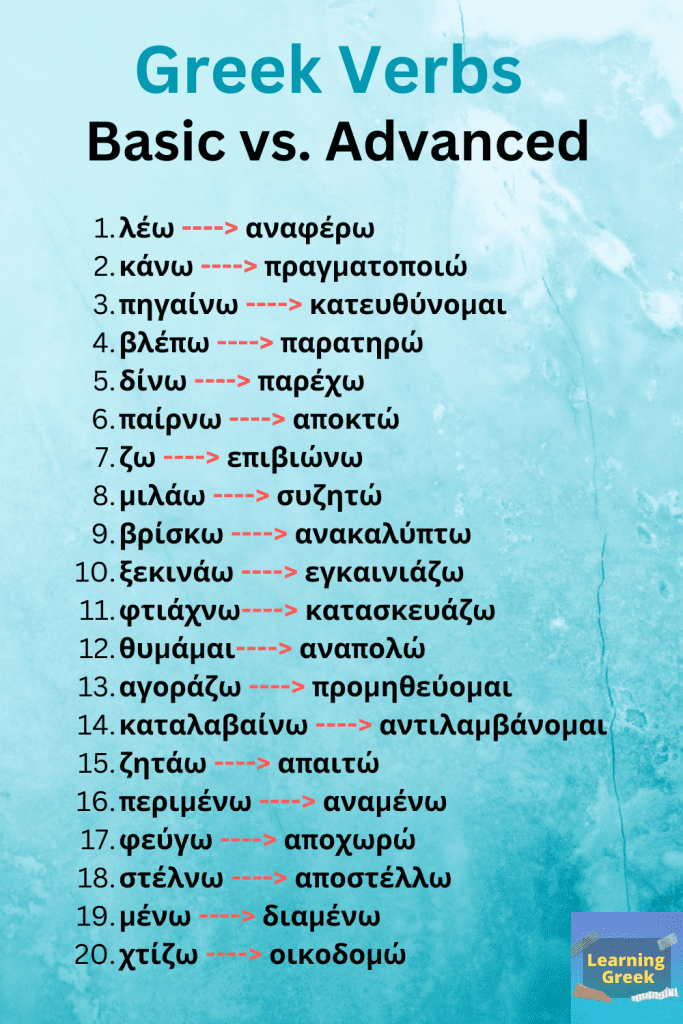
20 Greek Verbs: Basic vs. Advanced Alternatives
1. Λέω – Αναφέρω
Léo – anaféro
To say – to mention / to refer to
Λέω is one of the most frequently used verbs in Greek. We use it when saying something, telling someone something or expressing an opinion.
Αναφέρω is a more specific alternative when you want to mention something or refer to a particular subject. It is often used in more formal contexts.
- Είπα το όνομά του στη συζήτηση.
Ípa to ónomá tu sti sizítisi.
I mentioned his name during the conversation. - Ανέφερα το όνομά του στη συζήτηση.
Anéfera to ónomá tu sti sizítisi.
I mentioned his name during the conversation.
2. Κάνω – Πραγματοποιώ
Káno – pragmatopió
To do / to make – to carry out / to conduct
Κάνω is a very versatile verb. You can use it for countless activities, tasks and actions.
Πραγματοποιώ is more formal and is commonly used when talking about carrying out an activity, holding an event or completing a plan.
- Κάναμε μια έρευνα για το θέμα.
Kánаme mia érevna ya to théma.
We did some research on the subject. - Πραγματοποιήσαμε μια έρευνα για το θέμα.
Pragmatopiísame mia érevna ya to théma.
We conducted research on the subject.
3. Πηγαίνω – Κατευθύνομαι
Piyéno – katefthínome
To go – to head towards
Πηγαίνω is the everyday verb for going somewhere.
Κατευθύνομαι is useful when you want to emphasise the direction in which someone is heading. It is a little more formal and often appears in written Greek.
- Πηγαίνω στο κέντρο.
Piyéno sto kéntro.
I’m going to the city centre. - Κατευθύνομαι προς το κέντρο.
Katefthínome pros to kéntro.
I’m heading towards the city centre.
4. Βλέπω – Παρατηρώ
Vlépo – paratiró
To see – to observe / to notice
Βλέπω simply means to see or look at something.
Παρατηρώ means to observe something carefully or notice a detail. It is especially useful when describing what you have noticed about a person, situation or object.
- Βλέπω κάτι περίεργο στην εικόνα.
Vlépo káti períergo stin ikóna.
I see something strange in the picture. - Παρατηρώ κάτι περίεργο στην εικόνα.
Paratiró káti períergo stin ikóna.
I notice something strange in the picture.
5. Δίνω – Παρέχω
Díno – parého
To give – to provide
Δίνω is the basic verb for giving something to someone.
Παρέχω is more formal and is commonly used when talking about providing services, information, support or opportunities.
- Η εταιρεία δίνει πληροφορίες στους πελάτες.
I etería díni pliroforíes stus pelátes.
The company gives information to its customers. - Η εταιρεία παρέχει πληροφορίες στους πελάτες.
I etería paréhi pliroforíes stus pelátes.
The company provides information to its customers.
6. Παίρνω – Λαμβάνω
Pérno – lamváno
To take / to receive – to receive
Παίρνω has several meanings in Greek. Depending on the context, it can mean to take, receive, get or pick up.
Λαμβάνω is a more formal alternative when talking about receiving something, such as a message, an email, information or an award.
- Πήρα ένα μήνυμα από τον φίλο μου.
Píra éna mínima apó ton fílo mu.
I got a message from my friend. - Έλαβα ένα μήνυμα από τον φίλο μου.
Élava éna mínima apó ton fílo mu.
I received a message from my friend.
7. Ζω – Βιώνω
Zo – vióno
To live – to experience
Ζω means to live and can refer to being alive or living somewhere.
Βιώνω is used when talking about experiencing something, especially an important event, situation or period in your life. It is not a direct replacement for every use of ζω.
- Ζω μια δύσκολη περίοδο.
Zo mia dýskoli período.
I’m going through a difficult period. - Βιώνω μια δύσκολη περίοδο.
Vióno mia dýskoli período.
I’m experiencing a difficult period.
8. Μιλάω – Συζητάω
Miláo – sizitáo
To speak / to talk – to discuss
Μιλάω is the everyday verb for speaking or talking to someone.
Συζητάω means to discuss something or talk it over with someone. It is more specific than μιλάω because it refers to talking about a particular subject.
– Μίλησα με τον διευθυντή για το πρόβλημα.
Mílisa me ton diefthindí ya to próvlima.
I spoke with the manager about the problem.
– Συζήτησα με τον διευθυντή για το πρόβλημα.
Sizítisa me ton diefthindí ya to próvlima.
I discussed the problem with the manager.
9. Βρίσκω – Εντοπίζω
Vrísko – endopízo
To find – to locate / to identify
Βρίσκω is a very common verb meaning to find something or someone.
Εντοπίζω is more precise. It means to locate, identify or pinpoint something, often after searching or examining a situation.
- Βρήκα το λάθος στο κείμενο.
Vríka to láthos sto kείμενο.
I found the mistake in the text. - Εντόπισα το λάθος στο κείμενο.
Endópisa to láthos sto kímeno.
I identified the mistake in the text.
10. Ξεκινάω – Δρομολογώ
Xekináo – dromologó
To start – to set in motion / to initiate
Ξεκινάω is the everyday verb for starting something.
Δρομολογώ is used when setting a plan, process or action in motion. It is more formal and is particularly common in professional and administrative language.
- Ξεκινήσαμε τη διαδικασία για την κατασκευή του δρόμου.
Xekinísame ti diadikasía ya tin kataskeví tu drómu.
We started the process for building the road. - Δρομολογήσαμε τη διαδικασία για την κατασκευή του δρόμου.
Dromologísame ti diadikasía ya tin kataskeví tu drómu.
We set the process for building the road in motion.
11. Φτιάχνω – Κατασκευάζω
Ftiáhno – kataskevázo
To make / to fix – to construct / to manufacture
Φτιάχνω is another extremely useful Greek verb. It can mean to make, prepare, repair or fix something.
Κατασκευάζω is more specific. It means to construct or manufacture something, such as a building, a machine or a piece of equipment.
- Η εταιρεία φτιάχνει μηχανήματα.
I etería ftiáhni mihanimata.
The company makes machines. - Η εταιρεία κατασκευάζει μηχανήματα.
I etería kataskevázi mihanimata.
The company manufactures machines.
12. Θυμάμαι – Ανακαλώ
Thimáme – anakaló
To remember – to recall
Θυμάμαι is the everyday verb for remembering something or someone.
Ανακαλώ is a more formal alternative when referring to bringing something back to mind. You will also encounter the expression ανακαλώ στη μνήμη μου, meaning to recall something from memory.
- Θυμάμαι εκείνη την ημέρα πολύ καλά.
Thimáme ekíni tin iméra polí kalá.
I remember that day very well. - Ανακαλώ εκείνη την ημέρα με κάθε λεπτομέρεια.
Anakaló ekíni tin iméra me káthe leptoméria.
I recall that day in every detail.
13. Αγοράζω – Προμηθεύομαι
Agorázo – promithévome
To buy – to procure / to obtain supplies
Αγοράζω is the standard verb for buying something.
Προμηθεύομαι is more formal and is often used when obtaining supplies, materials or goods, especially for a business or organisation. It doesn’t always mean simply buying something in an ordinary shop.
- Το εστιατόριο αγοράζει φρέσκα λαχανικά κάθε πρωί.
To estiatório agorázi fréска lahaniká káthe proí.
The restaurant buys fresh vegetables every morning. - Το εστιατόριο προμηθεύεται φρέσκα λαχανικά κάθε πρωί.
To estiatório promithévete fréska lahaniká káthe proí.
The restaurant obtains fresh vegetables every morning.
14. Καταλαβαίνω – Αντιλαμβάνομαι
Katalavéno – antilamvánome
To understand – to realise / to perceive
Καταλαβαίνω is the everyday verb for understanding something.
Αντιλαμβάνομαι is a more formal alternative. Depending on the context, it can mean to understand, realise or become aware of something.
- Καταλαβαίνω ότι υπάρχει πρόβλημα.
Katalavéno óti ipárhi próvlima.
I understand that there is a problem. - Αντιλαμβάνομαι ότι υπάρχει πρόβλημα.
Antilamvánome óti ipárhi próvlima.
I realise that there is a problem.
15. Ζητάω – Αιτούμαι
Zitáo – etúme
To ask for / to request – to formally request
Ζητάω is the usual verb for asking for something or requesting something.
Αιτούμαι is a formal verb, mainly used in official, legal and administrative contexts. You might see it in applications, documents and formal requests.
- Ζήτησα άδεια από τον διευθυντή.
Zítisa ádia apó ton diefthindí.
I asked the manager for permission. - Αιτήθηκα άδεια από τον διευθυντή.
Etíthika ádia apó ton diefthindí.
I formally requested permission from the manager.
16. Περιμένω – Αναμένω
Periméno – anaméno
To wait – to await / to expect
Περιμένω is the everyday verb for waiting for someone or something.
Αναμένω is a more formal alternative. It is common in announcements, official communication and professional situations.
- Περιμένω την απάντησή σας.
Periméno tin apántisí sas.
I’m waiting for your reply. - Αναμένω την απάντησή σας.
Anaméno tin apántisí sas.
I await your reply.
17. Φεύγω – Αποχωρώ
Févgo – apohoró
To leave – to depart / to withdraw
Φεύγω is the everyday verb for leaving a place.
Αποχωρώ is more formal and is often used when someone leaves a meeting, an event, an organisation or a particular place.
- Έφυγε από τη συνάντηση νωρίς.
Éfige apó ti sinándisi norís.
He left the meeting early. - Αποχώρησε από τη συνάντηση νωρίς.
Apo hó rise apó ti sinándisi norís.
He departed from the meeting early.
18. Στέλνω – Αποστέλλω
Stélno – apostélo
To send – to dispatch / to send formally
Στέλνω is the common verb for sending messages, emails, letters or packages.
Αποστέλλω is a more formal alternative, frequently used in business correspondence and official communication.
- Στείλαμε τα έγγραφα χθες.
Stílame ta éngrafa hthes.
We sent the documents yesterday. - Αποστείλαμε τα έγγραφα χθες.
Apostílame ta éngrafa hthes.
We dispatched the documents yesterday.
19. Μένω – Διαμένω
Méno – diaméno
To stay / to live – to reside / to stay
Μένω can mean to live somewhere or to stay in a place.
Διαμένω is more formal and is often used when talking about someone’s accommodation or place of residence, especially in official or written contexts.
- Μένω σε ένα ξενοδοχείο στο κέντρο της Αθήνας.
Méno se éna xenodohío sto kéntro tis Athínas.
I’m staying in a hotel in the centre of Athens. - Διαμένω σε ένα ξενοδοχείο στο κέντρο της Αθήνας.
Diaméno se éna xenodohío sto kéntro tis Athínas.
I’m staying in a hotel in the centre of Athens.
20. Χτίζω – Οικοδομώ
Htízo – ikodomó
To build – to construct
Χτίζω is the everyday verb for building something, such as a house or a wall. It is also used figuratively, for example, when talking about building a relationship.
Οικοδομώ is more formal and is often used in written language. It can refer to constructing buildings, but it is also frequently used in a figurative sense.
- Θέλουμε να χτίσουμε μια καλύτερη κοινωνία.
Thélume na htísume mia kalíteri kinonía.
We want to build a better society. - Θέλουμε να οικοδομήσουμε μια καλύτερη κοινωνία.
Thélume na ikodomísume mia kalíteri kinonía.
We want to build a better society.
Here’s a quick summary of all 20 Greek verb pairs. You can use it as a reference when reviewing the vocabulary you’ve just learned.
| Basic Verb | Advanced Verb | Meaning (English) |
|---|---|---|
| λέω (léo) | αναφέρω (anaféro) | to say / to mention |
| κάνω (káno) | πραγματοποιώ (pragmatopió) | to do / to carry out |
| πηγαίνω (piyéno) | κατευθύνομαι (katefthýnome) | to go / to head towards |
| βλέπω (vlépo) | παρατηρώ (paratiró) | to see / to observe |
| δίνω (díno) | παρέχω (parécho) | to give / to provide |
| παίρνω (pérno) | λαμβάνω (lamváno) | to take / to receive |
| ζω (zo) | βιώνω (vióno) | to live / to experience |
| μιλάω (miláo) | συζητώ (syzitó) | to talk / to discuss |
| βρίσκω (vrísko) | εντοπίζω (endopízo) | to find / to locate |
| ξεκινάω (xekináo) | δρομολογώ (dromologó) | to start / to initiate |
| φτιάχνω (ftiáchno) | κατασκευάζω (kataskevázo) | to make / to construct |
| θυμάμαι (thimáme) | ανακαλώ (anakaló) | to remember / to recall |
| αγοράζω (agorázo) | προμηθεύομαι (promithevome) | to buy / to procure |
| καταλαβαίνω (katalavéno) | αντιλαμβάνομαι (antilavánome) | to understand / to perceive |
| ζητάω (zitáo) | αιτούμαι (etúme) | to ask / to to request |
| περιμένω (periméno) | αναμένω (anaméno) | to wait / to anticipate |
| φεύγω (févgo) | αποχωρώ (apohoró) | to leave / to depart |
| στέλνω (stélno) | αποστέλλω (apostéllo) | to send / to dispatch |
| μένω (méno) | διαμένω (diaméno) | to stay / to reside |
| χτίζω (chtízo) | οικοδομώ (oikodomó) | to build / to erect |
Are Advanced Greek Verbs Always Better?
Not necessarily! Some advanced verbs are simply more formal, while others have a more specific meaning. You wouldn’t normally use αναμένω when chatting with a friend, just as you wouldn’t use αιτούμαι when casually asking someone for something.
The basic verbs are essential in everyday Greek, but knowing their alternatives will help you understand more formal language and express yourself more precisely.
My advice? Learn these verbs in context rather than memorising them as interchangeable words. Try using two or three in your own sentences and gradually expand your vocabulary. Remember, it’s not about using the most complicated words, but knowing which word fits each situation!
Now it’s time to put what you’ve learned into practice! If you’d like to expand your Greek vocabulary even further, you might also enjoy my article about advanced Greek adjectives, and the one about advanced Greek nouns, where you’ll find more ways to enrich your Greek vocabulary,
Ready to test your knowledge?
Test Your Greek Verbs!
Let’s see how much you’ve learned. Choose the more appropriate advanced verb to complete each sentence.
1. Η εταιρεία ______ πληροφορίες στους πελάτες της.
(The company provides information to its customers.)
a) λέει
b) παρέχει
c) βλέπει
2. ______ ένα μήνυμα από τον διευθυντή.
(I received a message from the manager.)
a) Έλαβα
b) Έφτιαξα
c) Αποχώρησα
3. ______ ότι υπάρχει σοβαρό πρόβλημα.
(I realise that there is a serious problem.)
a) Αντιλαμβάνομαι
b) Κατασκευάζω
c) Προμηθεύομαι
4. Η εταιρεία ______ εξοπλισμό για το νέο εργοστάσιο.
(The company procures equipment for the new factory.)
a) συνομιλεί
b) προμηθεύεται
c) ανακαλεί
5. ______ την απάντησή σας με ενδιαφέρον.
(I await your reply with interest.)
a) Αναμένω
b) Οικοδομώ
c) Εντοπίζω
Answers: 1-b, 2-a, 3-a, 4-b, 5-a.