
Hello, dear Greek music enthusiasts!
Before we dive into today’s song Συννεφιασμένη Κυριακή let’s first explore the world of ρεμπέτικα (rebetika) and the powerful musical tradition behind it.
This beloved song is not only one of the most recognizable pieces of Greek music but also a beautiful example of how Greek songs can carry both personal emotions and the memories of an entire era.
What Is Rebetika Music?
Often described as the “Greek blues,” ρεμπέτικα (rebetika) songs emerged in the early 20th century among Greece’s working-class communities.
They speak of everyday struggles. Love, heartbreak, poverty, exile, with raw honesty and deep emotion.
Rebetika tells the stories of Asia Minor refugees and people facing the challenges of everyday city life. It combines traditional Greek melodies with Eastern musical influences.
Rebetika musicians bring these songs to life with instruments like the bouzouki, baglamas, and guitar.
For many Greeks, rebetika is not just music. It’s a window into the soul of a people who have faced hardship and turned their experiences into unforgettable songs.
Βασίλης Τσιτσάνης: A Legend of Rebetika
Few artists have shaped the sound and spirit of ρεμπέτικα as much as Βασίλης Τσιτσάνης.
Born in Trikala in 1915, Tsitsanis was a talented composer, singer, and bouzouki player who helped bring rebetika from small, underground circles to a wider Greek audience.
Through his music, rebetika developed new melodies and more poetic lyrics while keeping the honesty and deep emotion that made the genre so special.
Σωτηρία Μπέλλου: A Voice of Authenticity
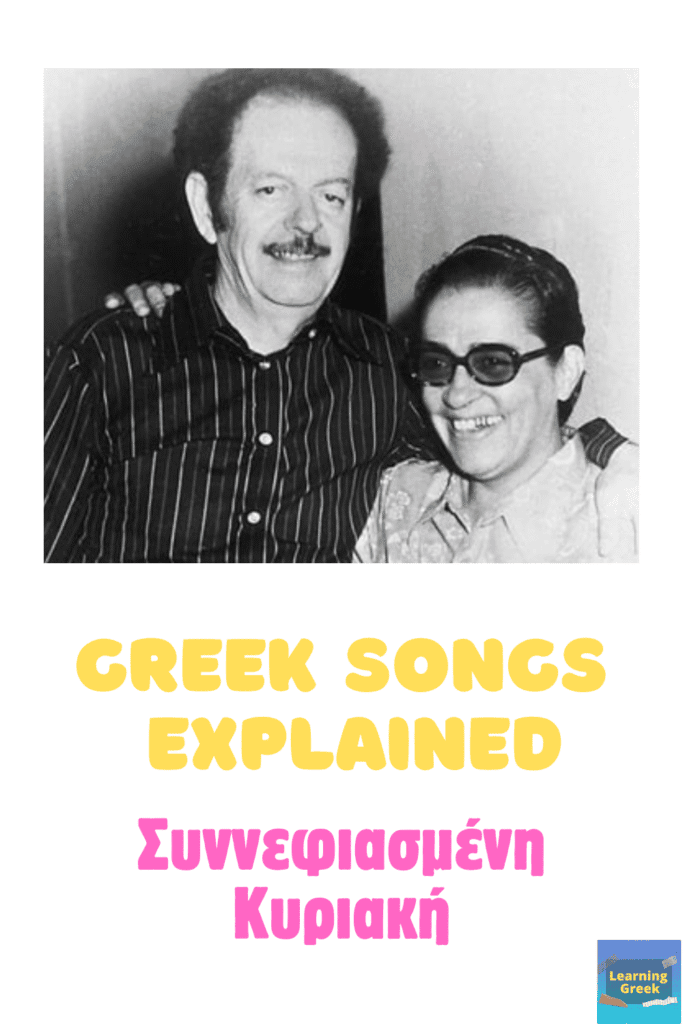
When we talk about rebetika, Σωτηρία Μπέλλου deserves special mention.
Her powerful and heartfelt voice made her one of the most iconic singers of the genre. Having lived through personal hardships and difficult times in Greece’s history, Bellou brought a unique emotional honesty to every song she sang.
Her unforgettable voice helped give Συννεφιασμένη Κυριακή the depth and emotion that have made it beloved by generations of Greeks.

A Gloomy Sunday, a Broken Heart, and a Nation’s Pain
Συννεφιασμένη Κυριακή, composed by Βασίλης Τσιτσάνης and first recorded in 1948 by Πρόδρομος Τσαουσάκης and Σωτηρία Μπέλλου, is one of the most beloved rebetika songs. Over the years, it has been interpreted by iconic Greek singers such as Στέλιος Καζαντζίδης, Μαρινέλλα, Γιώτα Λύδια, and Γιώργος Νταλάρας, among many others.
The song was written by Tsitsanis during the German Occupation of Greece, a period of immense suffering, hunger, and fear. The “cloudy Sunday” has often been understood as a reflection of the dark atmosphere of those years and the collective pain experienced by Greek people.
However, the song’s lasting popularity is not only connected to its historical background. For many Greeks, Συννεφιασμένη Κυριακή is loved because of its deep emotional power. Its simple but heartbreaking lyrics, haunting melody, and feeling of longing speak directly to the heart.
Even listeners who may not know the story behind its creation often connect with the sadness, nostalgia, and beauty expressed in the song.
This combination of personal emotion and historical memory is what has made Συννεφιασμένη Κυριακή a timeless piece of Greek music.
Take a moment to listen to the song below, following along as we explore its touching lyrics and meaning!
Συννεφιασμένη Κυριακή
Exploring the Lyrics
Below, you’ll find the full lyrics of Συννεφιασμένη Κυριακή with their English translations:
| Greek Lyrics | English Translation |
|---|---|
| Συννεφιασμένη Κυριακή | Cloudy Sunday |
| Μοιάζεις με την καρδιά μου | You look like my heart |
| Που έχει πάντα συννεφιά, συννεφιά | That is always cloudy, cloudy |
| Χριστέ και Παναγιά μου | Christ and Holy Mother |
| Που έχει πάντα συννεφιά, συννεφιά | That is always cloudy, cloudy |
| Χριστέ και Παναγιά μου | Christ and Holy Mother |
| Είσαι μια μέρα σαν κι αυτή | You are a day like this one |
| Που ‘χασα την χαρά μου | When I lost my joy |
| Συννεφιασμένη Κυριακή, Κυριακή | Cloudy Sunday, Sunday |
| Ματώνεις την καρδιά μου | You wound my heart |
| Συννεφιασμένη Κυριακή, Κυριακή | Cloudy Sunday, Sunday |
| Ματώνεις την καρδιά μου | You wound my heart |
| Όταν σε βλέπω βροχερή | When I see you rainy |
| Στιγμή δεν ησυχάζω | I find no peace for a moment |
| Μαύρη μου κάνεις τη ζωή, τη ζωή | You darken my life, my life |
| Και βαριαναστενάζω | And I sigh heavily |
| Μαύρη μου κάνεις τη ζωή, τη ζωή | You darken my life, my life |
| Και βαριαναστενάζω | And I sigh heavily |
Συννεφιασμένη Κυριακή
Verse-by-Verse Analysis
Verse 1: A Clouded Heart
Συννεφιασμένη Κυριακή
(Sinnefiasméni Kiriakí)
Cloudy Sunday
Μοιάζεις με την καρδιά μου
(Miazis me tin kardiá mu)
You look like my heart
Που έχει πάντα συννεφιά, συννεφιά
(Pu échi pánta sinnefiá, sinnefiá)
That is always cloudy, cloudy
Χριστέ και Παναγιά μου
(Christe ke Panayiá mu)
Christ and Holy Mother
The song begins by comparing a gloomy Sunday with the singer’s own heart, which is filled with sadness.
The repeated phrase “Χριστέ και Παναγιά μου” sounds like a heartfelt cry for comfort, showing the singer’s deep pain and search for hope.
Chorus: Lost Joy and a Wounded Heart
Είσαι μια μέρα σαν κι αυτή
(Íse mia méra san ki aftí)
You are a day like this one
Που ‘χασα την χαρά μου
(Pu ‘chasa tin chará mu)
When I lost my joy
The Sunday stands as a painful reminder of a specific loss.
The sadness feels like an open wound that has not healed, as shown in the line “Ματώνεις την καρδιά μου”. The image of a bleeding heart expresses deep emotional pain and sorrow.
Verse 2: Rainy Days and Heavy Sighs
Όταν σε βλέπω βροχερή
(Ótan se vlépo vrocherí)
When I see you rainy
Στιγμή δεν ησυχάζω
(Stigmí den isicházo)
I find no peace for a moment
Μαύρη μου κάνεις τη ζωή
(Mávri mou kánis ti zoí)
You darken my life
Και βαριαναστενάζω
(Ke varianastenázo)
And I sigh heavily
Here, the rain becomes a symbol of lasting sadness. Even the sight of a rainy day deepens the singer’s pain and makes him feel unable to find peace.
The life that was once full of happiness has turned “μαύρη”, and the singer is overwhelmed by “βαριαναστενάζω”, a word that expresses a sadness so intense that it feels physical.
Final Chorus: Life Filled by Sadness
The repetition of the chorus brings the song back to its central feeling: a heart wounded by loss and a life overshadowed by sorrow.
Through the repeated images of clouds, darkness, and sighs, the song captures a sadness that feels deeply personal while also reflecting the wider human experience of pain and longing.
Cultural Insights and Key Vocabulary
To fully appreciate Συννεφιασμένη Κυριακή, it helps to understand some of the Greek words and images that carry deep emotional meaning. Greek songs, especially ρεμπέτικα (rebetika), often use simple words to express powerful feelings such as sorrow, longing, and pain.
Let’s explore some key vocabulary from the world of this unforgettable song.
Η συννεφιά (I sinnefiá) – The cloudiness
Cloudy skies are often used in Greek poetry and music as a symbol of sadness, uncertainty, and difficult times. In Συννεφιασμένη Κυριακή, the cloudy Sunday reflects the sadness inside the singer’s heart.
Η Κυριακή (I Kiriakí) – Sunday
Sunday is traditionally connected with rest, family, and spiritual reflection in Greek culture. In this song, however, the cloudy Sunday becomes a symbol of sorrow and a painful memory.
Η πληγή (I pliyí) – The wound
A wound can describe both physical and emotional pain. In Greek songs, it often represents heartbreak, loss, and memories that continue to hurt.
Ο στεναγμός (O stenagmós) – The sigh
A sigh can express feelings that are difficult to put into words, such as sadness, longing, or disappointment.
Ο αναστεναγμός (O anastenagmós) – The deep sigh
Stronger than a simple sigh, αναστεναγμός expresses deep emotional pain. It is a word often found in rebetika because it captures silent suffering and longing.
Το δάκρυ (To dákri) – The tear
Tears in Greek music symbolize honesty and catharsis. Crying is seen not only as a private sorrow but as a sacred release of emotion.
Ο καημός (O kaimós) – The deep sorrow
Καημός is one of the most important words in Greek music. It describes a deep, lasting sadness, often mixed with longing and nostalgia. It is at the heart of the rebetiko feeling.
Η καρδιά (I kardiá) – The heart
In Greek culture, the heart is the place where emotions live. In songs like Συννεφιασμένη Κυριακή, the heart carries love, pain, memories, and sorrow.
Ο πόνος (O pónos) – The pain
Pain is a central theme in many rebetika songs. It is not hidden but expressed openly through music and lyrics.
Η ζωή (I zoí) – Life
Life is a recurring theme in Greek songs, often showing both the hardships and beautiful moments people experience.
Η ψυχή (I psichí) – The soul
The soul represents a person’s deepest feelings and inner world. Rebetika is often described as music that speaks directly to the soul.
Το μεράκι (To meráki) – Passion and love for what you do
Μεράκι is a special Greek word that describes doing something with care, passion, and soul. In rebetika, it represents the emotion and dedication behind the music.
Το ρεμπέτικο τραγούδι (To rebétiko tragúdi) – The rebetiko song
Rebetiko is often called the “Greek blues” because it expresses deep emotions and real-life experiences. Through stories of love, loss, hardship, and longing, rebetiko songs have become an important part of Greek cultural identity.
Conclusion: The Timeless Legacy of Συννεφιασμένη Κυριακή
Συννεφιασμένη Κυριακή remains one of the most beloved and emotional songs in Greek music. Through Βασίλης Τσιτσάνης’ unforgettable composition and Σωτηρία Μπέλλου’s powerful voice, the song continues to move listeners more than seven decades after it was first recorded.
Although the song carries the memory of a difficult period in Greek history, its lasting appeal comes from the emotions everyone can understand: sadness, longing, loss, and the search for comfort during hard times.
The beauty of Συννεφιασμένη Κυριακή lies in its simplicity. A few powerful words and a haunting melody are enough to express feelings that continue to touch generations of Greeks.
Rebetika songs like this are more than music. They are stories of people, memories, and emotions passed from one generation to the next.
If you enjoyed discovering the story behind Συννεφιασμένη Κυριακή, you can explore more Greek songs, artists, and musical traditions in my Greek Music category. Discover the stories, meanings, and cultural background behind some of Greece’s most beloved songs.
Have you ever listened to rebetika before? What is your favorite Greek song? Or is there another song you would like me to explore and explain next? I’d love to hear your thoughts and discover more Greek musical treasures together!



Hi Maria, Very nice job. However, you missed out on the most important thing about this song, and that is context. The song was written during the Nazi Occupation and could not be recorded until the Civil War that followed was almost over. The song is about the occupation. The cloudy Sunday that Tsitsanis refers to is indeed the occupation itself. His “Kane Ligaki Ipomoni” (also from the same period) is also about the occupation with a hope that it will be over soon. Cloudy Sunday does not have that hope component, just the pain…
Thank you so much for pointing this out!
I focused mainly on the emotional meaning of the lyrics, but knowing the background changes how we understand the “cloudy Sunday” as a reflection of the dark years Greece was experiencing at the time.
I appreciate you adding this important perspective. I’ll update the article to include this context because it deserves to be part of the story of such an important song.