Hello my beautiful friends! Today’s lesson will be short, sweet and easy, because Greek possessive pronouns are actually something you already know from our previous lesson on personal pronouns.
The only thing you need to know about Greek Possessive Pronouns is that they are the weak forms of personal pronouns in the genitive case. You see? You already know them.
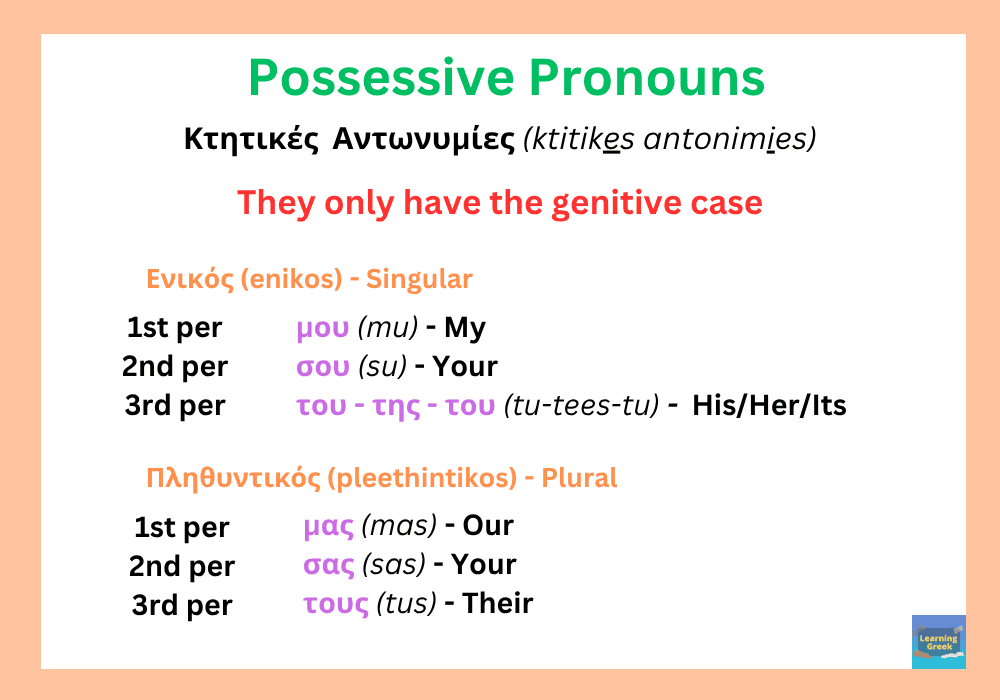
Just a quick reminder of what they are: μου, σου, του, της, του, μας, σας, τους.
And a picture to help you remember it more easily.
When Do We Use Greek Possessive Pronouns?
We use Greek possessive pronouns to show who or what something belongs to. In English, we use words like my, your, his, her, our, and their. In Greek, we use forms such as μου, σου, του, της, μας, σας, and τους.
The important thing to remember is that these forms usually come after the noun they refer to.
Now that you know what they do, let’s look at some examples and see how they work in real Greek sentences.
Greek Possessive Pronouns: Examples
Η τσάντα μου είναι ροζ (ee tsanta mu eene roz) – My bag is pink
Ο πατέρας σου είναι πολύ καλός άνθρωπος. (o pateras su eene polee kalos anthropos) – Your father is a very good person.
Ο σκύλος του τρέχει στον κήπο. (o skeelos tu trehee ston kipo) – His dog is running in the garden.
Αυτό είναι το βιβλίο της (afto eene to vivlio tees) – This is her book
Το ποδήλατό του έχει καινούρια λάστιχα. (to podilato tu ehee kenuryia lastiha) – Its bicycle has new tires.
Οι διακοπές μας φέτος ήταν υπέροχες. (ee diakopes mas fetos eetan eeperohes) – Our vacation this year was the wonderful.
Τα παιδιά σας είναι πολύ ευγενικά. (ta pedia sas eene polee evgenika) – Your children are very polite.
Τα πράγματά τους είναι πάνω στο τραπέζι. (ta pragmata tus eene pano sto trapezi) – Their things are on the table.
Each example demonstrates how the possessive pronoun is used in context to show ownership or association.
The Possessive Pronoun δικός μου
Additionally, especially when we want to emphasize, we use the pronoun δικός/ή- ιά/ό (dikos, –i/ia, -o) – own + genitive of the weak form of the personal pronoun.
Αυτή η τσάντα είναι δικιά μου! (aftee ee tsanta eene dikia mu) – This is my own bag!
Μένουν στο δικό τους σπίτι (menun sto diko tus spiti) – They live in their own house.
The possessive pronoun δικός μου, δική μου, δικό μου has three persons, two numbers, and is declined like a second-declension adjective (e.g., καλός-ή-ό).
How to Tell Personal and Possessive Pronouns Apart
1. To avoid confusing the weak forms of possessive pronouns with the weak forms of personal pronouns, we just need to remember that personal pronouns are found before or after verbs, while possessive pronouns are placed after nouns.
For example:
Του είπα την αλήθεια. (tu eepa tin aleethia) – I told him the truth. – personal pronoun
Δώσε μου τη γόμα. (dose mu ti goma) – Give me the eraser. – personal pronoun
Έσπασα το ρολόι του. (espasa to roloi tu) – I broke his watch. – possessive pronoun
Έχασα τη γόμα μου. (ehasa ti goma mu) – I lost my eraser. – possessive pronoun
2. Another way to understand whether a pronoun in its weak form is personal or possessive, is to replace it with the corresponding strong form.
For example:
Το σπίτι μου είναι μεγάλο. (to spiti mu eene megalo) – My house is big – possessive pronoun
Με πήρε τηλέφωνο. (me pire tilefono) – He/she called me (Πήρε εμένα τηλέφωνο) – personal pronoun
Where Does the Possessive Pronoun Go?
When we have phrases with an adjective and a noun such as, η περσινή γιορτή (ee persinee yiorti) – the last year’s celebration, the weak form of the possessive pronoun is usually placed between them: η περσινή μας γιορτή.
Conclusion
And that’s it! See?
Greek possessive pronouns are not as complicated as they may seem. Once you remember that they usually come after the noun and learn to recognize the difference between possessive and personal pronouns, you’ll start spotting them everywhere.
Now it’s your turn to practice! Try making a few sentences with μου, σου, του, της, μας, σας, and τους. The more you use them, the more natural they’ll become.
And if you’d like to continue exploring Greek pronouns, you can also read my guides to Greek personal pronouns and Greek demonstrative pronouns and the Greek cases.
Happy learning! ❤️