Hello my dear Greek-learning enthusiasts!
Today we’re looking at another pair of words that sound exactly the same but do completely different things in a sentence. I’m talking about: πιο vs ποιο.
Even many native Greeks sometimes pause before writing them.
The good news?
The difference is actually very small, so once you see it clearly, it sticks.
Let’s break it down together.
Πιο vs Ποιο: What They Really Mean
Here’s the difference in one sentence:
πιο (pio) means more.
ποιο (pio) means which?
That’s it.
One is about comparison, so we use it when something is “more” than something else.
The other is about asking, so we use it when we want to identify or choose something.
Because of that, they never play the same role in a sentence.
But let’s understand what these words actually are.
Πιο (Pio): What It Is and How It Works
The word πιο (pio) is an adverb.
That just means it does not change form, and it usually sits next to adjectives or other adverbs.
We use it because we want to compare things. It always adds the idea of “more”.
For example:
Αυτό είναι πιο εύκολο.
Aftó íne pio éfkolo.
This is easier.
Η Μαρία είναι πιο ψηλή από μένα.
I María íne pio psilí apó ména.
Maria is taller than me.
Θέλω κάτι πιο απλό.
Thélo káti pio apló.
I want something simpler.
Σήμερα κάνει πιο κρύο.
Símera káni pio krío.
It’s colder today.
In all these cases, πιο appears because we are comparing something. That’s why it always works with adjectives like εύκολο, ψηλή, απλό, κρύο.
So whenever you feel a comparison happening, you are in “πιο territory”.
Ποιο (Pio): What It Is and How It Works
Now let’s look at ποιο (pio).
This word comes from the question word family ποιος / ποια / ποιο.
It is the neuter form, but in real life we mainly use it in questions like “which?”.
So when you ask someone to choose or identify something, you use it.
For example:
Ποιο βιβλίο διαβάζεις;
Pio vivlío dhiavázis?
Which book are you reading?
Ποιο είναι το όνομά σου;
Pio íne to ónomá sou?
What is your name?
Ποιο χρώμα σου αρέσει περισσότερο;
Pio hroma sou arési perissótero?
Which color do you like most?
Ποιο θέλεις;
Pio thélis?
Which one do you want?
Here, ποιο appears because the sentence is asking for identification or choice. There is no comparison. Only selection.
That’s the key difference.
Ποιο in Indirect Questions (Extra but Important)
Sometimes ποιο is not in a direct question.
Instead, it appears inside another sentence.
We call this an indirect question.
And the rule stays the same.
We still use ποιο because we are not comparing anything. We are just asking or reporting a question inside a sentence.
For example:
Δεν ξέρω ποιο βιβλίο θέλεις.
Den xéro pio vivlío thélis.
I don’t know which book you want.
Μου είπε ποιο χρώμα του αρέσει.
Mou ípe pio hroma tou arési.
He told me which color he likes.
Θέλω να μάθω ποιο είναι το σωστό.
Thélo na mátho pio íne to sostó.
I want to know which one is correct.
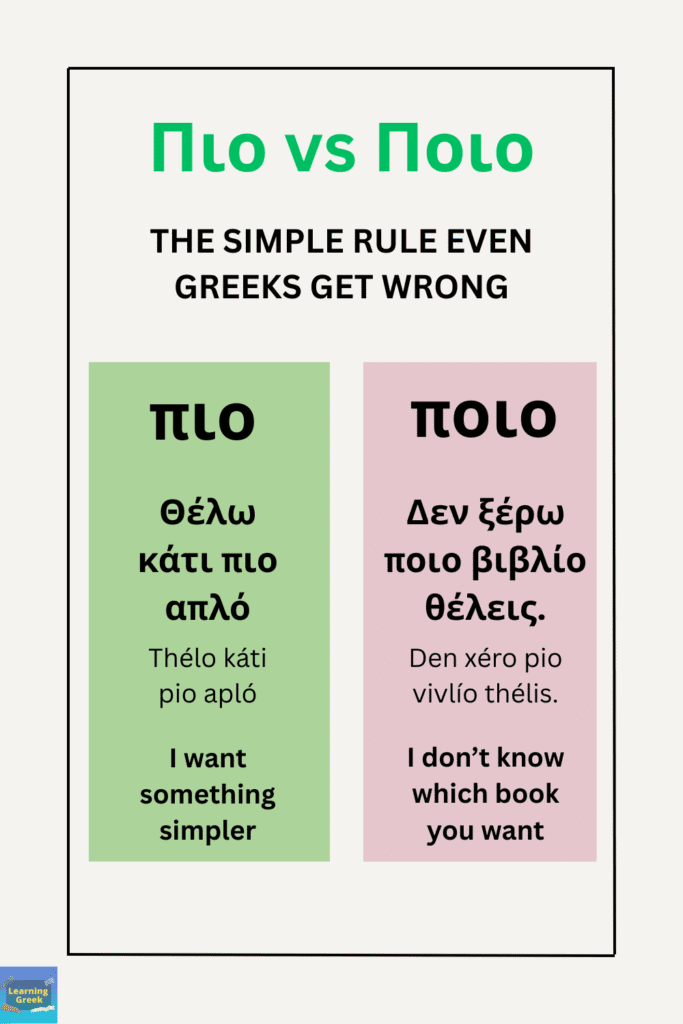
Πιο vs Ποιο: The Simple Rule
If you ever feel confused, just stop and ask this:
Am I comparing?
If yes, then use πιο because something is “more”.
Am I asking “which?” or trying to choose something?
If yes, then use ποιο.
Because of that, the whole system becomes very predictable.
One is for comparison.
The other is for questions.
That’s it.
Πιο vs Ποιο: Common Mix-Ups Cleared Up
Let’s look at a few examples that might confuse you.
Ποιο είναι πιο εύκολο;
Pio íne pio éfkolo?
Which one is easier?
Here’s what is happening:
The first word ποιο is asking the question, so we are choosing something.
The second word πιο is comparing difficulty, so we are saying “more easy”.
So both words can appear in the same sentence, but they still do completely different jobs.
Another example:
Ποιο σπίτι είναι πιο κοντά;
Pio spíti íne pio konτά?
Which house is closer?
Again, the first part is a question. The second part is a comparison.
That’s why both words are needed.
Mini Quiz – Πιο vs Ποιο
Let’s check if this clicks. Pick the correct form each time. You can find the answers at the end of the article.
1. _ βιβλίο διάβασες;
a) πιο
b) ποιο
2. Αυτό είναι _ ακριβό.
a) πιο
b) ποιο
3. _ σου αρέσει περισσότερο;
a) πιο
b) ποιο
4. Θέλω κάτι _ μικρό.
a) πιο
b) ποιο
5. _ αυτοκίνητο είναι το δικό σου;
a) πιο
b) ποιο
Wrap-up
Here’s what you really need to remember:
πιο (pio) = more, comparison
ποιο (pio) = which, question
So one builds comparisons.
The other helps you choose or identify something.
Because of that, they never replace each other, even if they sound identical when spoken.
And once you get used to this pattern, you stop guessing and start seeing it naturally in Greek sentences.
Take care 🙂
And if you want more Greek tips and tricks, I’ve got you!
Ό,τι vs ότι: The Simple Rule Greeks Still Mix Up
Greek Grammar Tips: The Rules for Using the Final ν
The “i” Sound in Greek: When to Use ι, η, υ, ει, οι, υι?
Answers
1: b) ποιο
2: a) πιο
3: b) ποιο
4: a) πιο
5: b) ποιο