Hello from Greece!
If you want to learn how to speak like a local, you quickly realize that standard Greek textbooks only tell half the story. While they are great for mastering perfect grammar and formal greetings, real everyday Greek is all about passion, loud voices, and a little bit of… drama.
To begin with, if you want to truly connect with the culture, you just need to know the unwritten rules of how Greeks actually talk. Greeks don’t just speak a language. In fact, they perform it with their entire bodies, facial expressions, and voices.
Let’s look at what Greeks actually say in everyday life. If you want to move past the dictionary and discover how to speak like a local, here are five phrases and gestures you need to know.
1. How to Speak Like a Local When Turning Off the Lights
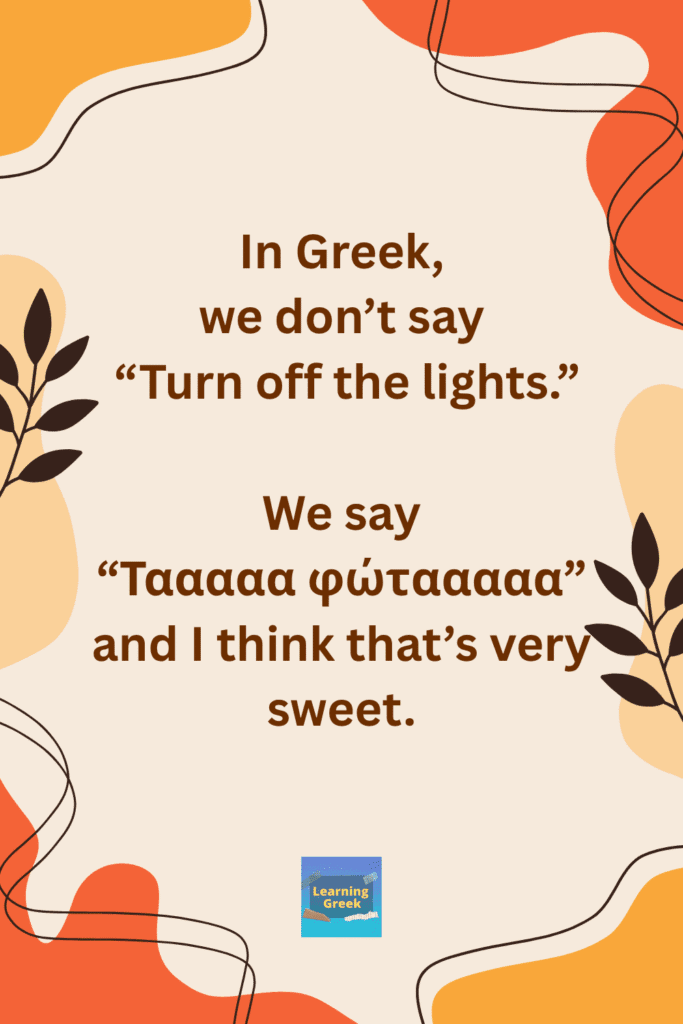
In English, if someone leaves a room and forgets to switch off the lamp, you might politely ask, “Could you turn off the lights?”
First, if you look up the literal translation in Greek, you get Κλείσε τα φώτα (klíse ta fóta), which means close the lights. However, if you are living in a Greek household, it rarely sounds that calm.
The Real Cultural Vibe
Leaving a light on in an empty room is treated like a minor household emergency in Greece. For this reason, instead of a polite request, you will usually hear someone yelling from three rooms away, practically crying over the electric bill.
Language & Pronunciation Breakdown:
- The Phrase: ΤΑΑΑΑ ΦΩΤΑΑΑΑΑ!!!
- Phonetic Pronunciation: (taaaa fótaaaaa!)
- What it literally means: THE LIGHTS!!!
- Grammatical note: Τα φώτα is the plural form of το φως (to fos), which means the light.
- Fun fact: This is where the English word photography, literally “drawing with light”, comes from!
2. Speak Like a Local with the Art of Saying “No” Without Words
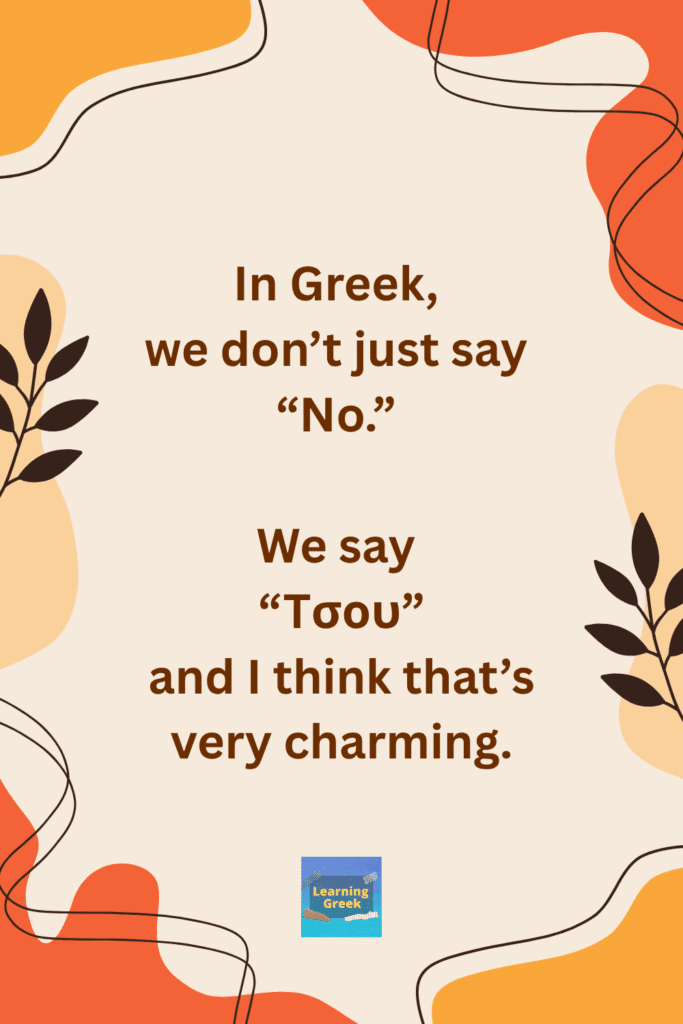
If you ask a beginner Greek student how to say no, they will proudly tell you it’s Όχι (óhi). While that is completely correct, a local might not even bother to use the word.
The Real Cultural Vibe
Greeks have a quick way of saying “no” without words that often confuses tourists. It looks like a slight reflex, but it is just a standard gesture used by everyone.
How to Do It:
To master this gesture, you don’t use your vocal cords at all. Instead, you simply tilt your head backward slightly, raise your eyebrows, and make a sharp clicking sound with your tongue against the roof of your mouth: Τσου (tsu).
Sometimes, Greeks will actually say the word out loud while doing it.
This head-tossing gesture is a traditional way to signal a refusal. Keep in mind that it is considered quite casual, so it isn’t very polite to use it in a professional setting.
3. Speak Like a Local and Understand Motherly Love

In English, parents might say, “Make sure you dress warmly!” or “Take a coat, it’s chilly.” But, if you want to learn how to speak like a local, you will learn that Greek motherly love comes down to three specific words.
The Real Cultural Vibe
The Ζακέτα να πάρεις is the ultimate Greek cultural meme. It represents the overprotective Greek mother. It does not matter if it is mid-July or a breezy autumn evening.
If you are leaving the house, a Greek mother will yell this phrase at you. As a result,to leave without a jacket is, in her eyes, an immediate invitation to catch pneumonia.
Language & Pronunciation Breakdown:
- The Phrase: Ζακέτα να πάρεις!!!
- Phonetic Pronunciation: zakéta na páris!
- What it literally means: A jacket, you must take!
- Grammatical note: Ζακέτα (zakéta) means jacket or cardigan. Also, πάρεις is a form of the verb παίρνω (perno), which means to take. The word να (na) sets up a subjunctive command, making it a loving but firm order.
4. How to Speak Like a Local When You Are Running Late

If you are running late for an appointment in English, you might say, “Hurry up!”, “Let’s go!”, or “We need to rush.” In Greek instead, you can replace all of those sentences with one single, incredibly versatile word.
The Real Cultural Vibe
Greeks love efficiency when they are frustrated, and the word Άντε is the swiss-army knife of the Greek language. While it can mean come on, when dragged out with a long “e” sound (ándeeeee!), it becomes an urgent, impatient, yet strangely affectionate way to tell someone to get moving.
Therefore, you’ll hear it constantly in traffic, in the supermarket, and whenever a group is trying to leave the house.
Language & Pronunciation Breakdown:
- The Word: Άντε!
- Phonetic Pronunciation: ándeeeee!
- What it means: Come on! / Let’s go!
- Grammatical note: Depending on your tone of voice, Άντε can mean Hurry up!, Yeah, right! (if said dismissively), or even Goodbye! when paired with άντε γεια (ánde ya).
5. Speak Like a Local to Deliver the Ultimate “I Told You So”
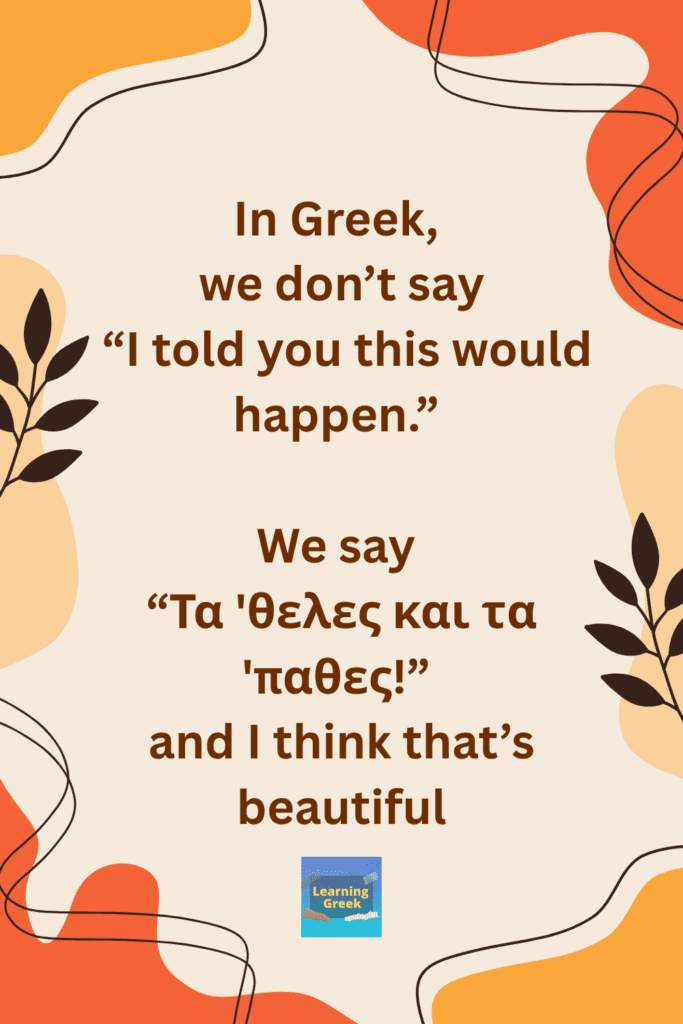
In English, when someone ignores your advice and things go exactly as badly as you predicted, you might say, “I told you so,” or “You brought this on yourself.”
However, in Greece, sympathy is replaced by a rhyming phrase about getting what you deserve.
The Real Cultural Vibe
Greeks hate to be proven wrong, and they will immediately point out when you caused your own problems. Because of this, the phrase Τα ‘θελες και τα ‘παθες is the ultimate way to say “I told you so”.
For instance, it can be used for a friend who drank too much and has a hangover, to someone who bought cheap shoes and complains about blisters. It is a tough-love reality check.
Language & Pronunciation Breakdown:
- The Phrase: Τα ‘θελες και τα ‘παθες!
- Phonetic Pronunciation: ta théles ke ta páthes!
- What it literally means: You wanted them, and you suffered them!
- Grammatical note: This is a brilliant shortcut phrase using two past-tense verbs. Ήθελες (itheles) comes from θέλω (to want), and έπαθες (epathes) comes from παθαίνω (to suffer/experience). When spoken quickly, the “η” and “ε” drop off, turning into the perfectly rhyming τα ‘θελες και τα ‘παθες
Wrapping It Up: Why textbook Greek isn’t enough
Learning a language is about so much more than memorizing vocabulary lists. Instead, it’s about understanding the humor, the habits, and the passion of the people who speak it.
So, the next time you are practicing your Greek, try shouting «ΤΑ ΦΩΤΑ!» or giving someone a classic backward head-click. You’ll instantly sound less like a textbook, and you will finally begin to speak like a local.
If you want to learn even more everyday street talk after this, make sure to check out make sure to check out my article on Greek slang phrases.
Ζακέτα να βάλετε!