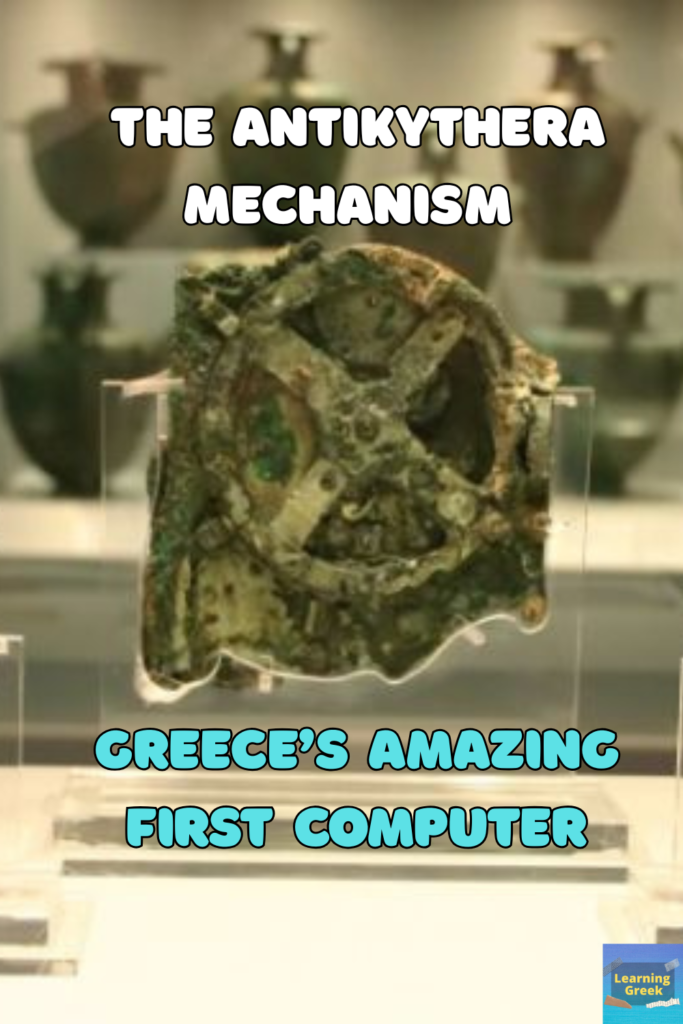

Hello everyone! Did you know that more than 2,000 years ago, the ancient Greeks created a machine that could predict solar and lunar eclipses, track the movements of the Sun and Moon, and calculate astronomical cycles?This extraordinary invention is called the Antikythera Mechanism, and it is widely known as the world’s oldest surviving analogue computer.
Its discovery amazed historians and scientists because it revealed just how advanced ancient Greek mathematics, astronomy and engineering had become.
But what exactly was this mysterious machine? How did it work, and who created it?
Let’s find out!
The Discovery: A Treasure Beneath the Sea
The story of the Antikythera Mechanism begins in 1900, near the small Greek island of Antikythera, located between Crete and the Peloponnese.
A group of sponge divers from the island of Symi explored the seabed when one of them discovered an ancient shipwreck at a depth of approximately 50 metres.
The wreck contained an astonishing collection of treasures, including bronze and marble statues, pottery, coins, glassware and other valuable objects.
Among these treasures lay something that initially looked like nothing more than a corroded lump of bronze.
The divers recovered the objects during underwater salvage operations in 1900–1901 and brought them to Athens.
In 1902, archaeologist Spyridon Stais examined some of the bronze fragments and noticed something unusual: tiny gear wheels with teeth.
He had discovered part of an extraordinary mechanical device.
At first, nobody fully understood its purpose or how it worked. It would take decades of research before scientists began to uncover its secrets.
What Exactly Was the Antikythera Mechanism?
The Antikythera Mechanism was a sophisticated mechanical calculator built around the second century BC.
It consisted of a complex system of interlocking bronze gears, dials, pointers and inscriptions, all housed inside a wooden case.
Today, researchers study 82 surviving fragments of the original device, including approximately 30 gear wheels with teeth.
Although centuries underwater destroyed much of the original machine, modern imaging techniques have helped scientists reconstruct many of its functions.
The user operated the mechanism by turning a hand crank. This movement activated the interconnected gears, which moved pointers across different dials and displayed astronomical information.
In simple terms, the device worked like a mechanical model of the heavens.
And its capabilities were remarkable!
What Could This Ancient Greek Computer Do?
The Antikythera Mechanism could calculate and display an impressive amount of astronomical information.
Its known functions include:
Predicting solar and lunar eclipses
The mechanism used recurring astronomical cycles to calculate when solar and lunar eclipses would occur.
Tracking the movements of the Sun and Moon
Its dials displayed their positions and movements through the sky.
Showing the phases of the Moon
A special display represented the changing appearance of the Moon, from new moon to full moon and back again.
Calculating astronomical calendars
The mechanism combined lunar and solar cycles to help users track time and understand astronomical patterns.
Tracking the cycles of the ancient Olympic Games
One of its dials followed a four-year cycle associated with the Panhellenic Games, including the Olympic Games.
Researchers have also discovered inscriptions that refer to the five planets known in antiquity: Mercury, Venus, Mars, Jupiter and Saturn.
These inscriptions suggest that the mechanism may also have displayed planetary positions, although scientists continue to investigate exactly how this part worked.
Think about that for a moment. More than 2,000 years ago, ancient Greek engineers had developed a mechanical device that could calculate and represent the movements of celestial bodies!
How Did the Antikythera Mechanism Work?
The secret of the Antikythera Mechanism lay in its extraordinary system of gears.
Each gear represented a particular astronomical cycle. When someone turned the hand crank, the movement passed through the interconnected gears and caused different pointers to move across the instrument’s dials.
The device used mathematical relationships between astronomical cycles to calculate future events.
Two particularly important cycles helped it predict eclipses and track the movements of the Moon.
The Saros Cycle
The Saros cycle lasts approximately 18 years and 11 days. After this period, eclipses tend to repeat in a similar pattern.
The mechanism used this cycle to predict solar and lunar eclipses.
The Metonic Cycle
The Metonic cycle describes the relationship between 19 solar years and 235 lunar months.
This relationship helped ancient astronomers combine lunar and solar calendars and understand how their cycles matched.
The Antikythera Mechanism transformed these complicated mathematical calculations into a visual, mechanical display.
Instead of performing all the calculations by hand, its user could turn a crank and observe the results on the dials.
Who Built the Antikythera Mechanism?
This remains one of the greatest mysteries surrounding the device.
We still don’t know the name of the person who designed or constructed it.
However, its complexity tells us that its creator possessed exceptional knowledge of mathematics, astronomy and mechanical engineering.
Researchers have explored possible connections with some of the most important scientists of ancient Greece, including Hipparchus of Rhodes and Archimedes of Syracuse.
Hipparchus made major contributions to ancient Greek astronomy. Some researchers believe that the mechanism’s lunar calculations may reflect mathematical ideas associated with his work.
Archimedes, on the other hand, became famous for his mathematical discoveries and mechanical inventions. Ancient sources also describe astronomical devices associated with him.
However, no conclusive evidence connects either scientist directly to the construction of the Antikythera Mechanism.
Its creator and exact place of manufacture remain unknown.
Why Was Its Discovery So Important?
The Antikythera Mechanism transformed our understanding of ancient Greek science and technology.
Before its discovery, historians had very little physical evidence of mechanical devices with such sophisticated gear systems from antiquity.
This extraordinary machine demonstrated that ancient Greek engineers could combine mathematics, astronomy and mechanical engineering to create incredibly complex instruments.
In fact, no other surviving mechanism from antiquity approaches its level of complexity.
Its technology was so advanced that we find no known surviving mechanical device of comparable complexity in the archaeological record for roughly another thousand years.
The mechanism also revealed how closely ancient Greek thinkers connected astronomy, mathematics and engineering.
It wasn’t simply a tool for measuring time. It represented a mechanical model of how ancient astronomers understood the movements and cycles of the universe.
How Did Modern Scientists Unlock Its Secrets?
For many decades, scientists struggled to understand the Antikythera Mechanism. Corrosion had damaged its bronze components, while centuries underwater had compressed and broken many of its fragments.
In the 1950s and 1970s, British science historian Derek de Solla Price carried out important research that helped establish the mechanism’s significance as an ancient astronomical calculator.
Later, an international team of Greek and British researchers took the investigation further.
They used advanced X-ray imaging, computed tomography and three-dimensional surface imaging to examine the fragments in extraordinary detail.
These technologies allowed researchers to look inside the corroded bronze without damaging the remaining pieces.
They could identify hidden gears, examine the teeth, read previously invisible inscriptions and reconstruct parts of the mechanism’s internal structure.
In 2006, researchers published important findings in the scientific journal Nature. Their study revealed new details about the mechanism’s astronomical calculations, including its eclipse-prediction system.
Even today, scientists continue to investigate the device, and some aspects of its original design and operation remain uncertain.
Where Can You See the Antikythera Mechanism Today?
You can see the surviving fragments of the Antikythera Mechanism at the National Archaeological Museum in Athens, Greece.
Although the fragments are relatively small and heavily corroded, they represent one of the most important discoveries in the history of science and technology.
The museum also helps visitors understand the device through reconstructions and models that illustrate how the original mechanism might have looked and operated.
If you’re in Athens, why not see this remarkable invention with your own eyes? Explore the Antikythera Mechanism and discover many more treasures of ancient Greece with a skip-the-line ticket and a guided tour of the National Archaeological Museum. It’s a wonderful opportunity to bring ancient Greek history to life.
I’ve found the perfect tours for you! Just take a look at the options in the widget below and choose the experience that suits you best.
A Remarkable Example of Ancient Greek Ingenuity
The Antikythera Mechanism is much more than an ancient artefact. It offers extraordinary evidence of the scientific and technological achievements of the ancient Greek world.
More than 2,000 years ago, Greek thinkers observed the heavens, studied mathematical relationships and developed ingenious ways to turn their knowledge into practical machines.
A device that spent centuries hidden beneath the sea eventually became one of the greatest discoveries in the history of science.
And perhaps the most fascinating thing of all is that, even after more than a century of research, the Antikythera Mechanism still holds secrets that scientists are trying to uncover.
Ancient Greece gave the world many remarkable ideas and inventions. This extraordinary machine is certainly one of them!
Further Reading & Sources
If you’d like to learn more about the Antikythera Mechanism and the research behind its discovery, here are some useful resources:
Antikythera Mechanism Research Project – Research, discoveries and publications about the ancient device.
The National Archaeological Museum of Athens – Archaeological research and publications relating to the mechanism.
Decoding the Ancient Greek Astronomical Calculator – The original 2006 scientific paper published in Nature.