
Hello, my beautiful Greek learners!
Today we are going to explore the most common Greek abbreviations, because knowing these shortcuts will help you read everyday texts like a true local.
To be honest, I must say that Greeks absolutely love their shortcuts, so it really seems like too many is never enough for us. Especially nowadays with the rapid rise of the internet, we seem to create brand-new ones every single day.
But don’t fret!
Since we want to keep things practical, we are going to learn only the Greek abbreviations that we use the most, or the ones you are most likely to see in a text. Plus, I’m going to give you a fun hint on how young Greek people create new slang while texting.
But let’s start by exploring the meaning of the word itself.
What Does Abbreviation mean in Greek?
In Greek, abbreviation means συντομογραφία.
It is a feminine noun so it must be accompanied with the article “η” when it’s needed.
Η συντομογραφία (i sintomografía) – The abbreviation
Οι συντομογραφίες (oi sintomografíes) – The abbreviations
It is also a compound word.
The first part comes from the three-form adjective σύντομος / η / ο (síntomos / i / o), which means brief. The second part ends in -γραφία (-grafía), which comes from the active verb γράφω (gráfo) – I write.
Please note that all abbreviations are pronounced in their complete form.
But let’s move on to the most common Greek abbreviations and see some examples.
Most Common Greek Abbreviations
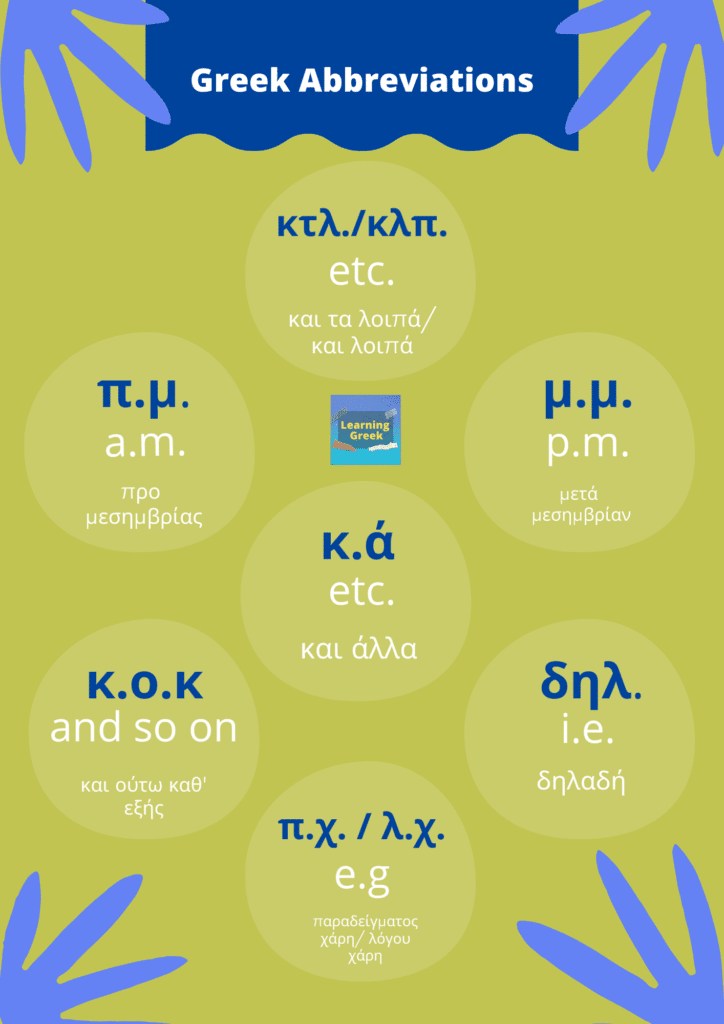
1. κτλ. / κλπ. = etc., et cetera
Full words: και τα λοιπά (ke ta lipá) / και λοιπά (ke lipá)
Έχω να κάνω πολλές δουλειές σήμερα. Να πάω τράπεζα, σούπερ μάρκετ κτλ.
Ého na káno pollés douleiés símera. Na páo trápeza, súper márket ktl.
I have a lot of work to do today. To go to the bank, supermarket, etc.
2. κ.ά = etc., et cetera
Full words: και άλλα (ke álla)
Στο σούπερ μάρκετ μπορείς να βρεις φρούτα, λαχανικά, κρέατα, κ.ά.
Sto súper márket boreís na vreis froúta, lahaniká, kréata, k.á.
In the supermarket, you can find fruits, vegetables, meats, etc.
3. π.χ. / λ.χ. = e.g., for example.
Full words: παραδείγματος χάρη (paradígmatos hári) / λόγου χάρη (lógou hári)
Στο κρέας μπορούμε να χρησιμοποιήσουμε πολλά μπαχαρικά π.χ. κανέλα.
Sto kρέas boroúme na hrisimopoiísoume pollá bahariká, p.h. kanéla.
We can use many spices in meat e.g cinnamon.
4. κ.ο.κ. = and so on (and so forth)
Full words: και ούτω καθεξής (ke oúto kathexís)
Για την αίτηση, πρέπει να συμπληρώσεις τα στοιχεία σου. Όνομα, επώνυμο κ.ο.κ
Yia tin etisi, prépi na simplirósis ta stihía sou. Ónoma, epónimo k.ο.k.
For the application, you must fill in your details. Name, surname and so on.
5. Δηλ. = i.e., id est, that is
Full word: δηλαδή (diladí)
Θα έρθω με τον ξάδελφό μου, δηλ. τον Γιάννη.
Tha értho me ton xádelfó mou, dil. ton Yiánni.
I will come with my cousin, i.e. John.

6. Κος. / Κ. = Mr., Mister
Full word: ο κύριος (o kirios)
Ο κ. Αντωνιάδης απουσιάζει
O k. Antoniádis apousiázi.
Mr. Antoniadis is absent
7. Κα. = Mrs., Madam
Full word: η κυρία (i kiría)
Η κα. Κράλλη θα έρθει σε λίγο
I ka. Králli tha érthei se lígo.
Mrs. Krali will be here soon
8. Δίδα = Miss
Full words: η δεσποινίς (i despinís) / η δεσποινίδα (i despinída)
Είστε η δίδα Πετράκη;
Iste i dída Petráki;
Are you miss Petraki?
9. π.Χ. = B.C., before Christ
Full words: προ Χριστού (pro Christoú)
Η ναυμαχία της Σαλαμίνας έγινε το 480 π.Χ.
I navmahía tis Salamínas éyine to 480 p.Ch.
The naval battle of Salamis took place in 480 B.C.
10. μ.Χ. = A.D., Anno Domini, after Christ.
Full words: μετά Χριστόν (metá Christón)
Ο Πρώτος Παγκόσμιος Πόλεμος ξεκίνησε το 1914 μ.Χ.
O Prótos Pankósmios Pólemos xekínise to 1914 m.Ch.
The First World War began in 1914 A.D.
11. π.μ. = a.m., ante meridiem, before noon.
Full words: προ μεσημβρίας (pro mesimvrías)
Το πλοίο φεύγει στις 11.00 π.μ.
To plío févyi stis 11.00 p.m.
The ship leaves at 11:00 a.m.
12. μ.μ. = p.m., post meridiem, after midday, afternoon.
Full words: μετά μεσημβρίαν (metá mesimvrían)
Θα συναντηθούμε στις 8.00 μ.μ.
Tha sinantithoúme stis 8.00 m.m.
We will meet at 8.00 p.m.
If you want to learn more about the Time in Greek you can check this post: How to tell the time in Greek.
13. ΥΓ. = PS., post scriptum
Full word: το υστερόγραφο (to isterógrafo)
Ο φίλος μου τελείωσε το γράμμα του λέγοντας: “ΥΓ. Σε αγαπώ”
O fílos mou teleíose to grámma tou légontas: ”YG. Se agapó“.
My boyfriend ended his letter by saying: “PS. I love you”
14. σελ. = p., page
Full word: η σελίδα (i selída)
Στο τέλος του βιβλίου, από τη σελ. 134 και μετά, υπάρχουν βοηθητικές ασκήσεις.
Sto télos tou vivlíou, apó ti sel. 134 kai metá, ipárhoun vithitikés askísis.
At the end of the book, from p.134 onwards, there are auxiliary exercises.
Greek months have also a short form. If you want to learn the abbreviations of Greek months you can check this post: Months in Greek

Modern Greek Abbreviations and Youth Slang
With the messaging applications becoming more popular day after day, Greek youngsters have invented a new way of communication. So, if you receive a text in Greek looking like that for instance,
Τ κνς;
don’t panic and don’t feel that you have forgotten all your Greek! It’s not so hard to decipher it if you know the trick. What do a lot of youngsters do while they are texting? They just remove the vowels from most of the words! Why do they do that? Well, to decrease the time of texting…
So, let’s decrypt our phrase
Greek Abb: Τ κνς;
Proper Greek: Τι κάνεις; (Ti kanis;)
Translation: What are you doing? / How are you?
Easy right? Well, I don’t say good because allow me to have my reservations about this kind of writing.
Conclusion: Mastering Greek Abbreviations
Ultimately, learning these Greek abbreviations is a fantastic shortcut to making your reading feel much more natural. Because native speakers use them constantly in books, newspapers, and text messages, recognizing them will instantly boost your confidence.
So, don’t feel overwhelmed if you see a strange combination of letters next time you are reading! Instead, just bookmark this handy list and take it one step at a time.
We have successfully covered the basics today, but there are definitely many more out there. Therefore, if you are ever curious about a specific short form, don’t hesitate to leave a comment below and I will get right back to you!