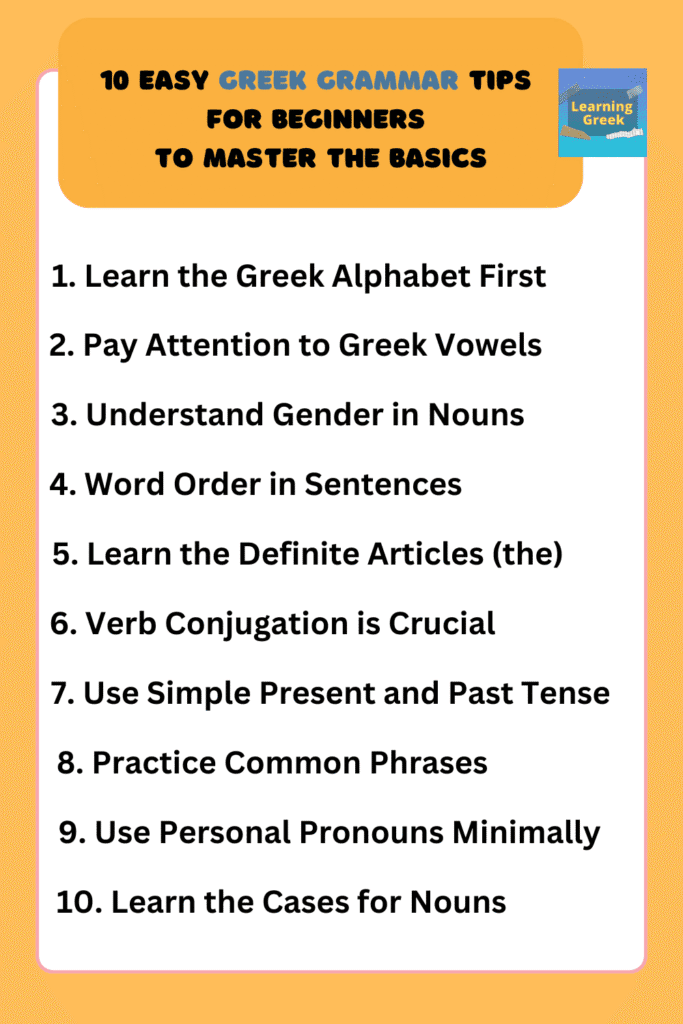

Many learners often ask me where to start when learning Greek, and I always recommend focusing on the basics.
If you’re new to the language, this guide provides essential steps to begin your journey.
It covers everything from mastering the Greek alphabet and common phrases to understanding simple grammar rules, like noun genders and verb conjugations.
By following these initial steps, you’ll build a strong foundation that will make progressing in Greek much easier.
1. Learn the Greek Alphabet First
- The Greek alphabet is unique but has many familiar letters. Mastering the alphabet is the first key to reading and writing.
- Quick Pronunciation Tips:
- “Β” is pronounced like an English “V.”
- “Δ” is pronounced like the soft “th” in “this.”
- “Χ” is pronounced like the “h” in “he.”
2. Pay Attention to Greek Vowels
- Greek has seven vowel sounds, but they may be written with different letters.
- Examples:
- “η,” “ι,” “υ,” “ει,” “οι” are all pronounced as “ee.”
- “ο” and “ω” are pronounced like “o” in “pot.”
- Focus on listening to the pronunciation of vowels to recognize them when written differently.
- Examples:
3. Understand Gender in Nouns
- Greek nouns have three genders: masculine, feminine, and neuter.
- Common endings to recognize gender:
- Masculine: Usually end in -ος, -ας, -ης (e.g., άνθρωπος (ánthropos) – person, human being).
- Feminine: Usually end in -α, -η (e.g., γυναίκα (yinéka) – woman).
- Neuter: Usually end in -ο, -ι, -μα (e.g., παιδί (pethEe) – child).
4. Word Order in Sentences
- Greek word order is flexible, but typically follows the Subject-Verb-Object pattern.
- Example:
- Εγώ τρώω ένα μήλο. (Egó tróo éna mílo) – I eat an apple
- However, you can rearrange words without changing the meaning too much due to verb conjugations.
- Example:
5. Learn the Definite Articles (the)
- Greek articles change depending on gender, case, and number (singular/plural).
- Masculine: ο (singular), οι (plural)
- Feminine: η (singular), οι (plural)
- Neuter: το (singular), τα (plural)
- Practice using these with nouns to build sentence structures.
6. Verb Conjugation is Crucial
- Verbs in Greek change depending on person and tense.
- Start by learning the present tense:
- Εγώ μιλάω (Egó miláo) – I speak
- Εσύ μιλάς (Esí milás) – You speak
- Αυτός/Αυτή/Αυτό μιλάει (Aftós/Aftí/Aftό milái) – He/She speaks
- Εμείς μιλάμε (Emís miláme) – We speak
- Εσείς μιλάτε (Esís miláte) – You (plural) speak
- Αυτοί/Αυτές/Αυτά μιλάνε (Aftí/Aftés/Aftά miláne) – They speak
- Many verbs are regular in their conjugation, but there are also irregular verbs you’ll encounter.
7. Use Simple Present and Past Tense
- Focus on mastering the Present Simple (what’s happening now) and the Past Simple (what happened).
- Example (Present): Τρώω μήλο (Tróo mílo) – I eat an apple.
- Example (Past): Έφαγα μήλο (Éfaga mílo) – I ate an apple.
8. Practice Common Phrases
- Learn basic phrases to practice sentence construction:
- Καλημέρα (kaliméra) – Good morning
- Ευχαριστώ (efharistó) – Thank you
- Πώς είσαι; (pós íse?) – How are you?
- Καλημέρα (kaliméra) – Good morning
- Ευχαριστώ (efharistó) – Thank you
- Πώς είσαι; (pós íse?) – How are you?
9. Use Personal Pronouns Minimally
- In Greek, pronouns like “I,” “you,” “he” are often implied in the verb, so they can be omitted.
- Example: Instead of saying Εγώ τρώω (Egó tróo) – I eat, you can simply say Τρώω (Tróo) – Eat.
10. Learn the Cases for Nouns
- Greek nouns and articles change depending on their role in the sentence:
- Nominative (subject of the sentence).
- Accusative (object of the verb).
- Focus on learning Nominative and Accusative cases first, as they are most common.
Start small and build on these basics gradually.
Greek may look challenging, but with consistent practice, you’ll pick up the patterns!
Happy Learning!

This is terrific. I lived in Greece for 20 years & learned the language pretty well. When I returned to Australia I went back to Uni & did a BA in Modern Greek, Modern English & Linguists. That was 25 years ago & I don’t get much opportunity to use my Greek. Your F/B page has been a wonderful help in maintaining (reminding/refreshing) my grasp on the language. Many thanks.
Thank you so much for this. After living in Greece for 20 years and studying Modern Greek, it really means a lot to hear that the page helps keep the language fresh. Greek may fade when we don’t use it, but it never really leaves. I’m glad the reminders are useful.
Να είστε καλά!