
Hello my fellow Greek learners!
Ever felt like Greek grammar is a giant puzzle? You aren’t alone! Learning how to start constructing phrases in Greek doesn’t have to be a headache.
While it has some quirks that are different from English, once you see the ‘logic’ behind the word order and endings, it all starts to click.
Let’s break it down into bite-sized pieces so you can start chatting today!
1. Basic Word Order for Constructing Phrases in Greek
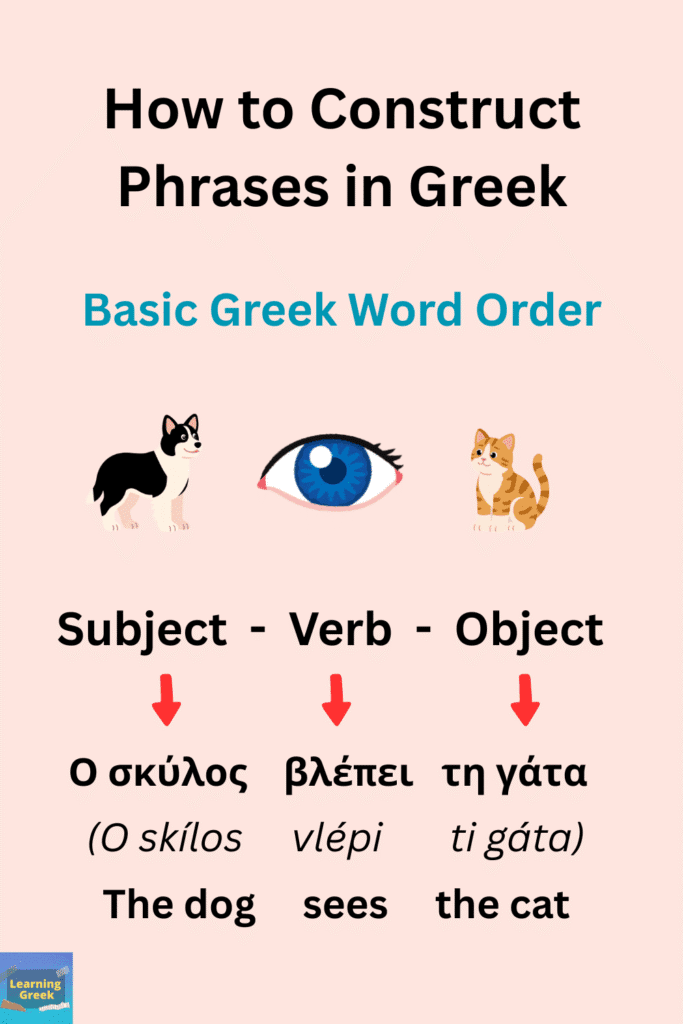
When you first begin constructing phrases in greek, you’ll notice it generally follows the Subject-Verb-Object (SVO) structure, similar to English. However, because Greek uses cases, the word order is actually quite flexible.
Example:
English: The dog sees the cat.
Greek: Ο σκύλος βλέπει τη γάτα. (O skílos vlépi ti gáta)
Here, the structure is:
Ο σκύλος = “the dog” (subject, nominative)
βλέπει = “sees” (verb)
τη γάτα = “the cat” (object, accusative)
You can even change the order for emphasis:
Greek (Word Order Changed): Τη γάτα βλέπει ο σκύλος. (Ti gáta vlépi o skílos).
2. Using Articles and Nouns Correctly
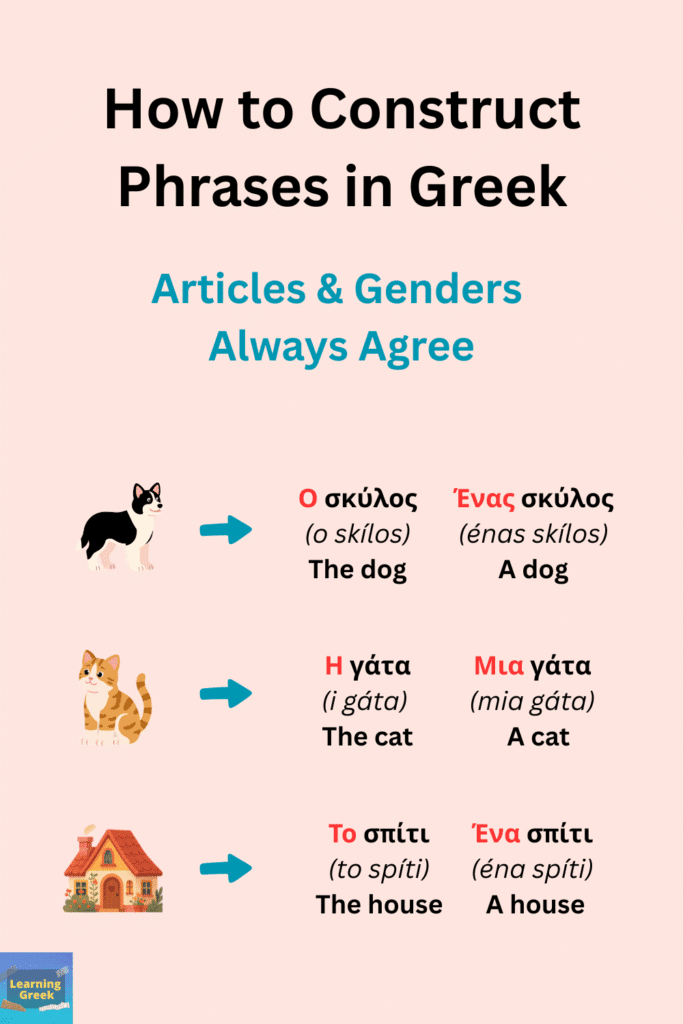
Greek uses definite and indefinite articles, which must match the gender (masculine, feminine, neuter), number (singular or plural), and case of the nouns they modify.
Masculine Example:
Definite: Ο σκύλος (o skílos) — The dog.
Indefinite: Ένας σκύλος (énas skílos) — A dog.
Feminine Example:
Definite: Η γάτα (i gáta) — The cat.
Indefinite: Μια γάτα (mia gáta) — A cat.
Neuter Example:
Definite: Το σπίτι (to spíti) — The house.
Indefinite: Ένα σπίτι (éna spíti) — A house.
If you want to go deeper into how these work, I have created a dedicated Greek articles guide for you to check out!
3. How Adjectives Work when Constructing Phrases in Greek
Adjectives in Greek are team players. They must agree with the nouns they describe in gender, number, and case. They typically appear before the noun but can also come after for emphasis.
Example:
English: The big dog sees the small cat.
Greek: Ο μεγάλος σκύλος βλέπει τη μικρή γάτα. (O megálos skílos vlépi ti mikrí gáta).
In this sentence:
Ο μεγάλος = “the big” (masculine, nominative)
τη μικρή = “the small” (feminine, accusative)
You can rearrange the sentence while keeping the meaning intact, thanks to the cases and adjective-noun agreement:
Greek (Word Order Changed):
Τη μικρή γάτα βλέπει ο μεγάλος σκύλος.
Other possible word orders include:
Verb-Subject-Object: Βλέπει ο μεγάλος σκύλος τη μικρή γάτα.
Object-Subject-Verb: Τη μικρή γάτα ο μεγάλος σκύλος βλέπει.
Adjective After Noun (for emphasis): Ο σκύλος ο μεγάλος βλέπει τη γάτα τη μικρή.
4. Verbs and Conjugation
Verbs change their endings based on the tense (present, past, future) and who is doing the action.
Here are examples for the verb τρώω (to eat):
Present: I eat = τρώω (tróo)
Future: I will eat = θα φάω (tha fáo)
Past: I ate = έφαγα (éfaga)
Example Sentences:
English: I eat an apple.
Greek: Τρώω ένα μήλο (Tróο éna mílo.).
English: We eat an orange.
Greek: Τρώμε ένα πορτοκάλι (Tróme éna portokáli).
5. Prepositions and Cases
Greek uses prepositions in combination with nouns usually in the in the accusative case.
Examples:
English: I live in a big city.
Greek: Ζω σε μια μεγάλη πόλη. (Zo se mia megáli póli.)
English: I am going with my friend.
Greek: Πηγαίνω με τον φίλο μου (Piyéno me ton fílo mou).
Quick Tip: Prepositions can be a little tricky because they change depending on the word that follows. If you want to see a full list and learn the rules, you can find more on prepositions here in my detailed guide.
6. Forming Questions
Questions in Greek can be formed by raising your intonation at the end of a sentence or by using question words, just like in English.
Common Question Words:
What?: Τι; (Ti?)
Who?: Ποιος/Ποια/Ποιο; (Pios/Pia/Pio?)
Where?: Πού; (Pú?)
How?: Πώς; (Pós?)
Why?: Γιατί; (Yiati?)
Example:
English: Where are you going?
Greek: Πού πηγαίνεις; (Pú piyénis?)
If you want to practice these more, I have created a guide on the 5 Ws in Greek to master every question word!
7. Using Negation
In Greek, to negate a verb, simply place δεν (then) before the verb.
Example:
English: I don’t know.
Greek: Δεν ξέρω. (Then kséro.)
English: He doesn’t want coffee.
Greek: Δεν θέλει καφέ (Then théli kafé).
Mastering the Flow: Avoiding English Habits
Even though the rules are flexible, you can often fall into “English-style” habits when constructing phrases in greek. Here is how to move away from literal translations and sound more natural:
Overusing Pronouns:
In English, you must say “I know.” In Greek, the verb ending already tells us who is speaking. While adding εγώ (egó) isn’t wrong, it’s usually unnecessary.
English style: Εγώ ξέρω – I know
Greek style: Ξέρω (kséro)
The Fear of Double Negatives
In English, “I don’t know nothing” is a big no-no. But when constructing phrases in greek, double negatives are actually mandatory!
Greek: Δεν ξέρω τίποτα (Den kséro típota) — Literally: I don’t know nothing.
English: I don’t know anything.
Playing with Adjectives
While adjectives usually go before the noun, placing them after the noun with a second article, like Ο φίλος ο καλός (o fílos o kalós), isn’t a mistake. It adds a poetic or emphatic touch.
Forgetting Articles with Proper Names
You must almost always use an article before a name. It’s Βλέπω τη Μαρία (vlépo ti María), literally I see the Maria.
Quick Recap:
1. Basic Structure: Greek follows SVO but is flexible due to cases.
2. Articles & Nouns: Always match the gender, number, and case of nouns with their articles.
3. Adjectives: Must agree with nouns in gender, number, and case.
4. Verbs:Change based on tense and person..
5. Prepositions: Usually used with the accusative case.
6. Questions: Use intonation or specific question words.
7. Negation: Place δεν before the verb to negate it.
Conclusion: Constructing Phrases in Greek
Learning to start constructing phrases in greek becomes easier once you grasp key rules like gender agreement, cases, and flexible word order.
With practice, you’ll be able to form clear and natural sentences, use adjectives correctly, and ask questions with ease. Keep practicing, and you’ll soon be speaking Greek confidently!
If you are just starting out, you can find more simple lessons like this one in my Beginners Greek – A1 category.
Happy learning! 🙂