
Hello my dear Greek- learning enthousiasts!
Since the article Ό,τι vs ότι: The Simple Rule Greeks Still Mix Up got so much love from you, I thought it would be useful to share another tip on words that many Greeks still confuse. We’re going to talk about
πολύ vs πολλή today. Yes, you’re right, they sound the same so the confusion is real when it comes to
Greek writing.
But no worries, we are going to break them down in a simple and clear way so from now on you can know instantly which to use in a phrase.
What πολλή and πολύ really mean
Here’s the core difference, nice and clear.
πολλή (pollí)
Means many/much and it’s a feminine singular adjective.
It belongs to the set: πολύς – πολλή – πολύ
πολύ (polí)
Also means many/much but it shows up in two different roles.
– as a neuter singular adjective from the same set above.
– as an adverb meaning very or a lot.
And this is usually where things fall apart, because the adverb πολύ looks exactly like the neuter adjective πολύ, while πολλή looks almost the same but works completely differently.
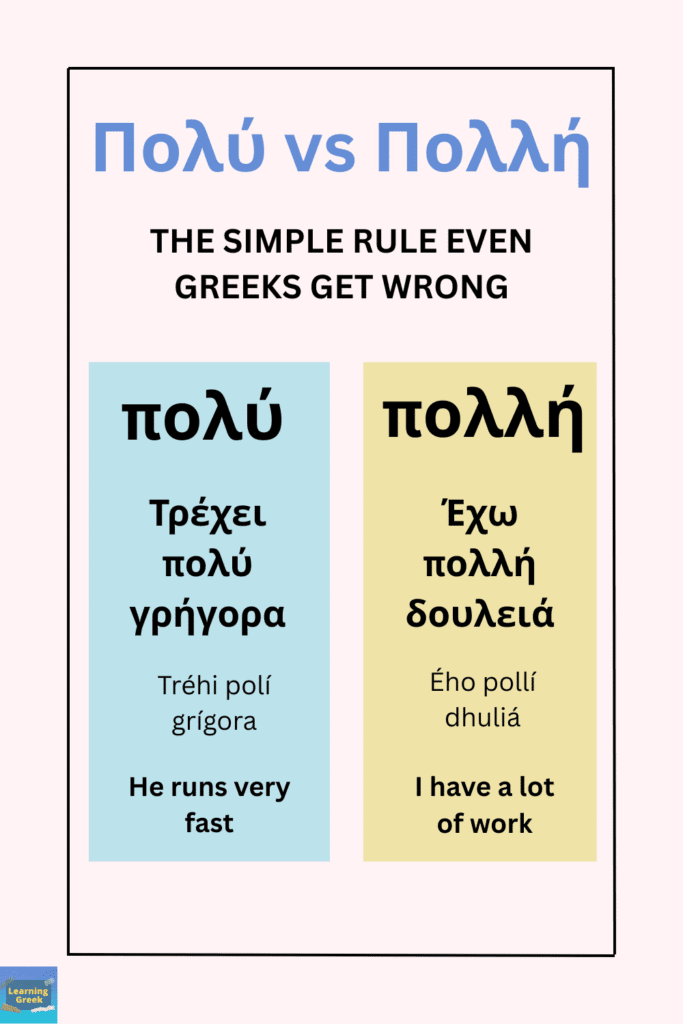
Πολύ vs Πολλή ιn a Νutshell
So the real question becomes: are you describing a noun or are you describing a verb/adjective/adverb?
And the answer to this question will tell you exactly which you need to use.
The Quick Answer
If it describes a verb, adjective or adverb → πολύ
If it describes a feminine noun → πολλή
This is actually all you need to know!
But let’s see some examples to digest it better.
1. πολύ as an adverb
This is the version you’ll see constantly in everyday Greek.
Think of it as “very” or “a lot”.
Use πολύ when it describes:
• a verb
• an adjective
• another adverb
Examples
Μου αρέσει πολύ.
Mou arési polí.
I like it a lot.
Είναι πολύ ωραίο.
Íne polí oréo.
It’s very nice.
Τρέχει πολύ γρήγορα.
Tréhi polí grígora.
He runs very fast.
Σε ευχαριστώ πολύ.
Se efharistó polí.
Thank you very much.
No nouns here — so it’s always πολύ.
2. πολλή as an adjective
Here we’re dealing with the feminine form of the adjective meaning much/a lot of.
Use πολλή when it describes a feminine singular noun.
Examples
Έχω πολλή δουλειά.
Ého pollí dhuliá.
I have a lot of work.
Ήπιε πολλή μπύρα.
Ípie pollí býra.
She drank a lot of beer.
Έγινε πολλή φασαρία.
Égine pollí fasaría.
There was a lot of noise.
If a feminine noun follows → πολλή.
Common mix-ups cleared up
Let’s solve the classic ones people hesitate on:
Είναι πολύ καλή.
Correct. You’re describing the adjective καλή, not the noun.
Έχει πολλή ζέστη.
Correct. Ζέστη is a feminine noun.
Περίμενα πολύ ώρα.
Trick sentence.
You might think “ώρα is feminine so it should be πολλή”.
But εδώ: πολύ describes the verb περίμενα → I waited a lot / for a long time.
So it stays πολύ.
Mini Quiz
A quick check before the final wrap-up. Pick the correct form each time. You can find the answers at the end of the article.
1. Έχω _ υπομονή.
a) πολύ
b) πολλή
2. Μιλάει _ γρήγορα.
a) πολύ
b) πολλή
3. Έχει _ σημασία.
a) πολύ
b) πολλή
4. Είναι _ καλή.
a) πολύ
b) πολλή
5. Περίμενα _ ώρα.
a) πολύ
b) πολλή
Wrap-up
Once you train your eye to look at the next word, the puzzle solves itself.
• Verb/adjective/adverb → πολύ
• Feminine noun → πολλή
It’s one of those small Greek details that clicks suddenly and never leaves you.
And if you want more Greek tips and tricks, I’ve got you!
Ό,τι vs ότι: The Simple Rule Greeks Still Mix Up
Greek Grammar Tips: The Rules for Using the Final ν
The “i” Sound in Greek: When to Use ι, η, υ, ει, οι, υι?
Take care 🙂
Answers
1: β) πολλή (feminine noun)
2: α) πολύ (describes the adverb γρήγορα)
3: β) πολλή (σημασία is feminine)
4: α) πολύ (describes the adjective καλή)
5: α) πολύ (describes the verb περίμενα)


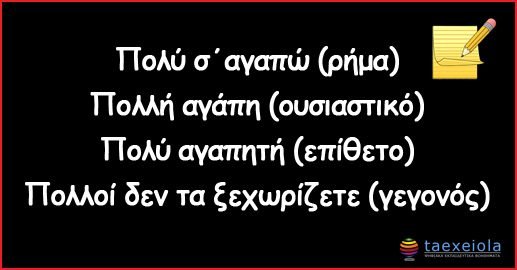
Fascinating
Should the verb ξεχοριζετε not be ξεχωριζουν ( in the sentence Πολλοι δεν τα ξεχωριζετε)?
Hey, both can be used. It depends on the context.