
Hello beautiful people!
Greek idioms often reflect the values and experiences of the culture, offering unique insights into life’s challenges and triumphs.
One such idiom is Μπήκε το νερό στο αυλάκι, which conveys a powerful message of perseverance and progress. But what exactly does it mean?
Let’s explore the deeper meaning behind this expression and its significance in Greek culture.
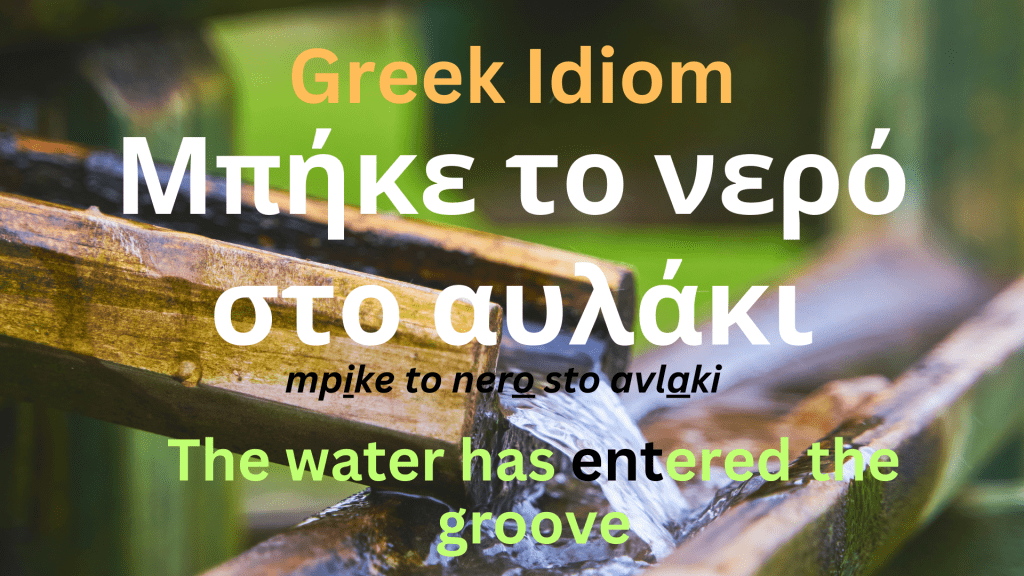
Μπήκε το νερό στο αυλάκι
(Mpike to nero sto avlaki)
- Literal Translation: The water has entered the groove.
- Meaning: This phrase means that things have started to fall into place, or progress has begun smoothly after initial difficulties.
Cultural Context
Agriculture has been a cornerstone of Greek society for thousands of years, deeply influencing the country’s language, culture, and daily life. In traditional Greek farming, water management is essential, particularly in the arid Mediterranean climate. Irrigation systems, often involving channels or grooves (αυλάκια, “avlakia”), were vital for ensuring crops received the necessary water to grow. When the water successfully enters the groove, it signifies that the irrigation system is functioning as intended, and the crops will thrive—metaphorically, that all the hard work is finally paying off.
The idiom “Μπήκε το νερό στο αυλάκι” captures this moment of relief and satisfaction, extending beyond agriculture to all aspects of life. It represents the moment when a plan or project starts moving in the right direction after overcoming obstacles.
The idiom also reflects the Greek appreciation for perseverance and hard work. Just as farmers must be patient and diligent in tending their fields, individuals are often required to put in sustained effort before seeing results. When the water finally “enters the groove,” it is a moment of validation, showing that the effort was worthwhile and that the future looks promising.
Examples in context
1. Personal Life Context
Scenario: A couple has been working through some relationship challenges, and things are now improving.
Example:
- Περάσαμε δύσκολες στιγμές, αλλά τώρα που λύσαμε τις διαφορές μας, νιώθω ότι μπήκε το νερό στο αυλάκι στη σχέση μας.
- Perasame diskoles stigmes, alla tora pu lisame tis diafores mas, niotho oti mpike to nero sto avlaki sti shesi mas.
- We went through tough times, but now that we’ve resolved our differences, I feel that the water has entered the groove in our relationship.
2. Academic Context
Scenario: A student has been struggling with their studies but finally finds a study method that works.
Example:
- Στην αρχή δεν μπορούσα να συγκεντρωθώ, αλλά τώρα που βρήκα τη σωστή μέθοδο, μπήκε το νερό στο αυλάκι και βλέπω αποτελέσματα.
- Stin arhee then borusa na sigkentrotho, alla tora pu vrika ti sosti methodo, mpike to nero sto avlaki ke vlepo apotelesmata.
- At first, I couldn’t focus, but now that I’ve found the right method, the water has entered the groove, and I’m seeing results.
3. Business Context
Scenario: After months of struggling to launch a new product, a company finally sees an increase in sales.
Example:
- Μετά από τόσους μήνες σκληρής δουλειάς, επιτέλους μπήκε το νερό στο αυλάκι και οι πωλήσεις μας ανεβαίνουν.
- Meta apo tosus mines skliris dulias, epitelus mpike to nero sto avlaki ke i polisis mas anevenun.
- After so many months of hard work, the water has finally entered the groove, and our sales are increasing
Conclusion
In each of these examples, the idiom Μπήκε το νερό στο αυλάκι is used to convey the idea that after a period of effort and difficulty, things have started to progress smoothly and successfully. The phrase is versatile and can be applied to many different situations, making it a valuable expression for both formal and informal conversations in Greek.
Fancy more idioms? Check here: Greek Idioms