

Hello, my beautiful Greek learners!
Today we are diving headfirst into the most popular Greek slang terms, because speaking like a local requires much more than just textbook grammar. Greek is a beautiful and complex language with a rich history.
However, like any living language, it possesses its own unique set of colloquial expressions that can leave even the most seasoned linguists scratching their heads.
But fear not!
This guide is your ticket to navigating the wonderful world of everyday street speech. Since these are the exact words and expressions that native speakers use daily, learning them will help you understand casual conversations and make your friends chuckle.
So, grab your souvlaki, loosen up, and let’s master some authentic Greek slang terms that are guaranteed to make you sound like a true insider!
25 Essential Greek Slang Terms
1. Έφαγα πακέτο
(Éfaga pakéto)
Meaning: To have a tough time, to deal with a difficult situation.
Explanation: Πακέτο (το) (pakéto) literally means package, but in local slang, this phrase means “I went through something really difficult.”
For example:
Έφαγα πακέτο στη δουλειά σήμερα.
(Éfaga pakéto sti douliá símera.)
I had a tough day at work today.
2. Κλαίω
(Kléo)
Meaning: To be overwhelmed in a humorous or sarcastical way.
Explanation: While the active verb κλάιω (kléo) literally means I cry, younger people use it to say “I’m dying of laughter,” similar to the English “I’m screaming.”
For example:
Κλαίω από τα γέλια!
(Kléo apó ta yélia!)
I’m crying with laughter!
3. Φλεξάρω
(Flexáro)
Meaning: To show off, to flex
Explanation: This is one of those modern Greek slang terms adopted directly from the English verb “to flex.” It means to display your wealth or achievements boastfully.
For example:
Ο Γιάννης φλεξάρει το καινούριο του αυτοκίνητο.
(O Yiánnis flexári to kainoúrio tou aftokínito.)
John is showing off his new car.
4. Κριντζάρω
(Krinjáro)
Meaning: To cringe
Explanation: This is another active verb adopted from English. It describes that internal feeling of intense embarrassment during awkward social situations.
For example:
Αυτό το αστείο με έκανε να κριντζάρω.
(Aftó to astío me ékane na krinjáro.)
That joke made me cringe.
5. Ρε
(Re)
Meaning: Hey, dude, man
Explanation: This is the most versatile word in the world of Greek slang terms. You can use it affectionately with friends or sharply during an argument.
For example:
Ρε, τι κάνεις εκεί;
(Re, ti kánis ekí?)
Hey, what are you doing there?
6. Μάγκας
(Mángas)
Meaning: Dude, tough guy, cool guy.
Explanation: The word μάγκας (o) (mángas) originally referred to members of the old Greek counter-culture underworld. Today, while it can mean a smart-aleck, it usually describes a clever, self-reliant, or cool person.
For example:
Αυτός ο τύπος είναι μεγάλος μάγκας!
(Aftós o tipos eínai megálos mángas!)
That guy is a really tough guy!
7. Ψιλο-
(Psilo-)
Meaning: Slightly, kind of
Explanation: Adding this prefix before an active verb or adjective means “slightly.” It is an excellent way to downplay a situation.
For example:
Φιλαράκι, ψιλοκρυώνω εδώ έξω.
(Filaráki, psilokrióno edó éxo.)
Buddy, I’m kind of cold out here.
8. Φάση
(Fási)
Meaning: Scene, vibe, situation
Explanation: Φάση (η) (fási) means the phase literally, but socially it refers to the general vibe or a specific happening.
For example:
Ήταν περίεργη η φάση όταν συνάντησα τον πρώην μου.
(Ítan períeryi i fási ótan sinántisa ton próin mou.)
It was an awkward situation when I ran into my ex.
9. Τζάμι
(Tzámi)
Meaning: Awesome, great, crystal clear
Explanation: Tζάμι (το) (tzámi) literally means the window pane or glass. In a casual conversation, however, it means everything is absolutely perfect.
For example:
Πώς ήταν το πάρτι χθες; Τζάμι!
(Pós ítan to párti chthes? Tzámi!)
How was the party yesterday? Awesome!
10. Φιλαράκι
(Filaráki)
Meaning: Buddy, pal
Explanation: Το φιλαράκι (to filaráki) is a sweet diminutive form of the word friend, used as a warm term of endearment.
For example:
Τι κάνεις, φιλαράκι μου;
(Ti kánis, filaráki mou?)
How are you, my buddy?
11. Χαλαρά
(Chalará)
Meaning: Relaxed, chill, take it easy
Explanation: This is a famous philosophy of life in Greece, especially in Thessaloniki! It describes a completely laid-back, stress-free attitude.
For example:
Πώς πέρασες το Σαββατοκύριακο; Χαλαρά.
(Pós pérases to Savvatokýriako? Chalará.)
How was your weekend? Chill.
12. Τρελός
(Trelós)
Meaning: Awesome, amazing, wild
Explanation: The three-form adjective ο τρελός, η τρελή, το τρελό (o trelós, i trelí, to treló) literally means crazy. Instead of something bad, in youth culture, it highlights something incredibly good.
For example:
Αυτή η συναυλία ήταν τρελή!
(Aftí i sinavlía ítan trelí!)
That concert was amazing!
13. Κουλ
(Cool)
Meaning: Cool, calm
Explanation: Borrowed directly from English, Greeks write this phonetically and use it to praise a relaxed personality.
For example:
Μου αρέσει ο νέος σου φίλος, είναι πολύ κουλ.
(Mou arési o néos sou fílos, eínai poli koul.)
I like your new friend, he is very cool.
14. Σπάω πλάκα
(Spáo pláka)
Meaning: To have a laugh, to joke around
Explanation: This phrase means to have fun in a light-hearted, joking manner. It’s often used when someone is enjoying themselves, especially when they’re laughing or joking around with friends.
For example:
Χθες το βράδυ σπάσαμε πλάκα με τους φίλους μου.
(Chthes to vrádi spásame pláka me tous fílous mou.)
Yesterday night we had a great time joking around with my friends.
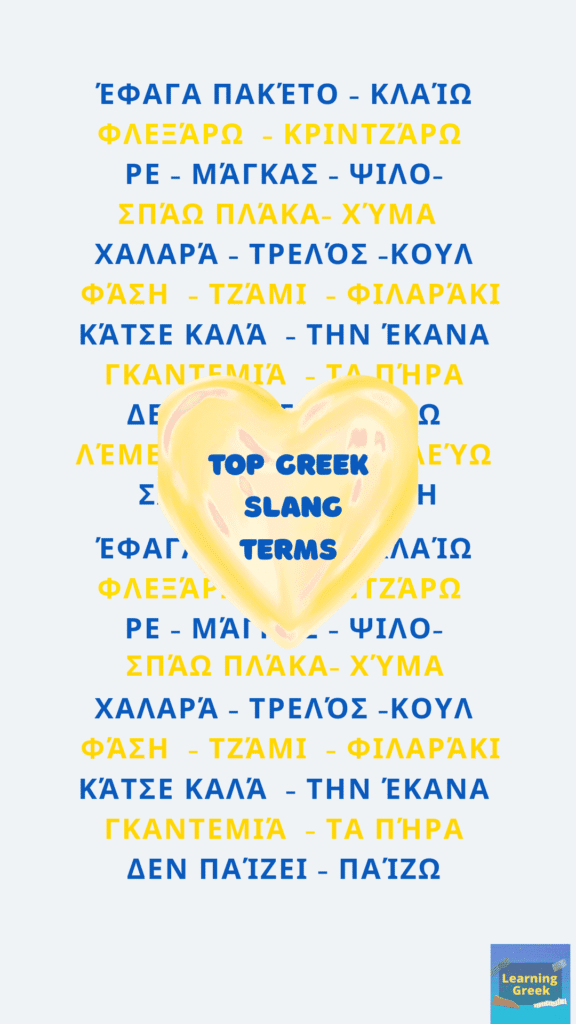
15. Χύμα
(Chima)
Meaning: Loose, disorganized, scattered, relaxed.
Explanation: Χύμα describes a very relaxed unstructured, disorganized, or scattered attitude. It can refer to a person who is a bit all over the place, lacking in discipline or order. This term can be used in a neutral or slightly critical way, depending on the context. So, while χύμα can sometimes be associated with a laid-back attitude, it more accurately conveys a sense of disorder or lack of structure.
For example:
Ο Γιάννης είναι πολύ χύμα τύπος και δεν έχει πρόγραμμα
(O Yiánnis eínai poli chima tipos kai den échi prógramma.)
John is a very laid-back guy and has no schedule.
16. Κάτσε καλά
(Kátse kalá)
Meaning: Calm down, behave yourself
Explanation: This expression translates literally to “sit well.” People use it to tell someone to behave, or to express amazement at a crazy fact.
For example:
Κάτσε καλά, δεν είναι τόσο σοβαρό το πρόβλημα.
( Kátse kalá, den eínai tóso sovaró to próvlima.)
Calm down, the problem is not that serious.
17. Την έκανα
(Tin ékana)
Meaning: I left, I’m out of here
Explanation: While the phrase looks like “I made it,” in street speech it is one of those popular Greek slang terms you use when you are leaving a place quickly.
For example:
Αργεί πολύ η ταινία, την έκανα για το σπίτι.
(Aryί poli i tenία, tin ékana yia to spíti.)
The movie is very late, I’m out of here for home.
18. Γκαντεμιά
(Gkantemiá)
Meaning: Bad luck, a total jinx
Explanation: Γκαντεμιά (η) (gkantemiá) is the ultimate word for an unfortunate stroke of bad luck.
For example:
Τι γκαντεμιά να χάσω το τελευταίο λεωφορείο!
(Ti gkantemiá na cháso to teleftεo leoforío!)
What bad luck to miss the last bus!
19. Τα πήρα
(Ta píra)
Meaning: I got angry, I lost my temper
Explanation: This translates literally to “I took them.” It means your blood is boiling because of an annoying situation.
For example:
Τα πήρα άσχημα με το αφεντικό μου σήμερα.
(Ta píra áschima me to afentikó mou símera.)
I got really angry with my boss today.
20. Δεν παίζει
(Den pézi)
Meaning: No way, it’s not happening
Explanation: This translates to “it doesn’t play.” Use it whenever you want to express absolute disbelief or that something is not going to happen.
For example:
Θα έρθεις μαζί μας απόψε; Δεν παίζει, είμαι κουρασμένος.
(Tha érthis mazί mas apópse? Den pézi, íme kourasménos.)
Are you coming with us tonight? No way, I’m tired.
21. Παίζω
(Pézo)
Meaning: To flirt, to be romantically involved
Explanation: Unlike the standard meaning of playing a game, the active verb παίζω (pézo) means someone is actively playing the field or flirting.
For example:
Αυτός ο τύπος παίζει με όλες.
(Aftós o tipos pézi me óles.)
That guy flirts with everyone.
22. Λέμε τώρα
(Léme tόrα)
Meaning: Just saying, for the sake of argument
Explanation: This translates to “we are saying now.” It acts as a conversational safety net, common in everyday Greek slang terms, when making wild hypotheticals.
For example:
Αν είχαμε πολλά λεφτά, θα αγοράζαμε νησί, λέμε τώρα.
(An ίchame pollá leftá, tha agorázame nisí, léme tόrα)
If we had a lot of money, we’d buy an island, just saying.
23. Την παλεύω
(Tin palévo)
Meaning: I’m managing, I’m coping
Explanation: This means “I am wrestling it.” It is often used to express coping with a difficult situation.
For example:
Πώς τα πας με τη δουλειά; Την παλεύω.
(Pós ta pas me ti douliá? Tin palévo.)
How’s work going with the job? I’m managing.
24. Σαβούρα
(Savoúra)
Meaning: Junk, rubbish, or a clumsy fall
Explanation: Σαβούρα (η) (savoúra) means garbage or low-quality items. In addition, “σαβούρα” is also slang for falling down, often used humorously to describe an awkward or clumsy fall. In this context, you might also hear the phrase “έφαγα σαβούρα” or “σαβουριάστηκα,” both meaning “I fell down.”
For example:
Καθάρισε το δωμάτιό σου από τις σαβούρες που έχεις μαζέψει.
(Kathárise to domátió su apó tis savúres pu échis mazépsi.)
Clean your room from all the junk you’ve accumulated.
25. Μούρη
(Moúri)
Meaning: Face, or someone cool
Explanation: Μούρη (η) (moúri) means the physical face or snout of an animal. Therefore, calling someone a “μεγάλη μούρη” means they are a legendary, important, or cool character in town.
For example:
Είσαι μεγάλη μούρη, φιλαράκι μου!
(Ise megáli moúri, filaráki mou!)
You’re really cool,
Conclusion
Mastering these Greek slang terms won’t just help you understand conversations better. It might even earn you some serious local street cred. Slang is like the secret sauce of any language, full of flavor and fun.
So, next time you’re chatting with Greek friends, slip in a few of these expressions and watch their reactions!
And if you want to move past street talk and learn more useful words, just head over to the Greek Vocabulary section to learn everyday expressions and phrases that will help you speak with confidence.
Καλή τύχη!
And may your slang game be strong!


Would help to hear spoken word.
Φανταστικό, ευχαριστώ πολύ!!!
Παρακαλώ 🙂
Pingback: How to Speak Like a Local – In Greek, We Don’t Say… - Learning Greek
Pingback: How to Say Awesome in Greek - Learning Greek