
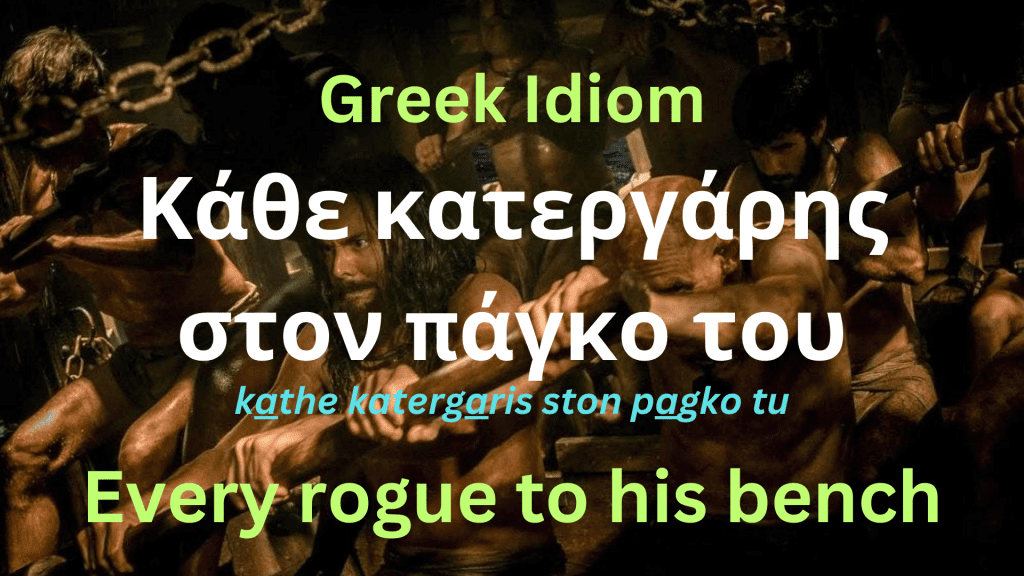
Greek idioms offer a unique glimpse into the nation’s rich history and cultural nuances. One such phrase is, Κάθε κατεργάρης στον πάγκο του.
Let’s delve into its meaning, usage, and historical roots.
Κάθε κατεργάρης στον πάγκο του
(Kathe katergaris ston pagko tu)
- Literal Translation: Every rogue to his bench.
- Meaning: This expression means that everyone should return to their work or duty, often used after a disruption or distraction.
Examples in context
1. Workplace Context
Scenario: After a long holiday or break, a manager encourages the team to focus and return to their duties.
Example:
- Καλά περάσαμε στις διακοπές, αλλά τώρα κάθε κατεργάρης στον πάγκο του, έχουμε πολλή δουλειά.
- Kala perasame stis diakopes, alla tora kathe katergaris ston pagko tu, ehume polee dulia.
- We had a great time on vacation, but now it’s time for everyone to get back to their workbench; we’ve got a lot to do
2. School Context
Scenario: After a school event, the teacher tells the students to return to their desks and continue their lessons.
Example:
- Η γιορτή τελείωσε, τώρα κάθε κατεργάρης στον πάγκο του! Συνεχίζουμε το μάθημα.
- I yiortee teliose, tora kathe katergaris ston pagko tu! Sinehizume to mathima.
- The celebration is over, now every rogue to his bench! Let’s continue the lesson.
3. Business Context
Scenario: After a weekend of relaxation, a parent tells their children that it’s time to focus on their schoolwork again.
Example:
- Είχατε το Σαββατοκύριακο να ξεκουραστείτε, αλλά τώρα κάθε κατεργάρης στον πάγκο του – πρέπει να κάνετε τα μαθήματά σας.
- Eehate to Savatokiriako na ksekurastite, alla tora kathe katergaris ston pagko tu.
- You had the weekend to rest, but now it’s time for every rogue to get back to his bench – you need to do your homework
Different Meanings of the word Κατεργάρης in Greek
The Greek word κατεργάρης has evolved over time and can have several meanings in English, depending on the context. Here are the main meanings:
- Rogue or rascal – Originally, “κατεργάρης” referred to someone involved in forced labor on a galley ship, often a convict, and this developed into a term for a deceitful or dishonest person.
- Cunning person – It can describe someone clever or crafty, often in a way that bends the rules to their advantage. Similar words in English could be trickster or sly person.
- Resourceful or capable person – In a more playful or positive sense, “κατεργάρης” can refer to someone who is skillful at handling tricky situations, akin to a sharp-witted or shrewd person.
Though the word has a history of negative connotations, over time it also took on a more neutral or even positive meaning in informal, teasing contexts.
Historical Development of the Idiom
The phrase κάθε κατεργάρης στον πάγκο του was originally used to describe the literal act of convicts returning to their rowing benches on galley ships. These κατεργάρηδες were often prisoners forced into hard labor, rowing the ships, whether for trade or military purposes. They sat on wooden benches, rowing when the wind wasn’t strong enough for the sails to power the ship. When the wind picked up, they were allowed to leave their benches, but as soon as it died down, they’d hear the order: “every rogue to his bench,” which meant they had to return to their oars.
Since most rowers were prisoners, the word κατεργάρης initially carried a negative meaning, referring to someone devious or dishonest. Over time, the term was also used in a more lighthearted way, meaning someone clever or resourceful in managing their affairs. However, the full phrase today is usually negative, commonly used when people must return to their work or daily routine, particularly after a break or holiday.

Conclusion
Understanding expressions like, Κάθε κατεργάρης στον πάγκο του, not only enhances our appreciation of the Greek language but also connects us to its historical context. Whether in schools, workplaces, or at home, this idiom serves as a timeless reminder to return to our responsibilities. So the next time you hear it, you’ll know it’s time for “every rogue to his bench”—time to get back to work!