
Hello my dearest friends!
Today we’re dipping our toes into some deeper grammar, yes, I’m talking about the Greek personal pronouns. But don’t worry! I’ll walk you throught it step by step so it won’t feel confusing or scary.
But first let’s see what Greek personal pronouns are and why they matter.
Greek personal pronouns are a fundamental part of the language.
They show who is doing something, who it is happening to, or who something belongs to. They change depending on the person, number, gender, and case, which can feel tricky at first, but we’ll take it slowly and make it easy to follow.
There are two types of Greek personal pronouns. The strong type and the weak type. Each has its own role, and once you see how they work, your Greek sentences will start to feel much more natural.
But first, let’s explain what strong and weak type means:
Strong Personal Pronouns:
Strong personal pronouns are like the stars of the sentence. They stand out and take the lead. When you say “I”, “you”, “he”, “she”, “it”, “we”, or “they”, you’re using strong personal pronouns. They show who is doing the action or who the action is happening to.
For example:
- I like pizza. (The action of liking is done by “I”.)
- She reads books. (The action of reading is done by “she”.)
Weak Personal Pronouns:
Weak personal pronouns are more like the helpful sidekicks. They usually stick close to verbs and aren’t the main focus. Weak personal pronouns act as objects in a sentence (like saying “me”, “you”, “him”, “her”, “it”, “us”, or “them”).
For example:
- She sees me. (“Me” is the object of the action “sees”.)
So now let’s get to know the Greek personal pronouns and see how they work in practice.
Greek Personal Pronouns
Προσωπικές Αντωνυμίες
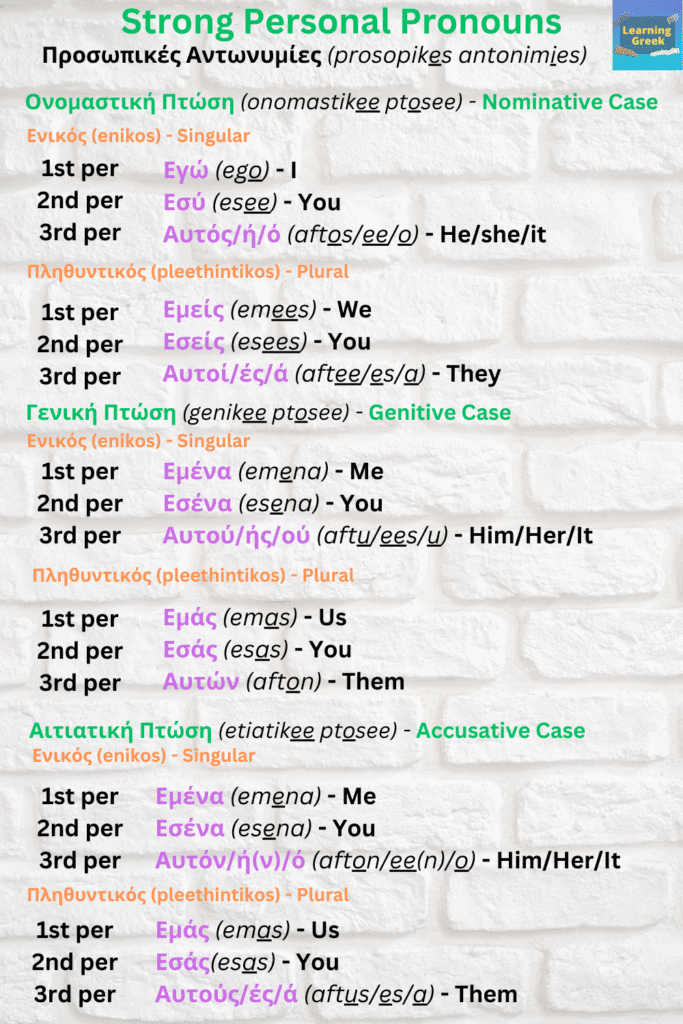
1. Nominative Case
Singular
Strong type:
- First Person: εγώ (ego) – I (The one who speaks)
- Second Person: εσύ (esee) – you (The one we speak to)
- Third Person: αυτός (aftos) – he, αυτή (aftee) – she, αυτό (afto) – it (The one about whom we speak)
Example:
Εγώ διαβάζω. (ego diavazo) – I read.
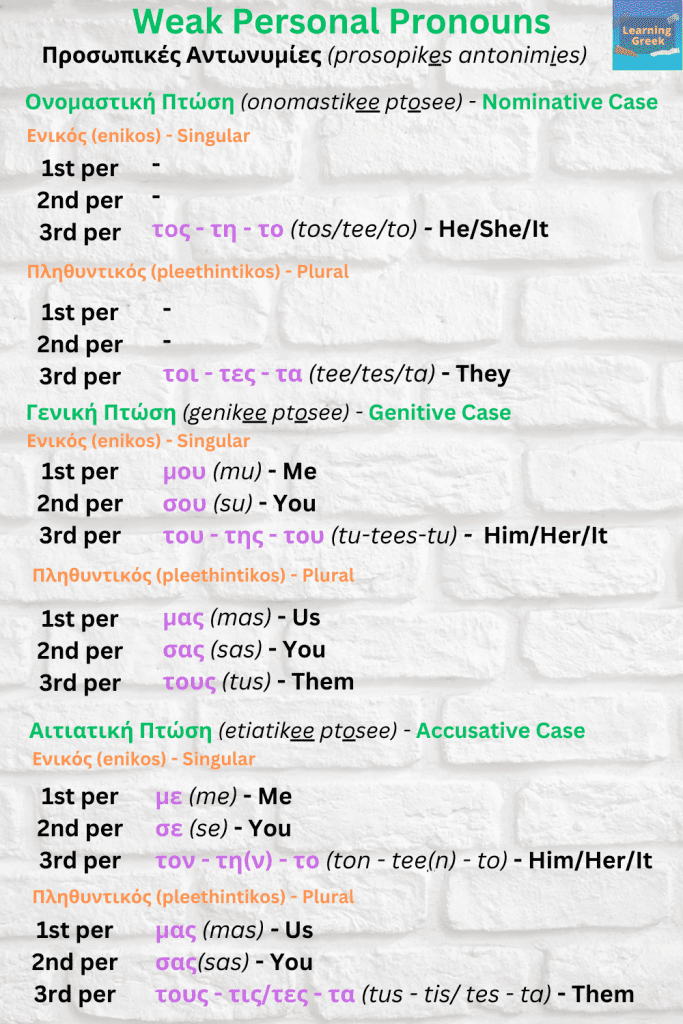
Weak type:
- First Person: –
- Second Person: –
- Third Person: τος (tos), τη (tee), το (to) – We use them only in the expressions να τος (na tos) – here/there he is, να τη (na tee) – here/there she is, να το (na to) – here/there it is
Example:
Πού είναι ο Γιώργος; Να τος, έρχεται! (pu eene o Yiorgos? Na tos, erhete) – Where is George? There he is, coming!
Plural:
Strong type:
- First Person: εμείς (emees) – we
- Second Person: εσείς (esees) – you all
- Third Person: αυτοί (aftee) – they (masculine), αυτές (aftes) – they (feminine), αυτά (afta) – they (neuter)
Example:
Αυτές τρώνε. (aftes trone) – They eat.
Weak type:
- First Person: –
- Second Person: –
- Third Person: τοι (tee), τες (tes), τα (ta) – We use them only in the expressions να τοι (na tee) — here/there they are (masculine), , να τες (na tes) – here/there they are (feminine) να τα (na ta) – here/there they are (neuter)
Example:
– Πού είναι τα γυαλιά μου; (pu eene ta yalia mu?) – Where are my glasses?
– Να τα! Δεν τα βλέπεις; (na ta! then ta vlepees?) – Here they are! Don’t you see them?
2. Genitive Case
Singular:
Strong type:
- First Person: εμένα (emena) – me
- Second Person: εσένα (esena) – you
- Third Person: αυτού (aftu) – him, αυτής (aftees) – her, αυτού (aftu) – it
Example:
Σε εμένα μιλάς; (se emena milas;) – Are you talking to me?
Weak type:
- First Person: μου (mu) – me
- Second Person: σου (su) – you
- Third Person: του (tu) – him, της (tees) – her, του (tou) – it
Example:
Σου είπα να έρθεις. (su eepa na erthees) – I told you to come.
Plural:
Strong type:
- First Person: εμάς (emas) – us
- Second Person: εσάς (esas) – you
- Third Person: αυτών (afton) – them
Example:
Το δώρο είναι για εσάς. (to doro eene gia esas) – The gift is for you.
Weak type:
- First Person: μας (mas) – us
- Second Person: σας (sas) – you
- Third Person: τους (tus) – them
Example:
Τους ανάγκασα να το φτιάξουν. (tus anagkasa na to ftiaxun) – I forced them to fix it.
3. Accusative Case
Singular:
Strong type:
- First Person: εμένα (emena) – me
- Second Person: εσένα (esena) – you
- Third Person: αυτόν (afton) – him, αυτή(ν) (aftee(n)) – her, αυτό (afto) – it
Example:
Βλέπει εσένα. (vlepee esena) – He/She sees you.
Weak type:
- First Person: με (me) – me
- Second Person: σε (se) – you
- Third Person: τον (ton) – him, την (teen) – her, το (to) – it
Example:
Τον ξέρω. (ton xero) – I know him.
Plural:
Strong type:
- First Person: εμάς (emas) – us (The collective victims)
- Second Person: εσάς (esas) – you (The group always in trouble)
- Third Person: αυτούς (aftus) – them, αυτές (aftes) – them, αυτά (afta) – them (The ones everyone blames)
Example:
Το σπίτι ανήκει σε αυτούς. (to spiti anikee se aftus) – The house belongs to them.
Weak type:
- First Person: μας (mas) – us (When you and your crew are in trouble)
- Second Person: σας (sas) – you all (When the whole group messed up)
- Third Person: τους (tus) – them (masculine), τις/τες (tis/tes) – them (feminine), τα (ta) – them (neuter) (Blame everyone else!)
Example:
Τις είδα να έρχονται. Φώναξέ τες! (tees eeda na erhonte. Fonakse tes!) – I saw them coming. Call them!
Usage Notes:
- Greek verbs often “know” who is doing what so you don’t always need the pronoun. For example, instead of saying, εγώ πηγαίνω (ego piyeno) – I go, just say πηγαίνω (piyeno) – I go. We usually use the personal pronoun in the nominative case only to emphasize who performed the action indicated by the verb. For instance: Εγώ το έκανα, όχι εσύ! (ego to ekana, ohi esee) – I did it, not you!
- The formal form of you – εσείς (esees) is used when you need to be polite, like when addressing your boss, your mother-in-law, or your cat (if it’s particularly dignified).
- The third-person pronouns agree in gender with the noun they replace or refer to.
- We should not confuse the weak forms of personal pronouns with the definite articles.
The weak forms of the third person personal pronoun accompany verbs, whereas articles accompany nouns or adjectives.
Conclusion
Now that you know your Greek pronouns,you can start using them confidently in your everyday conversations. If you want to go a step further, test what you’ve learned so far with
Personal Pronouns Quiz and check out my guides
on Greek possessive and
Greek demonstrative pronouns.
For a broader understanding of how Greek cases shape all pronouns,
don’t miss the Greek Cases guide.
Take care 🙂