
Hello my beautiful people!
Oh, my! The dreaded Greek alphabet!
This is how most people react when they see the Greek letters for the first time. But please, don’t be terrified! I know it can feel a bit overwhelming when you’re starting something new, but I’m here to help you learn smoothly and without any anxiety.
Shall we begin?
Why learn an alphabet? Any alphabet
When starting a new language, one of the first things you need to do is learn its alphabet. In fact, it’s the foundation for reading, writing, and understanding the language.
Even if Greek isn’t on your immediate learning list, getting familiar with its alphabet has surprising benefits.
For instance, it can help you better understand English words derived from Greek.
A Brief History of The Greek Alphabet
Before we move on, let’s see some historical facts.
To begin with, the Greek alphabet was developed around 1000 – 900 BC. Interestingly, it originated from the Phoenician alphabet and is the oldest alphabetic system that is still in use. It is the forebear of all European alphabets. Coptic, Cyrillic, Glagolitic, Gothic and Latin. As a result, some letters may look familiar.
Why is the Greek Alphabet so important?
Because Greek letters appear everywhere in science, math, and everyday life.
For example:
- Maths and science use many of the Greek alphabet letters as symbols. Even if you don’t like maths, like me – yes, guilty -, you probably have stumbled upon the famous letter Π (Pi) = 3,14. Yes, Π is a Greek letter.
Other “famous” Greek letters are Σ (sigma) which can stand for “sum” or Δ (delta) which can stand for “change”. These are just a few examples to mark the importance of Greek letters in maths. If you want more, please ask your maths teacher who probably loves maths much more than me. - Astronomy also really loves the use of Greek letters and names. For example, Άλφα (alpha) is the name they give to the biggest star in a constellation. Βήτα (beta) is the name of the second biggest star and so on.
- Computer science uses many of the Greek letters especially when it comes to coding.
- On college campuses, names of sororities and fraternities, all come from the Greek alphabet.
- In addition, many of the English words are of Greek origin. Even the word “alphabet” derives from the first two letters of the Greek alphabet. Άλφα – Βήτα (Alpha – Beta).
Clearly, therefore, the Greek alphabet is more than just a set of letters. It’s a key to understanding history, science, and culture.
Have I not convinced you yet of the importance of Greek Alphabet orshould I continue to act like Mr. Portokalos?
The Greek Alphabet
It is now time to really dig in to its core. Let’s start!
The modern Greek alphabet consists of 24 characters.
17 consonants: β, γ, δ, ζ, θ, κ, λ, μ, ν, ξ, π, ρ, σ (ς), τ, φ, χ, ψ
and 7 vowels: α, ε, η, ι, ο, υ, ω.
Words form by combining consonants and vowels, or by using two-letter consonants or vowels to create single sounds.
Helping Images
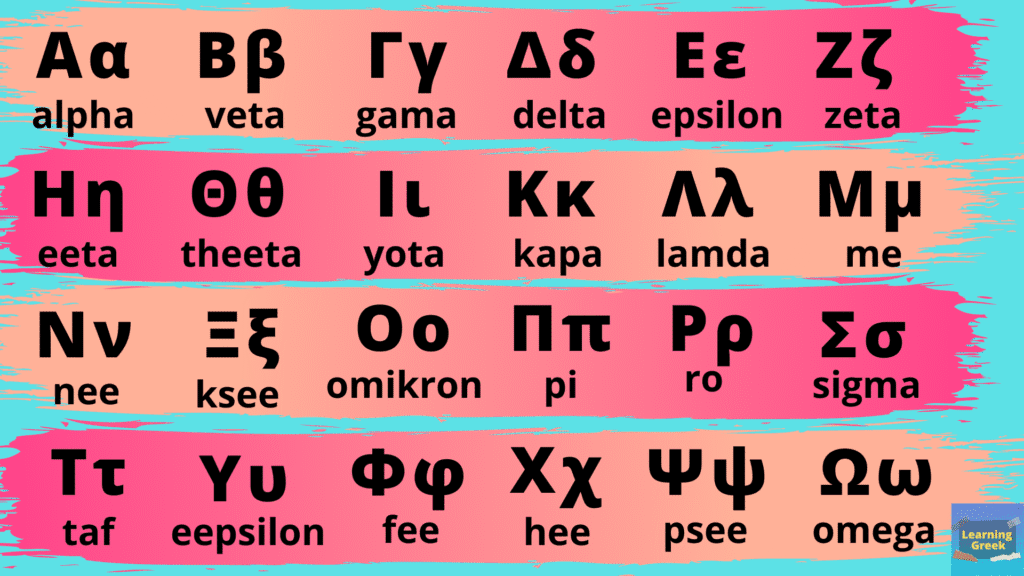
In the image below, you’ll find the Greek alphabet along with the names of each letter in Greek.
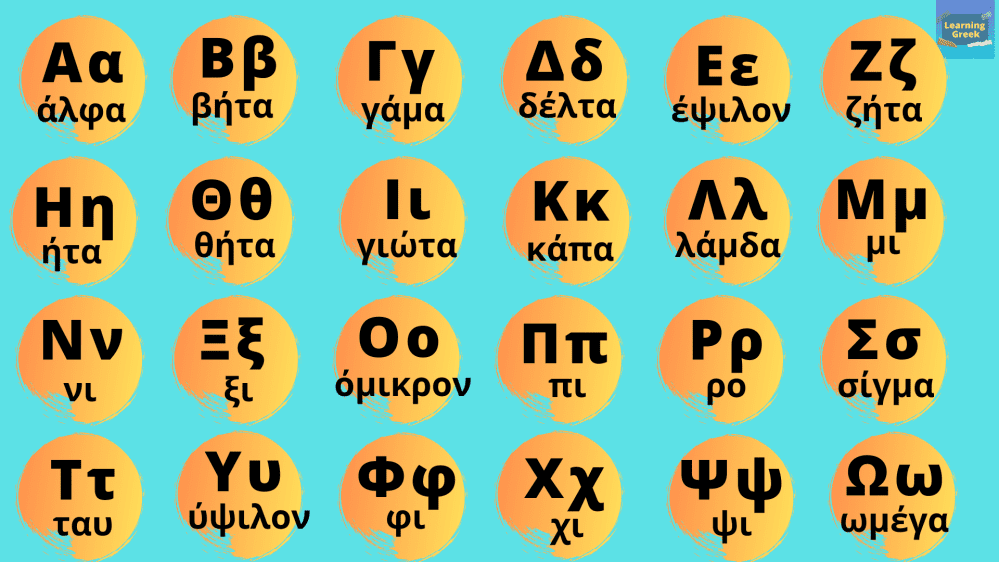
This version includes pronunciation guides in Latin/English to make learning easier.
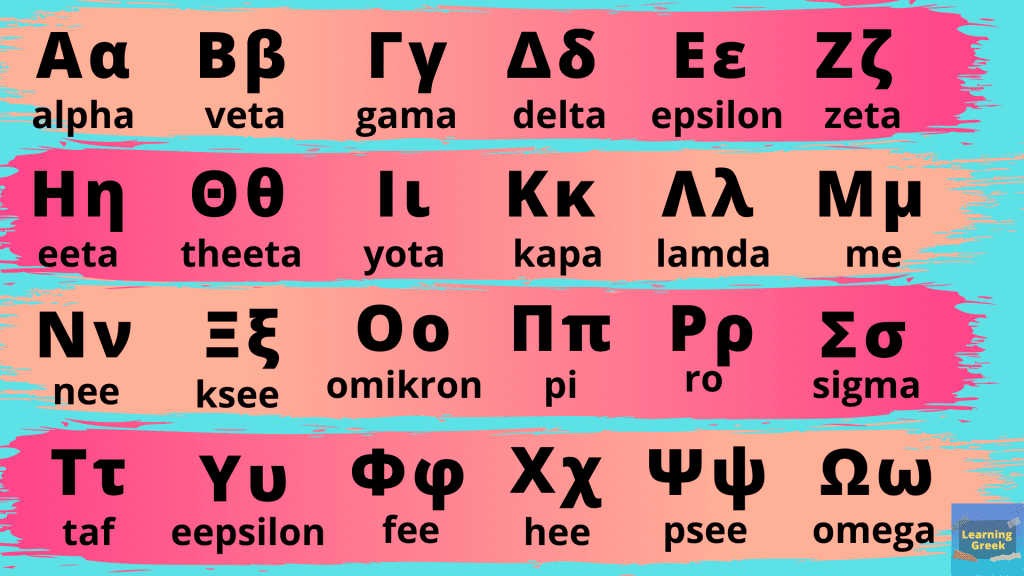
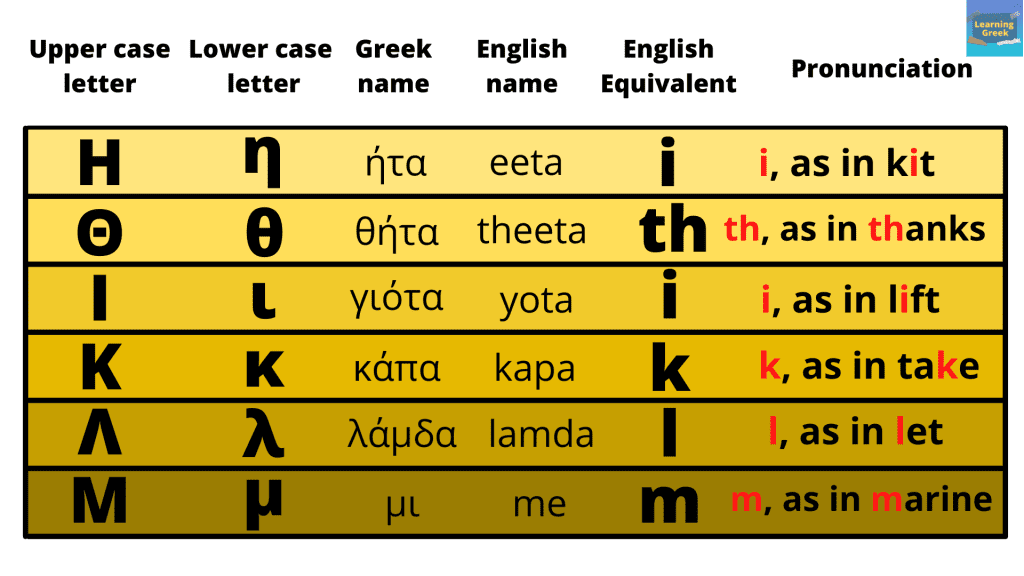
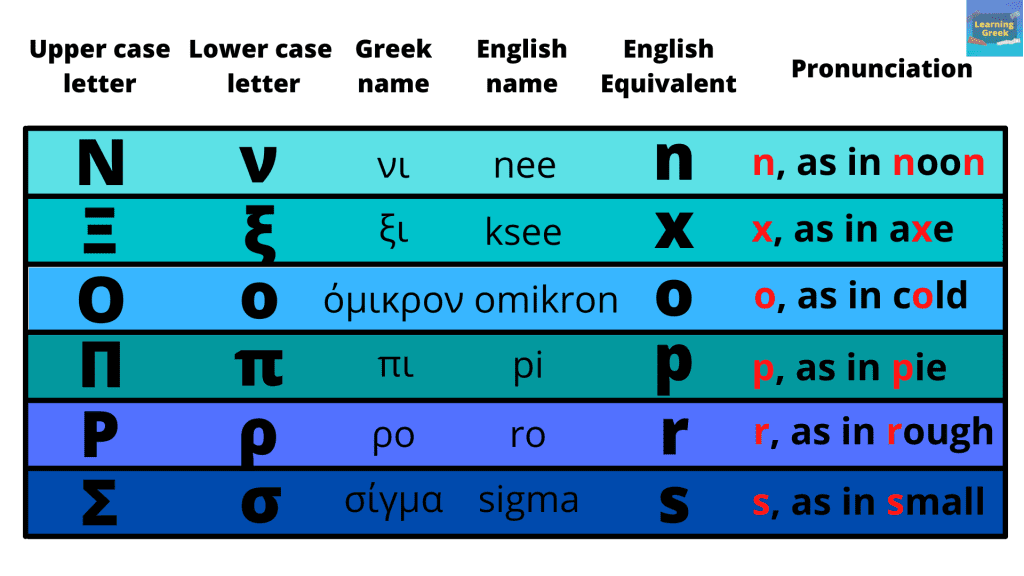
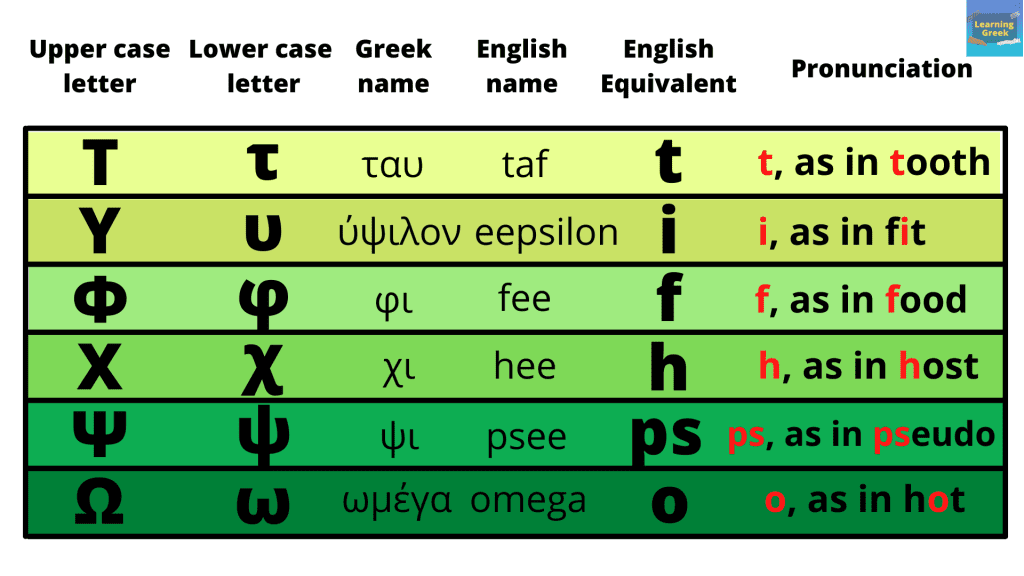
In the images below you can learn the alphabet along with the correct pronunciation of the letters. It is divided in 4 parts each containing 6 letters for smoother learning.
1: Α – Ε
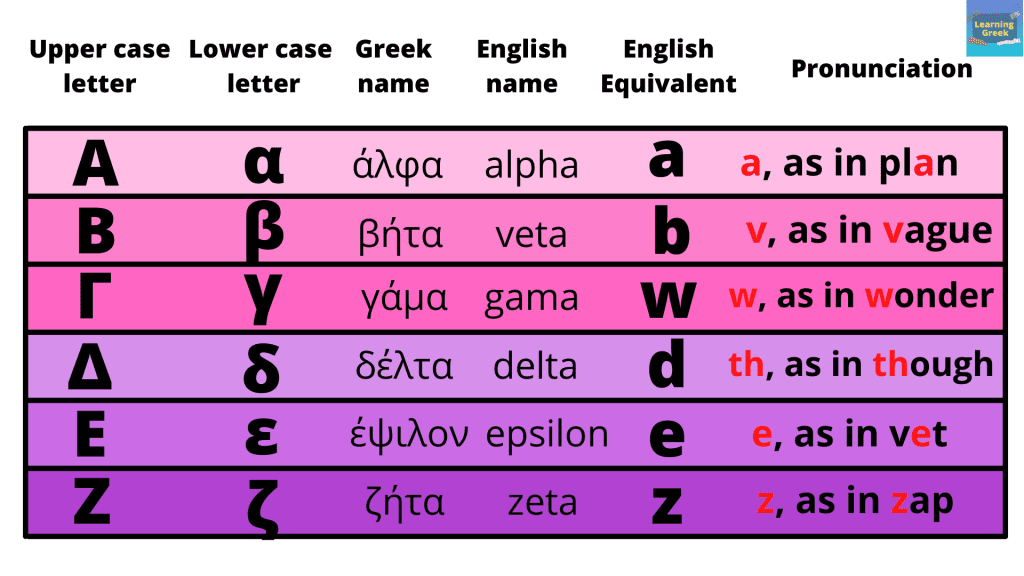
2: Η – Μ
3: Ν – Σ
4: Τ – Ω
Note:
- Σ,σ and ς: When σίγμα (sigma) is written at the end of a word, it is written like this: “ς”. This only happens in lower case words. Greeks call that “ς” τελικό σίγμα (final sigma or final “s”)
Once you feel confident, why not test yourself with the Greek Alphabet Quiz?
Greek Alphabet Video
Next, you can watch this video to hear the correct pronunciation of each Greek letter. It’s a fun way to practice and reinforce your learning.
Conclusion
Overall, the Greek alphabet has played a a significant role throughout history, contributing to science, arts, and language.Even if you don’t plan to learn Greek anytime soon – or never – knowledge of the Greek alphabet can aid you with a better understanding of maths and science and can also give you a better appreciation of the Greek classics.
Now how amazing is that?
Ready to keep learning Greek?
if you’re looking for the best way to continue your journey, here are my favorite beginner-friendly lessons:
10 Easy Greek Grammar Tips for Beginners – Don’t let the rules scare you! Here are my favorite shortcuts to help you learn smoothly.
Greek Greetings for Beginners – Now that you know the letters, learn how to say your very first ‘Hello’ like a native!
Days of the Week in Greek – Practice your new reading skills while mastering the calendar.
And if you want to keep practicing with the Greek alphabet, i have found tools and crafts to make learning even more enjoyable!
Until next time! Happy learning! 🙂



Hi I love this article and It has been helpful to me since I am learning Greek. So any assistance will be appreciated.
Hello and thanks! I’m happy that you’ve found it helpful 🙂
By the way …great article I don’t think it it is “maths”.. because math is a plural word.
Do you think I should spank my British editor?