
Hello dearests!
In a previous post, we talked about the Greek alphabet and we analyzed each of the twenty-four letters. Today, we will talk about the letter combinations.
Yes, yes, I know what you are thinking.
Twenty-four letters aren’tenough?
I’m afraid for Greeks the answer is no.
But please do not panic and look on the bright side!
Letter combinations are a vital part of the Greek alphabet and they will help you create and understand even more words and phrases.
Let’s get started then, shall we?
Greek Letter Combinations
Two-letter vowels – Δίψηφα φωνήεντα
We have already seen that the Greek alphabet consists of 7 vowels:
α, ε, η, ι, ο, υ, ω
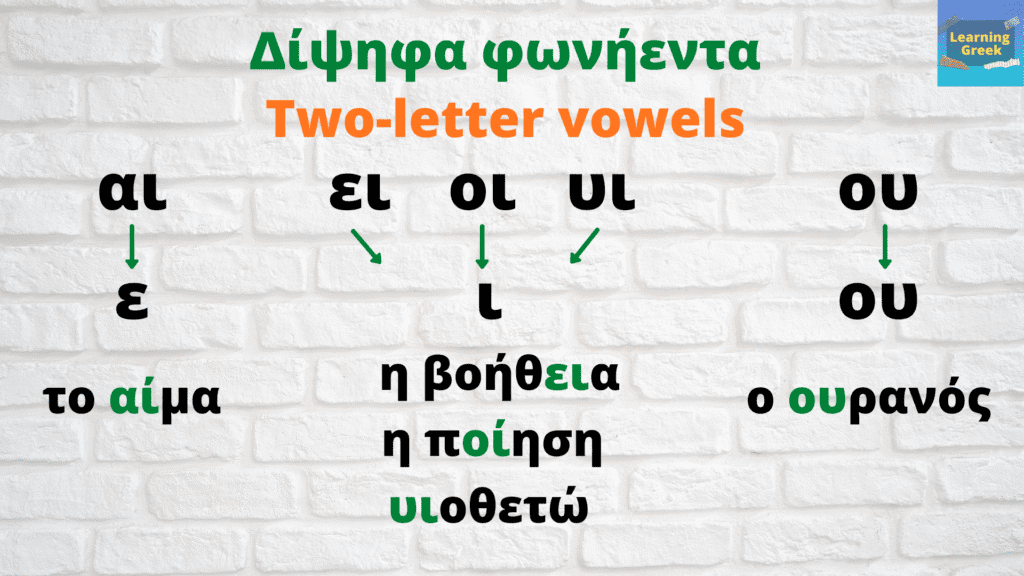
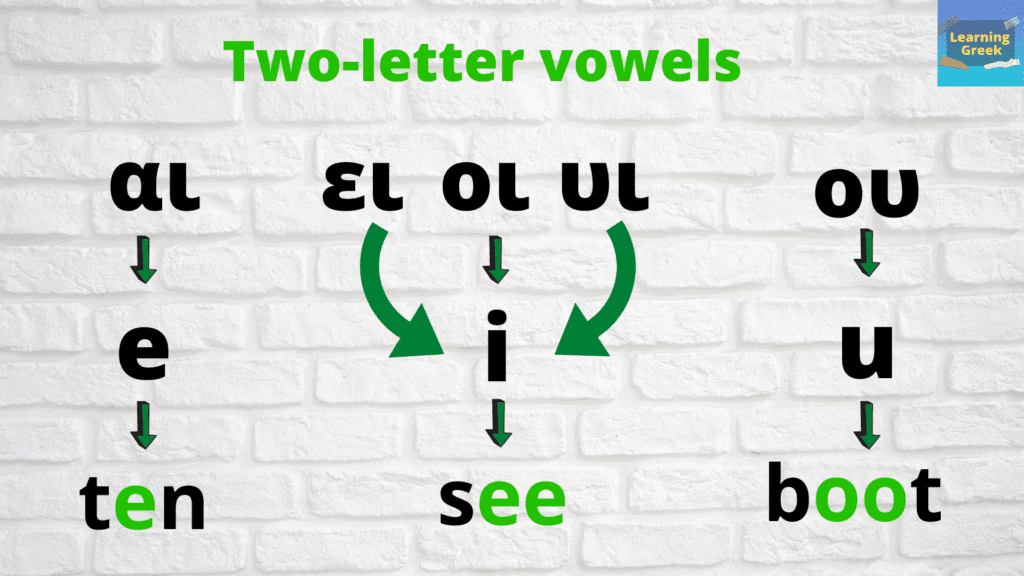
The Greek language has also 5 two-letter vowels which are the following:
αι, ει, οι, υι, ου
ΑΙ / αι → sounds like e in English
- Example: ten
- Notes: Always a short e sound, like the “e” in bed.
ΕΙ / ει → sounds like i in English
- Example: see
- Notes: A long or pure i sound, like in machine or ski
ΟΙ / οι → sounds like i in English
- Example: see
- Notes: Pronounced the same as ει, a long or pure i sound.
ΥΙ / υι → sounds like i in English
- Example: see
- Notes: Always a long i sound, like ει and οι.
Rarely used in modern Greek.
ΟΥ / ου → sounds like u in English
- Example: boot
- Notes: A long u sound, like “oo” in food.
The image below will help you understand two-letter vowels better.
Words that include Greek two-letter vowels
Letter Combinations – Examples:
αι
- το παιδί (pedi) – child
- το αίμα (ema) – blood
- κλαίω (kleo) – I cry
ει
- η ειρήνη (irini) – peace
- το εισιτήριο (isitirio) – ticket
- οι ειδήσεις (idisis) – news
οι
- η οικογένεια (ikoyenia) – family
- ο οικοδεσπότης (ikodespotis) – host
- η οικονομία (ikonomia) – economy
υι
- ο υιός (ios) – son
- η υιοθεσία (iothesia) – adoption
ου
- το βουνό (vuno) – mountain
- το λουλούδι (luludi) – flower
- η τούρτα (turta) – cake
Two-letter consonants – Δίψηφα σύμφωνα
We have already seen that the Greek alphabet consists of 17 consonants:
β, γ, δ, ζ, θ, κ, λ, μ, ν, ξ, π, ρ, σ (ς), τ, φ, χ, ψ.
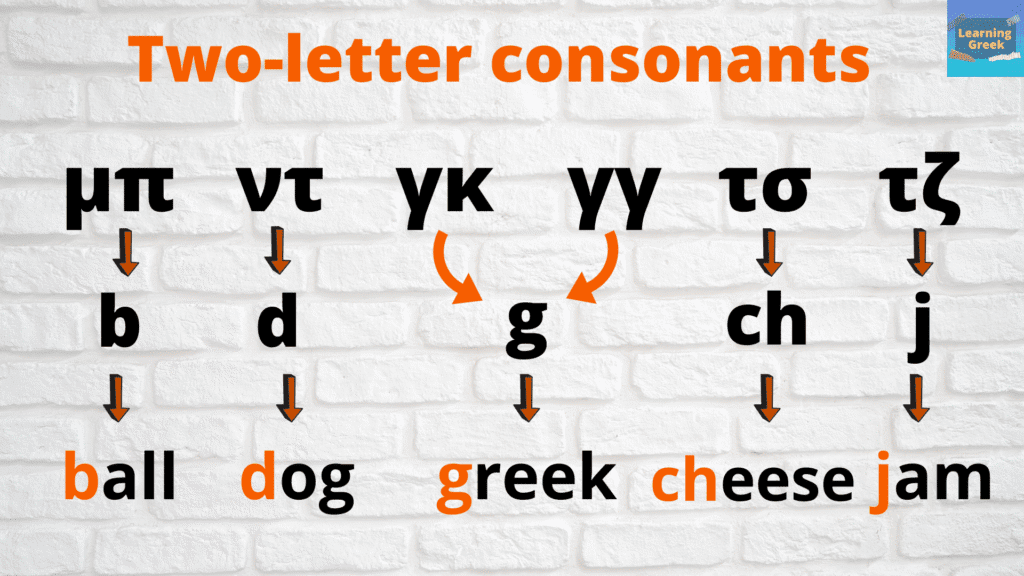
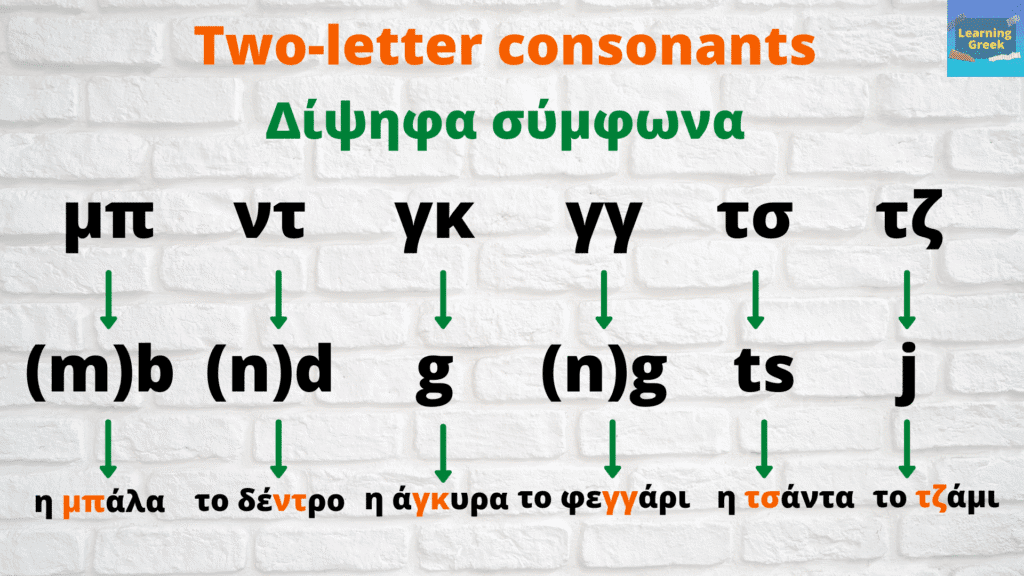
Apart from those 17, there are 6 two-letter consonants which are the following:
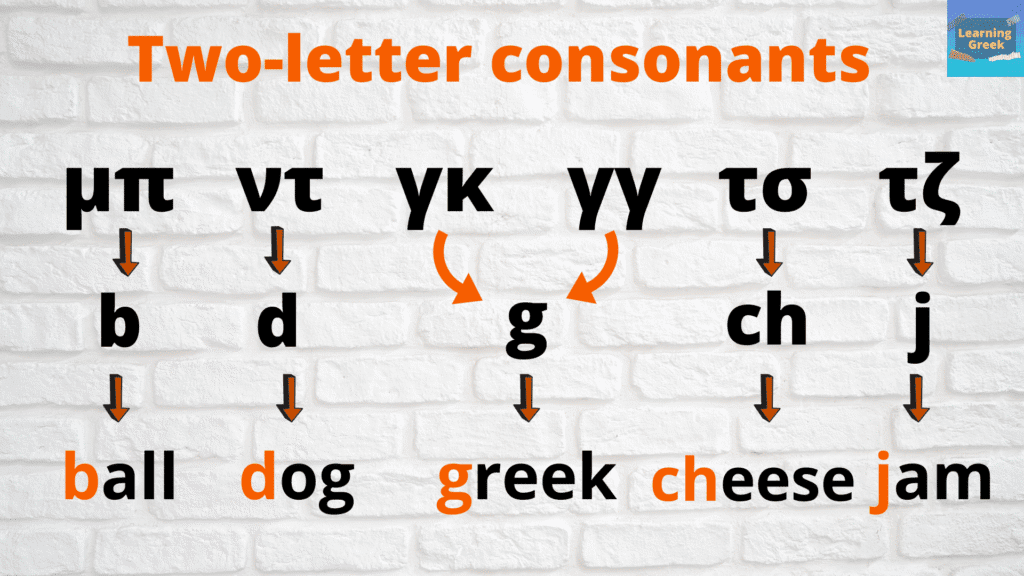
μπ, ντ, γκ, γγ, τσ, τζ.
ΜΠ / μπ – sounds like b in English
- Example: bat
- Notes: Appears at the beginning of words or in the middle. At the start of a word, it’s a hard b sound. In the middle, it may sound closer to mb.
ΝΤ / ντ – sounds like d in English
- Example: dog
- Notes: At the start of a word, it’s a hard d sound. In the middle, it can resemble nd.
ΓΚ / γκ – sounds like g in English
- Example: go
- Notes: Appears at the beginning of a word. In the middle, it may sound like ng.
ΓΓ / γγ – sounds like n + g (like ng in sing)
- Example: sing → the ng sound
- Notes: Always represents a nasal n before the hard g.
ΤΣ / τσ – sounds like ch in English
- Example: chair or cheese
- Notes: Always a voiceless affricate, like ch in “church.”
ΤΖ / τζ – sounds like j in English
- Example: jam
- Notes: Always a voiced affricate, like j in “juice.”
The images below will help you understand two-letter consonants better.
Words that include Greek two-letter consonants
Letter Combinations – Examples:
μπ
- ο μπαμπάς (babas) – father
- το μπαλόνι (baloni) – baloon
- το μπισκότο (biscoto) – biscuit
ντ
- η ντομάτα (domata) – tomatoe
- το δόντι (thodi) – tooth
- ο ελέφαντας (elefadas) – elephant
γκ
- η πριγκίπισσα (prigipissa) – princess
- η αγκαλιά (agalia) – hug
- το σαλιγκάρι (saligari) – snail
γγ
- το αγγούρι (aguri) – cucumber
- το φεγγάρι (fegari) – moon
- ο άγγελος (agelos) – angel
τσ
- η κάλτσα (kalcha) – sock
- η τσάντα (chanda) – bag
- το παπούτσι (paputsi) – shoe
τζ
- το τζάμι (jami) – glass
- ο ταξιτζής (taxijis) – taxidriver
- το τζάκι (jaki) – fireplace
A Final Note on Letter Combinations
Greek letters might look tricky at first, but don’t worry!
Once you get used to their sounds, reading and speaking will start to feel almost like a game. Keep practicing, have fun with it, and soon those letters will start dancing off the page all on their own!
If you’re feeling comfortable with these letter combinations, you can move on to the special sounds of αυ and ευ . They are a bit unique, but you’ve got this!
Well, that was it for today. See you at our next lesson! 🙂

Thank you!!! This is very helpful!!!
Hey! I’m glad I could help! 🙂
Thank you very much
Hi there, Grecophile since I was nine years old. Don’t have the money to go to school. Would love to know if there is a community of free learning and interacting in the Greek language. Good job on teaching and thank you
Hello, you can always join our facebook group https://www.facebook.com/groups/681017825336889 I’m researching right now best apps for learning Greek and I’ll make posts about them. Stay tuned!
Pingback: Greek Punctuation Marks and Orthographic Points