
Hello to all my Greek learners!
We’ve seen how cases work in Greek in a previous article, but I can feel the struggle a lot of you have with the Greek Accusative Case. It can definitely feel a bit overwhelming at first!
So, let’s go deeper into this and see in a simple way how this case works.
How to Spot the Greek Accusative Case
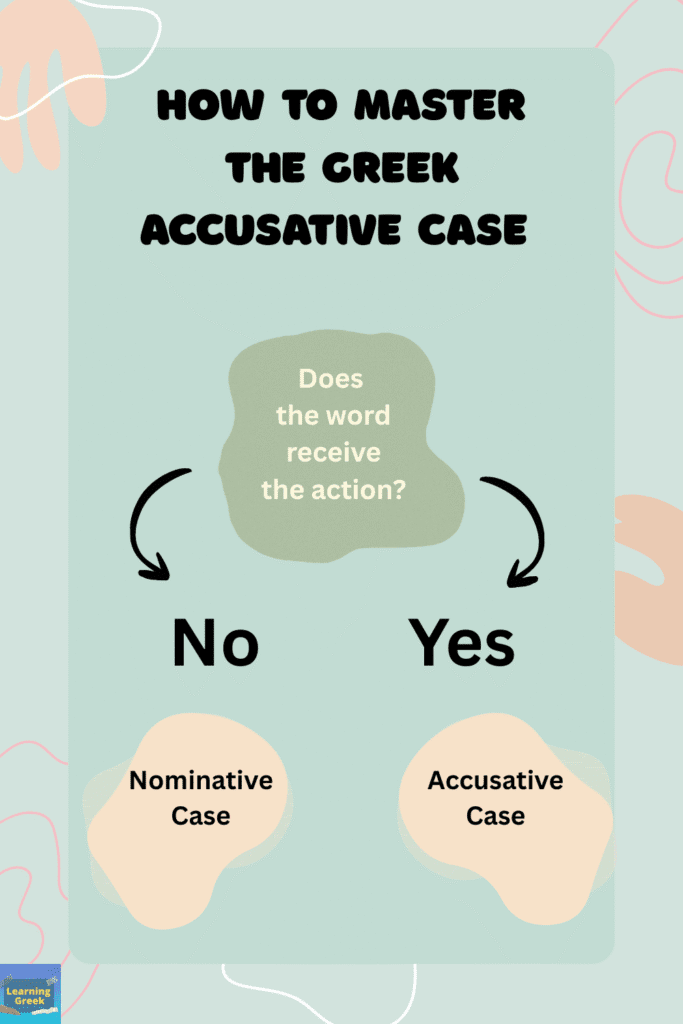
Think of the Greek Accusative Case simply as the “Receiver.” While the subject of your sentence is the one doing the action, the Accusative tells us who or what is on the receiving end.
To find the receiver in a sentence, we ask two simple questions:
Ποιον; (pion?) — Who? or
Τι; (ti?) — What?
Imagine this sentence: Ο Πέτρος βλέπει τη Μαρία (o Pétros vlépi ti María) — Petros sees Maria.
Πέτρος is the one doing the seeing.
Mαρία is the one being seen. She is “receiving” the look.
Because Maria is the receiver, her name and the article before it change to the Accusative case.
Let’s see some more examples to make it perfectly clear.
Who?
Ο μπαμπάς φωνάζει τον Κώστα. (o bampás fonázi ton Kósta) — Dad is calling Kostas.
The Logic: Who is Dad calling? Τον Κώστα.
What?
Ο μαθητής διαβάζει την ιστορία. (o mathitís diavázi tin istoría) — The student reads the history/story.
The Logic: What is the student reading? Την ιστορία.
The Articles: Your Best Friends
To use the Accusative, you usually just need to change the article (the word for “the”). Here is how article changes from the subject form (Nominative) to the receiver form (Accusative).
| Gender | Subject (Nominative) | Receiver (Accusative) |
| Masculine | ο (o) οι (i) | τον (ton) τους (tous) |
| Feminine | η (i) οι (i) | τη (ν) (tin) τις (tis) |
| Neuter | το (to) τα (ta) | το (to) τα (ta) |
Quick Tip: Notice that the Neuter form το (to) stays exactly the same!
If you want to know when to keep or drop the “n” at the end of τη(ν), you can read more in my guide on the rules for using the final ν.
What Happens to the Nouns?
The Greek Accusative Case affects all nouns, but it is much easier than it looks! Most feminine and neuter nouns stay exactly the same. Only the article changes. Masculine nouns are the only ones that usually lose their final -ς.
Masculine Nouns – The “Changers”
These nouns drop the final -ς when they receive an action.
The friend: ο φίλος (o fílos) → τον φίλο (ton fílo)
Περιμένω τον φίλο μου (periméno ton fílo mou) — I am waiting for my friend.
The coffee: ο καφές (o kafés) → τον καφέ (ton kafé)
Θέλω τον καφέ (thélo ton kafé) — I want the coffee.
Feminine Nouns
The noun itself doesn’t change; you only need to change the article to τη(ν).
The door: η πόρτα (i pórta) → την πόρτα (tin pórta)
Κλείνω την πόρτα (klíno tin pórta) — I close the door.
The mother: η μητέρα (i mitéra) → τη μητέρα (ti mitéra)
Αγαπάω τη μητέρα μου (agapáo ti mitéra mou) — I love my mother.
Neuter Nouns
These are the simplest because absolutely nothing changes!
The water: το νερό (to neró) → το νερό (to neró)
Πίνω το νερό (píno to neró) — I drink the water.
The child: το παιδί (to pedí) → το παιδί (to pedí)
Βλέπω το παιδί (vlépo to pedí) — I see the child.
Prepositions
Some small words act like “magnets” for the Accusative. When you see these prepositions, the word following them must be in the Accusative:
σε (se) (to / in / at):
Πάω στην αγορά (páo stin agorá) – I go to the market.
με (me) (with):
Είμαι με τον φίλο (ímai me ton fílo) – I am with the friend.
για (gia) (for / about):
Είναι για τη Μαρία (íne gia tin María) – It is for Maria.
από (apó) (from):
Είμαι από την Ελλάδα (ímai apó tin Elláda) – I am from Greece.
The Golden Rule of the Greek Accusative Case
When you’re writing or speaking, don’t get stuck on every single grammar rule. Just remember this:
If the person or thing is receiving the action, focus on the article. Use τον (ton) for the guys, τη(ν) (ti/tin) for the girls, and το (to) for everything else.
If you get the article right, most Greeks will understand you perfectly, even if you forget to drop a final -ς here or there!
You’ve Got This!
Learning the Greek Accusative Case is a marathon, not a sprint. At the end of the day, the goal is to communicate and connect with people. If you use τον (ton) instead of ο (o) when you’re talking about your friend, you’re already halfway there!
Don’t be afraid to make mistakes. That’s exactly how we learn. Keep practicing those “receiver” sentences, and soon it will feel like second nature.
Happy Greek learning!



Λατρεύω όλα όσα κάνετε!
Ευχαριστώ πάρα πολύ!
Finally! A resource that is giving me what I want to know! I have been looking for something like this, but only finding things that don’t explain enough, or explain to technically, neither of which helps. This is great!!! Ευχαριστώ πολύ!!
I’m so glad I could help!
If you have questions about specific rules, please do let me know and I will try to simplify it 🙂
Vos explications sont trés utiles car trés abordables , faciles à comprendre et assimiler .Vous me permettez de progresser plus facilement et avec confiance .Merci beaucoup Marina .
Merci beaucoup! I’m so happy to hear that the lessons are helping you progress with confidence. That is exactly why I do this 🙂