
Hello my beautiful Greek learner enthusiasts!
And yes, I’m emphasizing the word enthusiasts, because as the Facebook page and group grow, I see people from all around the world eager to learn Greek and not afraid to ask questions. And this is very important because questions move you forward and add solid bricks to your journey of learning.
Some questions can be answered in a comment, but others need more space and attention. And that’s exactly the kind of question we’re dealing with today.
But let’s take things from the beginning.
A few days ago, I posted a reel asking you to choose the correct article. This is the image from the reel.
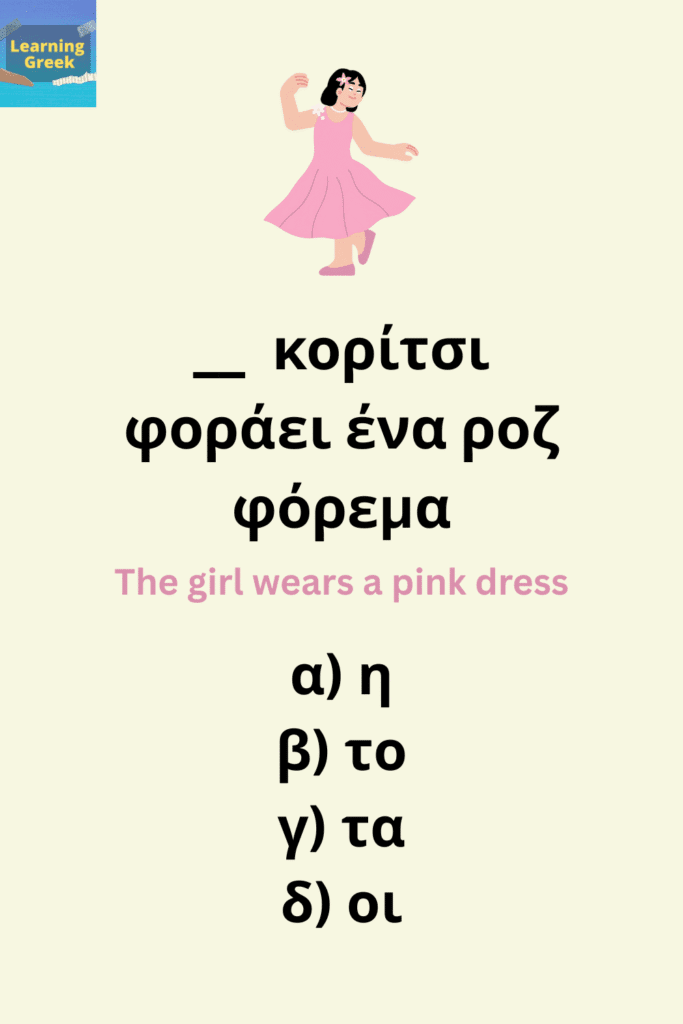
Before scrolling down, take a moment to think of the answer.
As i saw from your answers, it was easy to exclude:
γ) τα
δ) οι
because they were plural articles. No one chose those.
But confusion started between
α) η
β) το
Although the correct answer is β) το, a lot of you chose α) η.
And I had questions like:
Why isn’t it η?
Yes, I can understand the confusion and maybe the thought behind it. Greeks are crazy? The girl is feminine!
One comment said:
Doesn’t make sense to foreign people, but it’s like that.
This is why I’m here to explain today. And trust me it will not only make sense for this particular word – το κορίτσι – but it will also help you recognize many neuter nouns in Greek, even if you don’t know their meaning yet.
But let’s put everything in order by explaining first this particular word, το κορίτσι, and then we will look at the bigger picture, where I will help you recognize many neuter words.
Why the word κορίτσι is neuter
The first, simple and grammatical explanation is that it ends with -ι. That’s it actually!
But if you want to go a little deeper you need to find the root of the word.
Κορίτσι comes from the Ancient Greek word κόρη that during Byzantine Greek became κορίτσι by adding the diminutive -ίτσι. And all diminituves are neuter in Greek.
There’s another explanation saying that words referring to children are often neuter.
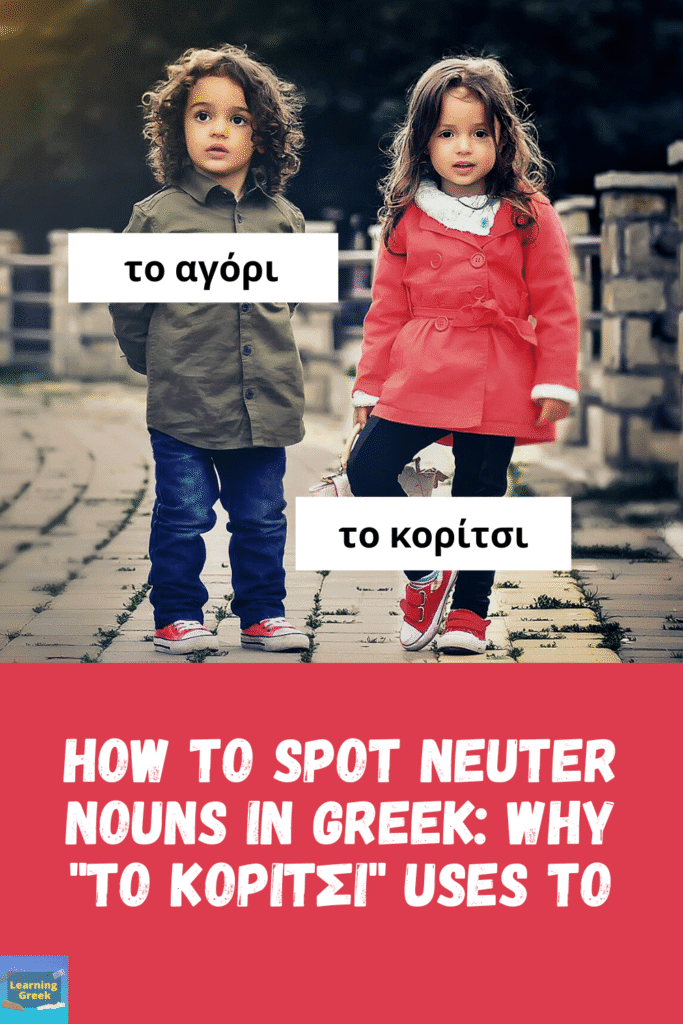
το παιδί (to pedí)- the child
το αγόρι (to agóri)- the boy
το κορίτσι (to korítsi)- the girl
All children, all neuters!
Now let’s see the big picture and talk about how you can distinguish if a word is neuter in Greek.
It’s all about the endings
An easy way to understand the gender of a noun in Greek, even if you don’t know the meaning of it, is to look at the ending of the word. The ending in most cases will guide you. And we’re going to talk about neuter endings today. I don’t want to throw all genders to you at once. The important thing is to digest what you’re learning. So, let’s get started!
Greek Neuters Ending in -ι, -ια
Let’s bring agαin the examples we used above. You can see that all three words end in -ι and in plural they end in -ia
το παιδί (to pedí)- the child / τα παιδιά (ta paidiá)
το αγόρι (to agóri) – the boy / τα αγόρια (ta agória)
το κορίτσι (to korítsi)- the girl / τα κορίτσια(ta korítsia)
We have some words in Greek that their meaning can be found in two genders. Look the words below.
ο σκύλος (o skílos) – the dog —> το σκυλί (to sklí) – the dog / τα σκυλιά (ta skiliá)
η γάτα (i gáta) – the cat —> το γατί (to gatí)- the cat again / τα γατιά (ta gatiá)
As you can see in the examples above, both words in neuter end in -ι.
-ι is the most common ending of neuter words and you will find it in a bunch of words.
Neuters in -μα, -τα
Another very common ending for neuters is the -μα ending which in plural becomes -τα. Let’s see some examples.
το μάθημα (to máthima) – the lesson / τα μαθήματα (ta mathímata)
το όνομα (to ónoma) – the name / τα ονόματα (ta onómata)
το σώμα(to sóma) – the body / τα σώματα (ta sómata)
το αίμα (to éma) – the blood / τα αίματα (ta émata)
το χρώμα (to chróma) – the color / τα χρώματα (ta chrómata)
Neuters in -ο, -α
You will certainly come accross neuters with these endings. Let’s see some of them.
το βιβλίο (to vivlío) – the book / τα βιβλία (ta vivlía)
το αυτοκίνητο (to aftokínito) – the car / τα αυτοκίνητα (ta aftokínita)
το σχόλιο (to schólio) – the comment / τα σχόλια (ta schólia)
το πλοίο (to plío) – the ship / τα πλοία (ta plía)
το δέντρο (to déntro) – the tree / τα δέντρα (ta déndra)
Greek Neuters in -υ, -α
Although in Modern Greek we don’t have so many words ending in -υ, is good to recognize it when you see it especially in common words like:
το βράδυ (to vrádi) – the night / τα βράδια (ta vrádia)
το δάκρυ (to dákri)- the tear / τα δάκρια (ta dákria)
Neuters ending in -ν, -vτα
Again not so common but we have some really interesting words in Greek ending in -ν. Let’s see some:
το παρόν (to parón) – the present / τα παρόντα (ta parónta)
το παρελθόν (to parelthón) – the past / τα παρελθόντα (ta parelthónta)
το ενδιαφέρον (to endiaféron) / the interest τα ενδιαφέροντα (ta endiaféronta)
το περιβάλλον (to perivállon) / the environment τα περιβάλλοντα (ta perivállonta)
το προϊόν (to proïón) / the product τα προϊόντα (ta proïónta)
So, until now we saw that neuters end in -ι, -μα, -ο ,-υ and -ν.
Once you spot these endings, you know immediately that the word is neuter and it needs το or τα if it’s in plural as an article.
Have we finished? I’m afraid not.
Are you gonna hate me for what comes next? Probably…but remember Greek Grammar is not my creation. Greek is one of the oldest languages that has evolved during the centuries blah, blah. I know I’m not saving it a lot but… I feel you.
So, let’s continue
Greek neuters ending in -ος, -η
Yes, I know! This is a very common ending for male nouns and adjectives and some feminines. I know that you probably want to turn off your phone or laptop at this point but before doing that, wait! I have a small trick to recognize what is neuter. But let’s see first some examples:
το λάθος(to láthos) – the mistake / τα λάθη (ta láthi)
το πάθος (to páthos) – the passion / τα πάθη (ta páthi)
το κράτος (to krátos) – the state / τα κράτη (ta kráti)
το δάσος (to dásos) – the forest / τα δάση (ta dási)
το κέρδος (to kérdos) – the profit / τα κέρδη (ta kérdi)
The trick
Ok, now I want you to look carefully at the ending of the plural.
They all end in -η.
And this is actually the trick. When you are not sure about the gender of a word, just think of its plural form. If it ends in -η, chances are that you have come across a neuter word.
In fact, you can apply this trick to many words that you are unsure. If the plural of a word ends in -η or -a, then you are probably looking at a neuter word.
Smaller Categories
These are all the major categories but we do have some neuter words with different endings from the above ones. They don’t include many words but some of them are very common so it so good to know them.
neuters in -ας, – τα
το κρέας (to kréas) – the meat / τα κρέατα (ta kréata)
το τέρας (to téras) – the monster / τα τέρατα (ta térata)
neuters in -ως, – τα
το φως (to fós) – the light / τα φώτα (ta fóta)
το καθεστώς(to kathestós) – the regime / τα καθεστώτα (ta kathestóta)
neuters in -ες, -η
το ιδεώδες(to ideódes) – the ideal / τα ιδεώδη (ta ideódi)
το αιλουροειδές (to eluroidés) – the feline / τα αιλουροειδή (ta eluroidí)
There are also some words from older versions of Greek that we still use today and they are neuter. Words like πυρ (pyr) – fire or ήπαρ (to ípar) – liver.
Quick Referance Table of Neuter Endings
| Ending | Usually Neuter | Example |
|---|---|---|
| -ι | ✔ | κορίτσι |
| -μα | ✔ | μάθημα |
| -ο / -ιο | ✔ | βιβλίο |
| -υ | ✔ | βράδυ |
| -ν | ✔ | προϊόν |
| -ος | sometimes | λάθος |
| -ας | few | κρέας |
| -ως | few | φως |
Conclusion
So…are Greeks crazy because a girl is neuter? Nope!
Greek grammar just follows patterns that don’t always match biological gender.
Once you start noticing endings, something magical happens. Words stop looking random. You start guessing genders correctly, even for words you see for the first time.
And remember that every question you ask, every confusion you share, every mistake you make…it’s just another solid brick in your learning journey.
Keep going! I’m right here with you 🙂

OMG! Ευχαριστώ πολύ! You just explained to me one of the rule that most confused me since I’m in Greece (8years rolling). I was always walking on eggshells when using words like λάθος, κρέας, κράτος… Χίλια ευχαριστώ 🙌🏼
Hey,
I’m glad I could help 🙂
Γεια σου 😊
Μερικές φορές μπαίνω εδώ και διαβάζω λίγο.
Τις τελευταίες εβδομάδες προσπαθώ σιγά σιγά να μάθω ελληνικά, αλλά δεν είναι εύκολο…
Είμαι Πολωνή και σε λίγα χρόνια θα ήθελα να μετακομίσω στην Ελλάδα, οπότε αξίζει να μάθω έστω λίγα από τη γλώσσα.
Είναι όμως δύσκολο να βρω έναν καλό Πολωνό δάσκαλο.
Τα αγγλικά δεν είναι το δυνατό μου σημείο, αλλά μου αρέσει να μένω εδώ και να διαβάζω περισσότερο.
Σε ευχαριστώ πολύ 💛
Τα Ελληνικά σου είναι σε πολύ καλό επίπεδο!
Χαίρομαι πολύ που βρίσκεις τα άρθρα μου χρήσιμα.
Με το καλό να έρθεις στην Ελλάδα 🙂
Ευχαριστώ, Μαρίνα! Τα εξηγείς πολύ καθαρά και με βοηθάς πολύ
Χαίρομαι πολύ που σε βοηθάω! 🙂
Γεια σας!.. είμαι ο Παμπλος! Προς το παρόν μαθαίνω ελληνικά. Χαρικα που ειμαι εδώ.