

Hello my wonderful Greek learners!
Today, we’re going to explore a Greek proverb that is bittersweet and deeply human.
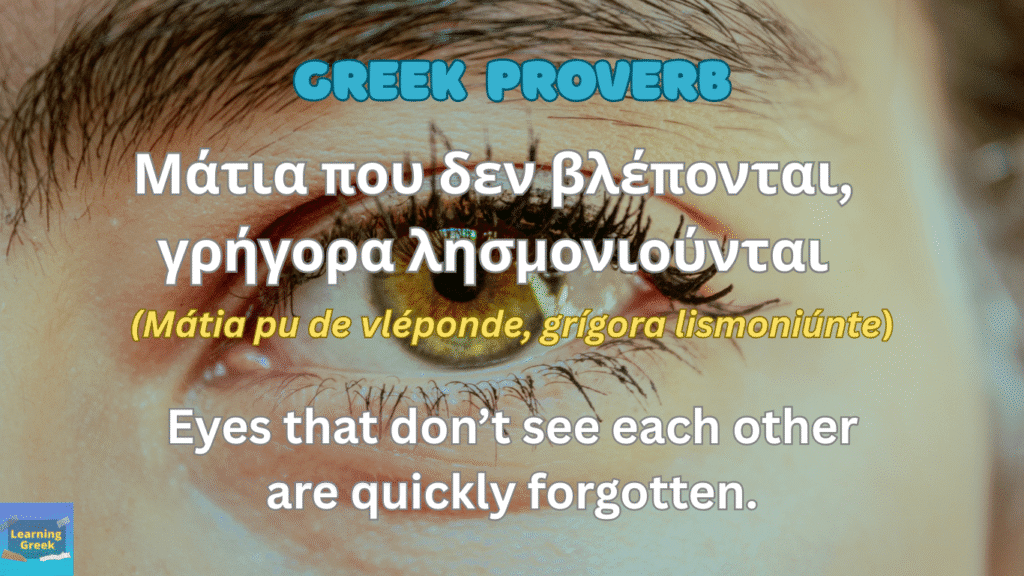
Μάτια που δεν βλέπονται, γρήγορα λησμονιούνται, we Greeks love to say.
But let’s see what it really means, how it is used and why it still feels painfully accurate.
Μάτια που δεν βλέπονται, γρήγορα λησμονιούνται
(Mátia pu de vléponde, grígora lismoniúnte)
Literal Translation: Eyes that don’t see each other are quickly forgotten.
Meaning: This proverb points to a simple truth. Distance weakens connection. When people stop seeing each other regularly, feelings fade, bonds loosen, and even strong relationships can slowly drift apart. It doesn’t always mean there’s bad intention. Life just gets in the way.
Greeks use this phrase to talk about:
– Friendships that fade over time
– Long-distance relationships
– People who promise to stay in touch but don’t
– Emotional distance, not just physical absence
Grammatical Breakdown
Μάτια (Mátia)
Type: Noun, plural
το μάτι -τα μάτια
Meaning: Eyes
Usage: Often used symbolically in Greek to talk about attention, connection, or observation.
που (pu)
Type: Relative pronoun
Meaning: That / which
Usage: Connects the subject (μάτια) to the verb (βλέπονται), forming the clause.
δεν (den)
Type: Particle (negation)
Meaning: not / don’t
Usage: Negates the verb that follows (δεν βλέπονται)
A little note:
You might see the proverb written with δε or δεν.
There is a consensus to use δεν in modern Greek writing to avoid confusion between δεν and δε.
But if you want to learn how to use the final -v properly, you can take a look at my article:
The Rules for Using the Final ν
βλέπονται (vléponde)
Type: Verb, passive voice, third person plural of the verb βλέπομαι. Active voice – Βλέπω
Meaning: See each other
Usage: Indicates mutual action between people.
γρήγορα (grígora)
Type: Adverb
Meaning: Quickly
Usage: Describes the speed at which something happens.
λησμονιούνται (lismoniúnte)
Type: Verb, passive voice, third person plural of the verb λησμονούμαι. Active voice – λησμονώ
Meaning: Are forgotten
Usage: More poetic and emotional than ξεχνιούνται (from the verb ξεχνώ – forget)
Examples in Context
- Friendship Example
Talking about someone you haven’t seen in years.
Χαθήκαμε με τον Στέλιο. Από τότε που έφυγε στο εξωτερικό, δεν ξαναμιλήσαμε. Μάτια που δεν βλέπονται, γρήγορα λησμονιούνται…
Chathíkame me ton Stélio. Apó tóte pou éfiye sto exoterikó, den xanamílisame. Mátia pu den vléponde, grígora lismonioúnte…
We lost touch with Stelios. Since he moved abroad, we haven’t spoken again. Out of sight, out of mind… - Relationship Example
Commenting on a long-distance relationship
Χώρισαν η Μαρία και ο Γιάννης. Ε, μάτια που δεν βλέπονται…
Chórisan i María ke o Yiánnis. E, mátia pou den vléponde…
Maria and Yiannis broke up. Well, out of sight…
Greeks often don’t even finish the proverb because the meaning is obvious.
Tone and Usage
This proverb is very common in spoken Greek. It is slightly melancholic, but it is used as an observation, not a complaint. It is not rude nor dramatic.
Similar Proverb in English
An English equivalent could be Out of Sight, Out of Mind.
But I think that the Greek version is more tender, emphasizing the importance of presence in relationships.
Cultural Insight
This proverb reflects how much Greeks value presence.
Seeing someone regularly, sharing a cup of coffee or a meal, these small things really matter.
Historically, Greek communities were close-knit and physical presence was essential. When people moved away, maintaining relationships was hard. No phones, no messages, no easy way to stay connected. This proverb grew out of this reality.
But even today, despite technology, the proverb still hits home. Because deep down, Greeks believe real connections need presence.
Final Thoughts
Μάτια που δεν βλέπονται, γρήγορα λησμονιούνται, isn’t cynical. It is honest.
It reminds us to show up, stay connected, and not take closeness for granted. Because affection, like language, fades when you stop practicing it.
And if learning Greek ever feels slow, just remember. The more you see it, hear it, and use it, the less likely it is to be forgotten!
Happy learning!
If you enjoy how I explain Greek proverbs, check out also these ones:
– The Meaning Behind ‘Αγάλι αγάλι γίνεται η αγουρίδα μέλι’: A Lesson in Patience
– The Wisdom of ‘Όποιος βιάζεται, σκοντάφτει’
– The Wisdom of ‘Απ’ το στόμα σου και στου Θεού τ’ αυτί’: A Greek Lesson on Hope and Faith


Thank you for this proverb. In German we say: “Aus den Augen, aus dem Sinn”. Close to the english translation: Out of the eyes, out of the mind.
You’re welcome! Thank you for providing the German version.
In Spanish we say “ojos que no ven, corazón que no siente”. It’s something so as “eyes that don’t see, heart that doesn’t feel”. Mainly used when you cheat your boy/girlfriend or husband/wife.
I’m happy now ‘cos I understood the spanish phrase without the translation 😀