
Hello, my Greek language enthusiasts! 😊
Let’s talk about the “i” sound in Greek spelling. It’s one of the trickiest parts of learning Greek, but with a little practice and some handy tips, you’ll get the hang of it in no time!
In Modern Greek, the “i” sound can be written in six different ways: ι, η, υ, ει, οι, υι. At first it might feel overwhelming, but don’t worry, understanding the “i” sound in Greek will help you recognize patterns, rules, and exceptions making it easier to know which letter to use.
And because I know that six different ways to write one sound might feel terrifying at first, I’ve created a handy cheat sheet for you with the most common ‘i’ sounds you’ll meet. Keep it close, and then let’s dive into all the forms together!
Your Quick “i” Sound Cheat Sheet
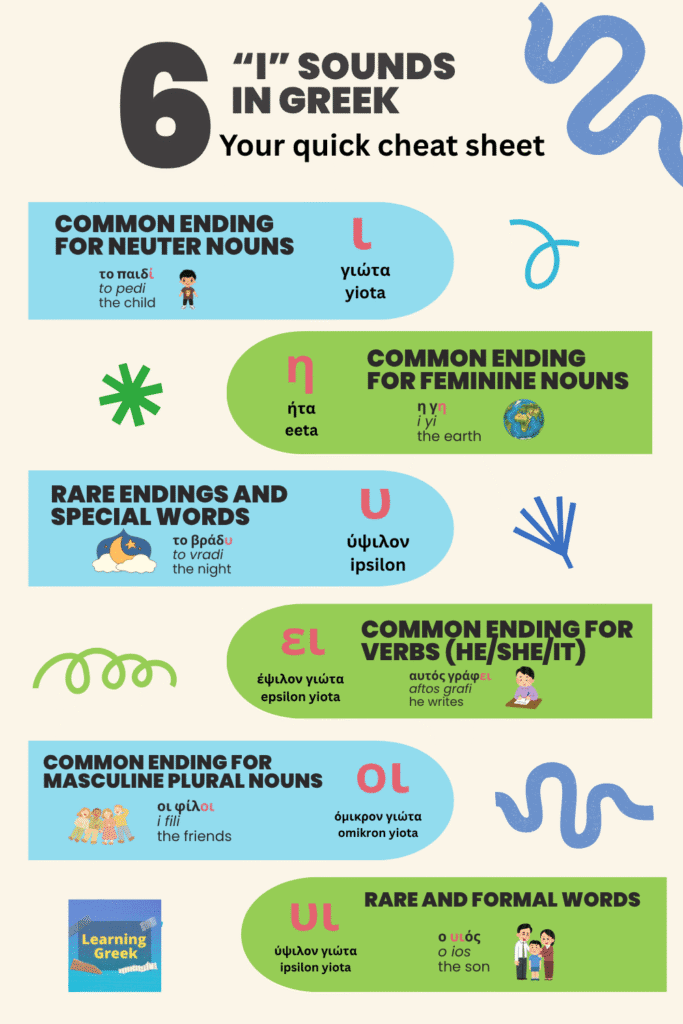
If you’re in a middle of a sentence and need a fast answer, here is how to pick the right “i”:
The “Object” Rule (το): Use -ι for most neutral “thing” words.
το παιδί (to pithí) — the child
The “Girl” Rule (η): Use -η for feminine words.
η γη (i yi) — the earth
The “Action” Rule: When “he” or “she” is doing something, it usually ends in -ει.
αυτός γράφει (aftós gráfi) — he writes
The “Group” Rule (οι): Talking about a group of friends? Use the plural -οι.
οι φίλοι (i fíli) — the friends
The “Rare” Ones: Words like το βράδυ (to vráthi — the evening) or ο υιός (o iós — the son) are special cases to memorize as you go!
Got the basics down? Great! Now, let’s take a closer look at all six forms and the secret rules that make them easy to remember.
What the “i” Sound in Greek Actually Is
Greek has a rich history, and the different spellings of “i” reflect that. While all these letters and combinations sound the same today, they often hint at a word’s origin or grammatical function. Learning to spot these clues makes spelling much easier and gives you a solid handle on the “i” sound in Greek.
General Patterns for Each Way to Write the “i” Sound in Greek
Now let’s break it down and make it easier to understand, so you can confidently write the “i” sound in Greek in any word!
When to use ι – γιώτα / yiota
Common in neuter noun endings
e.g., το παιδί (to pedí) – the child, το καλοκαίρι (to kalokéri) – the summer
However, there are some exceptions such as
το βράδυ (to vrádi) – the night, το δάκρυ (to dákri) – the tear, το δίχτυ (to díhti) – the net, το στάχυ (to stáhi) – the ear of corn
Used in many diminutives (words made smaller or cuter)
e.g., το σπιτάκι (to spitáki) – the little house
When to use η – ήτα / eeta
Found in feminine noun endings
e.g., η γη (i yi) – the earth
In addition, adjectives ending in -η
e.g., μικρή (mikrí) – small, ζεστή (zestí) – warm
When to use υ – ύψιλον / ipsilon
Found in specific word roots or derivatives, often from Ancient Greek
e.g., η υγεία (i iyía) – health, ο ύπνος (o ípnos) – sleep.
Part of diphthongs or compound words
e.g., το αυτί (to aftí) – the ear, where υ combines with α
Similarly, you can read more about αυ and ευ, here: Vowel combinations – αυ and ευ
Greek words that end in -υ without forming part of the diphthongs ου (u), αυ , or ευ are relatively uncommon, which makes them easier to memorize.
Below are their main categories, along with examples:
Nouns Ending in -υ
βράδυ (vrádi) – night, δάκρυ (dákri) – tear,ισχύς (ischís) – force, άστυ (ásti) – city, δίχτυ (díhti) – net, μυς (mis) – muscle, οξύ (oxí) – acid, and στάχυ (stáhi) – cob.
Adjectives Ending in -υς
πολύς (polís) – much/many, ευθύς (efthís) – straight, ελαφρύς (elafrís) – light, παχύς (pahís) – thick/fat, βαρύς (varís) – heavy/strong, βαθύς (vathís) – deep, μακρύς (makrís) -long.
Adverbs Ending in -υ
πολύ (polí) – very/too much/a lot,μεταξύ (metaxí) – between, αναμεταξύ (anametaxí) – among, .αντίκρυ (andíkri) – opposite.
Pronouns
The pronoun εσύ (esí) – you is a widely used word in this category.
When to use ει – έψιλον γιώτα / epsilon yiota
Often used in verb form endings of 2nd and 3nd person
e.g., εσύ βλέπεις (esí vlépis) – you see, αυτός βλέπει (aftós vlépi) – he sees
When to use οι – όμικρον γιώτα / omikron yiota
Common ending of masculine plural nouns and adjectives
e.g., οι καλοί (i kalí) – the good ones, οι φίλοι (i fíli) – the friends
The plural forms of feminine -ος (-os) ending nouns
e.g., η είσοδος (i ísodos) – entrance – οι είσοδοι (i ísodi) – entrances, η μέθοδος (i méthodos) – method – οι μέθοδοι (i méthodi) – methods
When to use υι – ύψιλον γιώτα / ipsilon yiota
Rare in Modern Greek but present in certain words, mostly archaic or formal
e.g., o υιός (o iós) – the son and its derivatives; for example, η υιοθεσία (i iothesía) – adoption
Often replaced in colloquial usage by simpler forms
e.g., υιός is commonly replaced by γιος.
The “i” Sound in Greek in Prefixes
Prefix δυσ- (Difficulty or Bad):
δυσάρεστος (disárestos) – unpleasant, δύσπιστος (dίspistos) – skeptical, δυστυχής (dιstιchís) – unfortunate
Prefix δι-/δισ- (Two):
δίδραχμο (dídrachmo) – two-drachma coin, δικέφαλος (dikéfalos) – two-headed, διπρόσωπος (diprósopos) – double-faced
Prefix δυ- (Two, but thematic):
δυάρι (diári) – pair, two-unit apartment, δυαρχία (diarchía) – diarchy
Key Suffixes for the “i” Sound in Greek
-τήριο (-tírio):
Used in words denoting places related to a specific function.
e.g. το εργαστήριο (to ergastírio) – laboratory, το δικαστήριο (to dikastírio) – courthouse.
-οσύνη (-osíni):
Found in abstract feminine nouns.
e.g., η καλοσύνη (i kalosíni) – kindness, η δικαιοσύνη (i dikaiosíni) – justice.
-ότητα (-ótita):
Used in abstract feminine nouns.
e.g., η ανθρωπότητα (i anthropótita) – humanity, η κοινότητα (i kinótita) – community.
-είο (-ío):
Found in nouns referring to places (with stress on ει).
e.g., το σχολείο (to scholío) – school, το νοσοκομείο (to nosokomío) – hospital, το γραφείο (to grafío) – office.
-ιο (-io):
Common in neuter nouns referring to objects.
e.g., το εργοστάσιο (to ergostásio) – factory, το ημερολόγιο (to imerolóyio) – diary, το βιβλίο (to vivlío) – book.
-ημα (-ima) (neuter nouns):
Commonly used in neuter nouns.
e.g., το μάθημα (to máthima) – lesson, το διάστημα (to diástima) – interval, το ποίημα (to píima) – poem.
Exceptions: Μήνυμα (mínima) – message, έλλειμμα (éllima) – deficit/shortfall .
-ιά (-iá):
Found in feminine nouns and often denotes a quality or association.
e.g., η γιαγιά (i yiayiá) – grandmother, η μηλιά (i miliá) – apple tree, η αγκαλιά (i angaliá) – hug.
Exceptions: Δουλειά (douliá) -work/job, παντρειά (pantriá) – marriage, σοδειά (sodiá) – harvest.
-εία (-ía):
Common in abstract feminine nouns and derivatives of verbs ending in -εύω.
e.g., η μαγεία (i mayía) – magic, η γοητεία (i goitía) – charm.
-ίδι (-ídi):
Found in diminutives and neuter nouns.
e.g., το στολίδι (to stolídi) – ornament, το ταξίδι (to taxídi) – journey, το παιχνίδι (to pechnídi) – game.
Exceptions: Καρύδι (karídi) – walnut, κρεμμύδι (kremmídi) – onion, φρύδι (frídi) – eyebrow.
-ισμός (-ismós):
Found in masculine nouns referring to ideologies or systems.
e.g., ο πολιτισμός (o politismós) – civilization, ο αθλητισμός (o athlitismós) – sportsmanship.
-ιστής (-istís) / -ητής (-itís) / -ίτης (-ítis):
Used in masculine nouns referring to professions, roles, or traits.
e.g., ο πολεμιστής (o polemistís) – warrior.
-ίδα (-ída)
Found in feminine nouns.
e.g., η νυχτερίδα (i nychterída) – bat, η γαρίδα (i garída) – shrimp, η εφημερίδα (i efimerída) – newspaper
-ήθρα (-íthra)
Used in feminine nouns often referring to objects or receptacles.
η δαχτυλήθρα (i dachtylíthra) – thimble, η τσουλήθρα (i tsoulíthra) – slide.
-ισσα (-issa)
These words are typically feminine nouns, such as:
Η μάγισσα (i mágissa) – witch, Η βασίλισσα (i vasílissa) – queen, Η μέλισσα (i mélissa) – bee
-πώλης and -πωλείο
Derived from the verb πωλώ (to sell in formal Greek or ancient Greek):
ο βιβλιοπώλης (o vivliopólis) – bookseller, ο ανθοπώλης (o anthopólis) – florist
Similarly, nouns ending in “-πωλείο” follow this pattern:
το βιβλιοπωλείο (to vivliopoleío) – bookstore
-ποιός and -ποιείο
Derived from the verb ποιώ (to create or to make):
ο αρτοποιός (o artopiós) – baker, ο ηθοποιός (o ithopoiós) – actor
Nouns ending in “-ποιείο” follow the same logic:
το αρτοποιείο (to artopoieío) – bakery
When the “i” Sound in Greek is Not at the End of a Word
If the ‘i’ sound occurs within a word rather than at the end, then focusing on the root or the components of compound words can often guide you. Moreover, roots can provide clues based on words you may already recognize.
For instance, if you know how to spell φίλος (fílos – friend), then words derived from it will also include φι- spelled the same way. Next, here are some examples:
- φιλία (filía) – friendship
- φιλοσοφία (filosofía) – philosophy
- φιλόσοφος (filósophos) – philosopher
- φιλοξενούμενος (filoxenúmenos) – guest
Similarly, understanding a root like κύκλος (kίklos – circle) can help with related terms:
- κυκλικός (kιklikós) – circular
- κύκλωμα (kίkloma) – circuit
- εγκύκλιος (engίklios) – circular letter or encyclical
- πολύκυκλος (polίkιklos) – multi-cycle
Homophones and Homonyms
Sometimes the “i’ sound in Greek isn’t just tricky for spelling. In fact, it can also create words that sound the same but mean totally different things. Here are a few fun examples:
- δανικό τυρί (Danish cheese) vs. δανεικό ρούχο (borrowed cloth)
- κριτικός (critical/judge) vs. κρητικός (Cretan)
Also, you can read more about homophones, here: Exploring Greek Homophones
Tips for Conquering the “i” Sound in Greek
1. Write Without Fear
Making mistakes is part of learning. Grab a notebook and write as much as you can without worrying about being perfect. Remember, mistakes are simply stepping stones to improvement!
2. Learn Common Root Words
Greek words often share roots that hint at their spelling. For example:
- Φίλος (fílos, “friend”) → Φιλοσοφία (filosofía, “philosophy”).
Spotting these connections helps you remember how words are built.
3. Get Familiar with Verb Conjugations
Pay attention to verb patterns, especially endings like -ει and -ι, because they repeat across many words.
4. Memorize Noun Endings and Articles
Noun endings are closely tied to their gender and number. For example:
- Ο φίλος (o fílos, “the [male] friend”) → Οι φίλοι (i fíli, “the [male] friends”).
- Η φίλη (i fíli, “the [female] friend”) → Οι φίλες (i fíles, “the [female] friends”).
In addition, the articles (ο, η, οι) can guide you to the right spelling.
5. Focus on Patterns and Suffixes
Greek has many predictable endings, yet there are also some quirky exceptions.
Conclusion
There will be moments when you’re unsure how to spell a word, especially if you’re hearing it for the first time. That’s totally okay! Greek spelling is a skill you build over time. The best advice? Keep practicing and don’t give up. With practice, you’ll be able to write the ‘i’ sound in Greek correctly in almost any word. No guessing needed.
Ready for your next spelling challenge? If you found this helpful, you’ll love my simple guides on ο vs ω: The Simple Spelling Guide and ε vs αι: Everything You Need to Know. They make those tricky vowel pairs just as easy!
So, grab your pen, dive into your favorite Greek texts, and practice with confidence. You’ve got this—καλή επιτυχία! (good luck!)


This is absolutely wonderful for a lover of languages like myself.
I’m glad it helped you!
Thanks a lot, this was very helpful
You’re welcome 🙂
Estoy sorprendido de lo versátil de su app! Lo usaré para otros idiomas pero para griego me está ayudando increíblemente.
Gracias
Thank you so much! I’m really happy it’s helping you with Greek 🙂