Hello, Greek learners! 😊
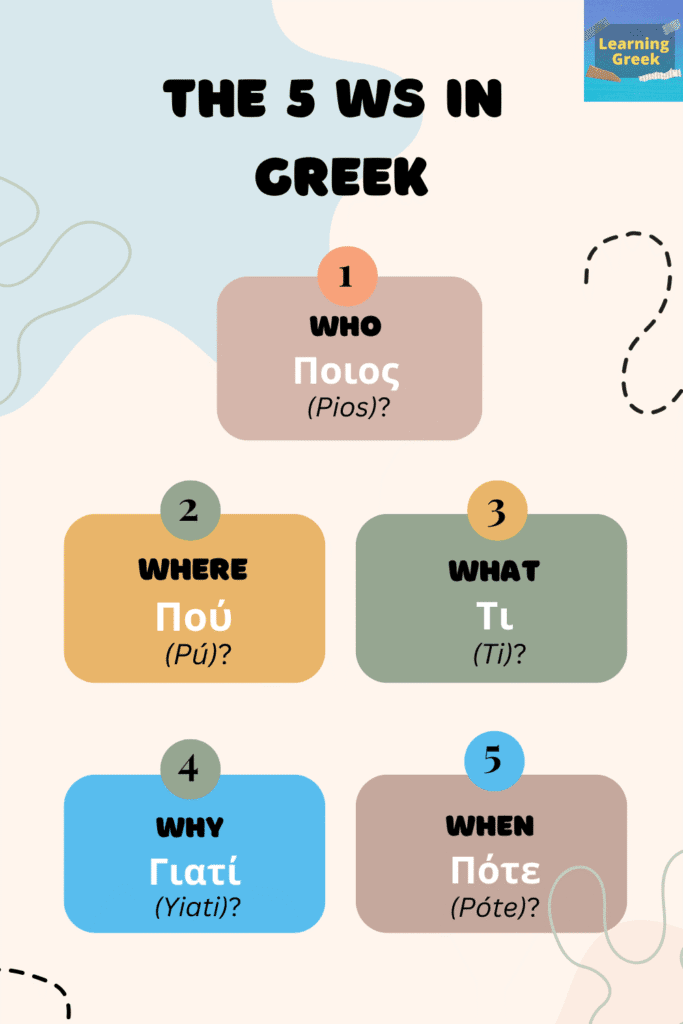
Today, we’re diving into one of the essentials for connecting phrases: the 5 Ws in Greek!
In Greek, these question words:who, what, where, when, and why, are fundamental for asking questions, gathering information, and starting conversations.
Mastering Ποιος, Πού, Τι, Γιατί, and Πότε will help you express curiosity, ask questions naturally, and engage in everyday Greek interactions.
Let’s explore each one and see how they work in context with pronunciation and example phrases!
The 5 Ws in Greek
1. Who – Ποιος (Pios)?
In Greek, Ποιος (Pios) means “Who”.
There are different forms based on gender and whether you are talking about one person or a group:
Singular (One person):
Ποιος (Pios) for masculine
Ποια (Pia) for feminine
Ποιο (Pio) for neuter
Plural (More than one):
Ποιοι (Pioi) for masculine
Ποιες (Piés) for feminine
Ποια (Pia) for neuter
Use this when asking about people, and it’s perfect for getting to know others.
If you’re still getting used to how Greek personal pronouns work with gender, don’t worry! I have a full breakdown of the basics that makes it much easier to remember.
- Ποιος είναι αυτός;
(Pios íne aftós?)
Who is he? - Ποια είναι η δασκάλα σου;
(Pia íne i thaskála su?)
Who is your teacher? - Ποιοι είναι οι φίλοι σου;
(Pioi íne i fíli su?)
Who are your friends?
2. Where – Πού (Pú)?
Πού (Pú) means “Where” in Greek.
It’s essential when you need directions or want to know the location of a person or thing.
- Πού μένεις;
(Pú ménis?)
Where do you live? - Πού είναι το βιβλίο μου;
(Pú íne to vivlío mu?)
Where is my book? - Πού θα πάμε αύριο;
(Pú tha páme ávrio?)
Where will we go tomorrow?
Πού is versatile and will come in handy in all kinds of situations, from navigating a new town to locating a friend.
Did you notice the little accent mark on Πού?
It’s actually super important! If you leave it off, που changes meaning entirely. I wrote a quick breakdown of the Πού vs που rule if you want to see how the accent changes everything.
3. What – Τι (Ti)?
Τι (Ti) translates to “What” and is super useful for getting explanations, definitions, or descriptions. Whether you’re trying to figure out what someone is doing or what an item is, τι is the word to use.
- Τι κάνεις;
(Ti kánis?)
What are you doing? - Τι είναι αυτό;
(Ti íne aftó?)
What is this? - Τι σκέφτεσαι;
(Ti skéftese?)
What are you thinking?
Τι is essential for many different types of questions, making it one of the most used question words in Greek.
4. Why – Γιατί (Yiati)?
In Greek, Γιατί (Yiatí) means “Why.” It’s used to understand the reasons behind actions, decisions, or events. You can use it to start deep conversations and learn about people’s motivations and opinions.
- Γιατί είσαι λυπημένος;
(Yiatí íse leepiménos?)
Why are you sad? - Γιατί δεν ήρθες χθες;
(Yiatí then írthes hthes?)
Why didn’t you come yesterday? - Γιατί πρέπει να μάθω Ελληνικά;
(Yiatí prépi na mátho Eliniká?)
Why should I learn Greek?
Asking Γιατί will help you understand the “why” behind people’s actions and thoughts, opening the door to deeper conversations.
5. When – Πότε (Póte)?
Πότε (Póte) translates to “When” and is used for asking about timing. From organizing meetups to knowing when an event will happen, πότε is essential for making plans and understanding schedules.
- Πότε θα φτάσουμε;
(Póte tha ftásume?)
When will we arrive? - Πότε είναι τα γενέθλιά σου;
(Póte íne ta yenéthlia su?)
When is your birthday? - Πότε θα γίνει η συνάντηση;
(Póte tha yíni i sinántisi?)
When will the meeting take place?
Πότε helps you get the timing just right, whether you’re making plans or just finding out when something will happen.
Putting Together the 5 Ws in Greek:
A Conversation Example
Let’s see how all five of these question words could come together in a conversation:
- Ποιος έρχεται στο πάρτι;
(Pios érhete sto párti?)
Who is coming to the party? - Πού θα γίνει το πάρτι;
(Pú tha yíni to párti?)
Where will the party be? - Τι θα φέρεις μαζί σου;
(Ti tha féris mazí su?)
What will you bring with you? - Γιατί κάνεις πάρτι;
(Yiatí kánis párti?)
Why are you having a party? - Πότε ξεκινάει;
(Póte ksekinái?)
When does it start?
Final Thoughts
Learning the 5 Ws is like getting a backstage pass to the Greek language. These five little words—Ποιος, Πού, Τι, Γιατί, and Πότε—are the keys to moving past simple greetings and starting real conversations.
The best way to remember them is to start using them today. Next time you’re thinking about your plans or talking to a friend, try to swap out one English question word for a Greek one.
You’ll be surprised how quickly you’ll start feeling more confident and connected.
Happy learning, and enjoy using your 5 Ws in Greek!