Hello, my beautiful Greek learning enthusiasts! Today we’re going to explore the tasty world of…vegetables! Learning the names of vegetables in Greek is not only a practical but also a fun way to expand your vocabulary.
Whether you’re shopping at a Greek market, cooking at home, ordering food at a restaurant, or simply talking about what you like to eat, you’ll find these words useful.
In this guide, you’ll learn the names of common vegetables in Greek, how to use them in everyday situations, and some useful phrases you can start using right away. So, let’s get started!
How to Say Vegetables in Greek
The Greek word for vegetable is:
το λαχανικό
(to lachanikó)
vegetable
The plural is:
τα λαχανικά
(ta lachaniká)
vegetables
For example:
Τρώω πολλά λαχανικά.
(Tróo pollá lachaniká.)
I eat a lot of vegetables.
You’ll hear λαχανικά all the time in Greece, especially when talking about food, cooking, shopping, and eating out.
Common Vegetables in Greek
Let’s look at some of the most common vegetables in Greek. You can use the list below together with the pictures to help you remember the vocabulary.
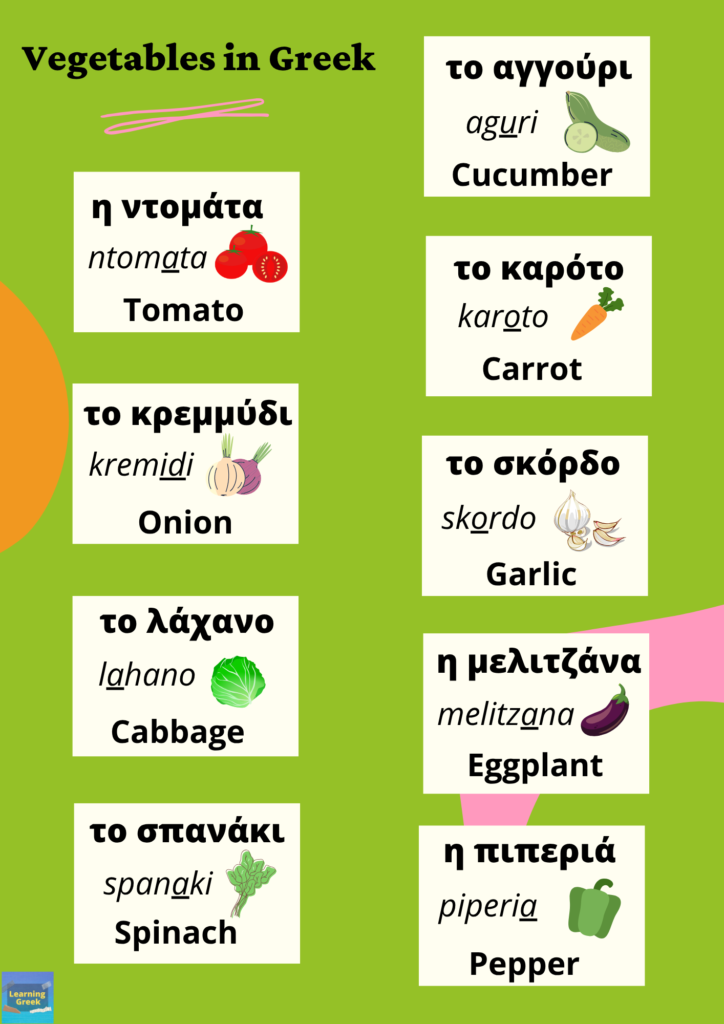
το αγγούρι (to aguri) – cucumber
το καρότο (to karóto) – carrot
η ντομάτα (i ntomáta) – tomato
το κρεμμύδι (to kremídi) – onion
το σκόρδο (to skórdo) – garlic
η μελιτζάνα (i melitzána) – eggplant
το λάχανο (to láhano) – cabbage
το σπανάκι (to spanáki) – spinach
η πιπεριά (i piperiá) – pepper
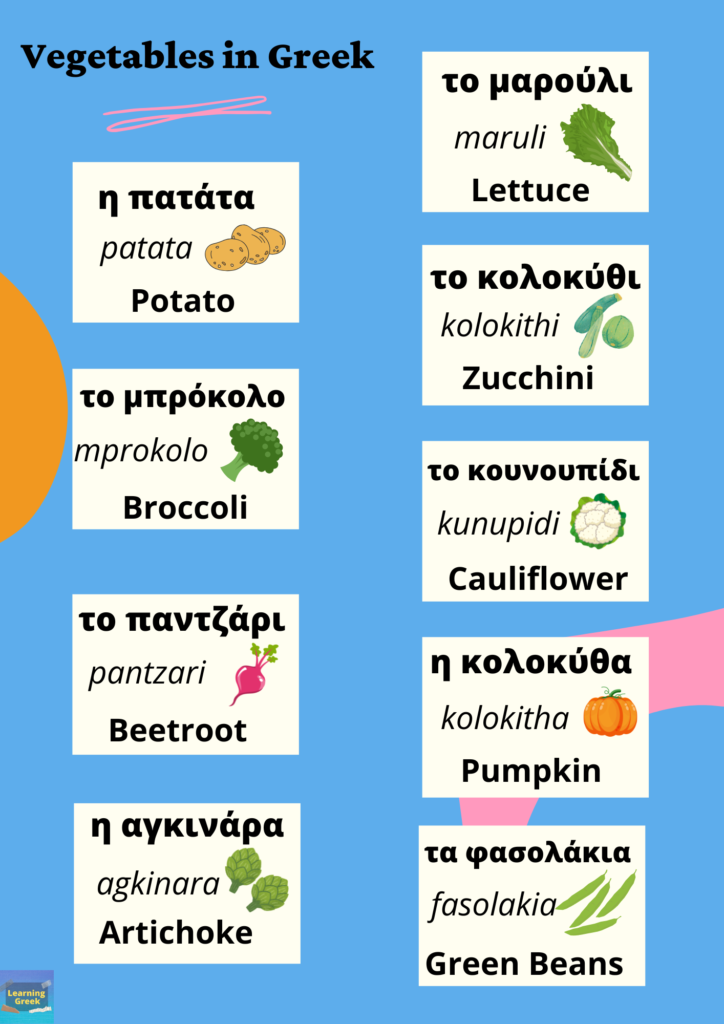
το μαρούλι (to marúli) – lettuce
το κολοκύθι (to kolokithi) – zucchini
η πατάτα (i patáta) – potato
το μπρόκολο (to mprókolo) – broccoli
το κουνουπίδι (to kunupídi) – cauliflower
η κολοκύθα (i kolokitha) – pumpkin
το παντζάρι (to pantzári) – beetroot / beet
η αγκινάρα (i agkinára) – artichoke
τα φασολάκια (ta fasolákia) – green beans
Don’t worry about memorizing all of them at once. Start with a few of your favorites and add more as you go.
Vegetables in Greek in Everyday Context
Knowing individual vegetable names is useful, but using them in real situations is even better. Here are some examples of how you might use your vegetables in Greek vocabulary in everyday life.
At the Market
If you visit a Greek market (λαϊκή αγορά or laikí agorá), you’ll hear and use many of these words. Here are some phrases you might use:
Πόσο κάνουν τα καρότα;
(póso kánoun ta karóta;)
How much are the carrots?
Θέλω μισό κιλό ντομάτες, παρακαλώ.
(thélo misó kiló ntomátes parakaló)
I want half a kilo of tomatoes, please.
Έχετε πατάτες;
(éhete patátes;)
Do you have potatoes?
Πόσο κοστίζει το μαρούλι;
(póso kostízei to marúli;)
How much does the lettuce cost?
Θα ήθελα ένα κιλό αγγούρια.
(tha íthela éna kiló angúria)
I would like a kilo of cucumbers.
Μπορείτε να μου δώσετε τρία κολοκυθάκια;
(boríte nah mou dósete tría kolokithákia;)
Can you give me three zucchinis?
Έχετε φρέσκα φασολάκια;
(éhete fréska fasolákia;)
Do you have fresh green beans?
Πόσο κάνει το μπρόκολο και το κουνουπίδι;
(póso káni to brókolo ke to kounupídi;)
How much for the broccoli and cauliflower?
Μπορώ να δοκιμάσω μία ντομάτα;
(boró nah dokimáso mía ntomáta;)
Can I taste one tomato?
Δεν είναι πολύ ώριμες οι ντομάτες.
(then íne polí órimes i ntomátes)
The tomatoes aren’t very ripe.
In the Kitchen
Once you’ve bought your vegetables, you’ll probably use them in the kitchen. Here are some useful phrases:
Ψιλόκοψε το κρεμμύδι.
(psilókopse to kremmίthi)
Finely chop the onion.
Πρόσθεσε λίγο σκόρδο.
(prósthese lígo skórtho)
Add a little garlic.
Ανακάτεψε το μαρούλι με το αγγούρι.
(anakátepse to marúli me to angúri)
Mix the lettuce with the cucumber.
Πλύνε καλά τα λαχανικά πριν τα μαγειρέψεις.
(plíne kalá ta lachaniká prin ta mayirépsees)
Wash the vegetables well before cooking them.
Κόψε το αγγούρι σε λεπτές φέτες.
(kópse to angúri se leptés fétes)
Cut the cucumber into thin slices.
Βάλε τα καρότα στην κατσαρόλα.
(vále ta karóta stin katsaróla)
Put the carrots in the pot.
Μπορείς να μου δώσεις δύο πατάτες;
(borís nah mou dóseis thío patátes;)
Can you give me two potatoes?
Θα φτιάξω σπανακόπιτα με φρέσκο σπανάκι.
(tha ftiaxo spanakópita me frésko spanáki)
I will make spinach pie with fresh spinach.
Πρόσθεσε λίγο αλάτι στο μπρόκολο.
(prósthese lígo aláti sto brókolo)
Add a little salt to the broccoli.
Μην ξεχάσεις να κόψεις το σκόρδο!
(min ksehásis nah kópsis to skórtho!)
Don’t forget to chop the garlic!
Το κουνουπίδι θέλει 10 λεπτά βράσιμο.
(to kunupídi théli théka leptá vrάsimo)
The cauliflower needs to be boiled for 10 minutes.
In a Restaurant
When ordering in a restaurant, knowing how to ask about vegetables in Greek or specify how you want them prepared can come in handy.
Τι λαχανικά έχετε σήμερα;
(ti lachaniká éhete símera;)
What vegetables do you have today?
Θα ήθελα μια σαλάτα με μαρούλι, ντομάτα, και αγγούρι.
(tha íthela mía saláta me marúli, ntomáta ke angúri)
I would like a salad with lettuce, tomato, and cucumber.
Μπορώ να έχω τα λαχανικά ψητά, παρακαλώ;
(boró nah oho ta lachaniká psitá, parakaló;)
Can I have the vegetables grilled, please?
Περιέχει το πιάτο σπανάκι ή μπρόκολο;
(periéhi to piáto spanáki í brókolo;)
Does the dish contain spinach or broccoli?
Θα ήθελα την ψητή μελιτζάνα ως συνοδευτικό.
(tha íthela tin psití melitzána os sinothevtikó)
I would like the grilled eggplant as a side dish.
Talking About Preferences
Of course, you’ll also want to be able to talk about which vegetables you like or dislike.
Δεν μου αρέσει το κουνουπίδι.
(then mou arési to kunupídi)
I don’t like cauliflower.
Τρελαίνομαι για ντομάτες!
(trelénome ya ntomátes!)
I love tomatoes!
Τρώω πολλά λαχανικά για να είμαι υγιής.
(tróo polá lachaniká yia nah íme yíis)
I eat a lot of vegetables to stay healthy.
Αποφεύγω τις πατάτες γιατί έχουν πολλές θερμίδες.
(apofévgo tis patátes yatí éhoun polés thermíthes)
I avoid potatoes because they have many calories.
Practicing Vegetables in Greek
Learning vegetables in Greek is a great starting point for practicing your everyday Greek. Here are a few simple ways to make these words part of your routine:
Label items in your kitchen:
Place labels with the Greek name on vegetables, fruits and other foods in your home.
Watch Greek cooking shows:
Listen for vegetable names in Greek cooking shows or videos and pay attention to how native speakers use them.
Practice at the market:
If you’re in Greece or near a Greek-speaking community, practice asking for vegetables at the market or grocery store.
Practice while cooking:
Say the Greek names out loud as you prepare your food. It may feel a little silly at first, but it can help you remember the words.
The more often you see and use these words, the easier they’ll become to remember.
Frequently Asked Questions About Vegetables in Greek
How do you say vegetables in Greek?
Vegetables in Greek is λαχανικά (lachaniká). The singular form, λαχανικό (lachanikó), means vegetable.
What is the Greek word for vegetable?
The Greek word for vegetable is λαχανικό (lachanikó). Its plural form is λαχανικά (lachaniká).
What are some common vegetables in Greek?
Some common vegetables in Greek include ντομάτα (tomato), αγγούρι (cucumber), πατάτα (potato), καρότο (carrot), κρεμμύδι (onion), μαρούλι (lettuce), μελιτζάνα (eggplant), and σπανάκι (spinach).
Conclusion
By learning the names of vegetables in Greek, you’ll not only improve your vocabulary but also become more confident when shopping, cooking, ordering food, and talking about what you like to eat.
And you know how much Greeks love food!
So pick a few vegetable names, start using them, and build your vocabulary one Greek word at a time.
Happy learning!