
Hello beautiful people! Greek punctuation marks and orthographic points are important for clarity, structure, and meaning in written Greek.
While there are similarities to the punctuation used in English and other languages, Greek also has some punctuation marks and orthographic points that are different and require special attention.
In this lesson, we will explore the orthographic points and primary punctuation marks used in Greek and their functions. We will skip the Greek accent mark since we already have discussed about it in previous lesson.
So, let’s begin, shall we?
Orhographic Points –
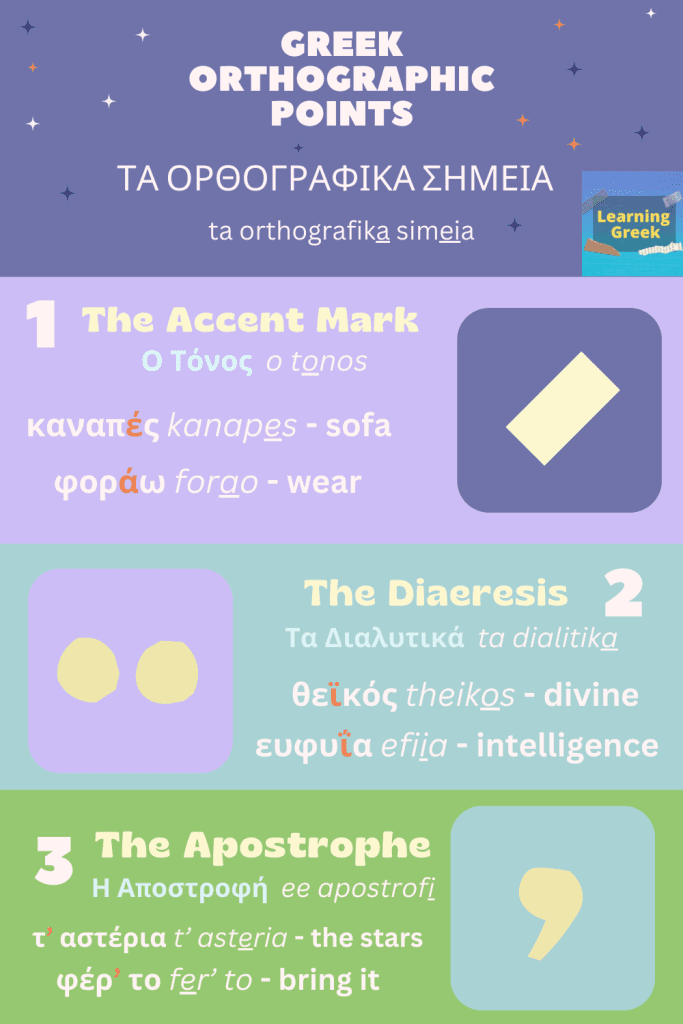
Τα Ορθογραφικά Σημεία (ta orthografika seemia)
The Greek Diaeresis – Τα Διαλυτικά (ta dialitika)
The diaeresis (¨) indicates that two vowels that are next to each other do not form a two letter vowel but are pronounced separately.
προϋπηρεσία (proipiresia) – employment experience
θεϊκός (theikos) – divine
Although diaeresis is not so commonly used as the accent mark, it is very important to place them when needed otherwise the meaning of the word can change. Take the word παϊδάκια (paedakia) for example. With diaeresis means lamp chops. Without them, παιδάκια (pedakia) means little children.
When they come after a vowel that is accented, they are placed to the left and right of the accent.
ευφυΐα (efiia) – intelligence
ναυσιπλοΐα (nafsiploia) – navigation
Keep in mind that we don’t use them when the first of the two vowels is accented.
νεράιδα (neraida) – fairy
γάιδαρος (gaidaros) – donkey
Note: We also use diaeresis when words are written in capital letters.
ΧΑЇΔΕΥΩ (chaidevo) – caress
The Apostrophe – Η Αποστροφή (ee apostrofi)
The apostrophe (‘) is used in Greek to indicate the omission of a vowel, often for poetic or euphonic purposes, similar to contractions in English.
Example:
τ’ αστέρια (t’ asteria) – the stars
Punctuation Marks –
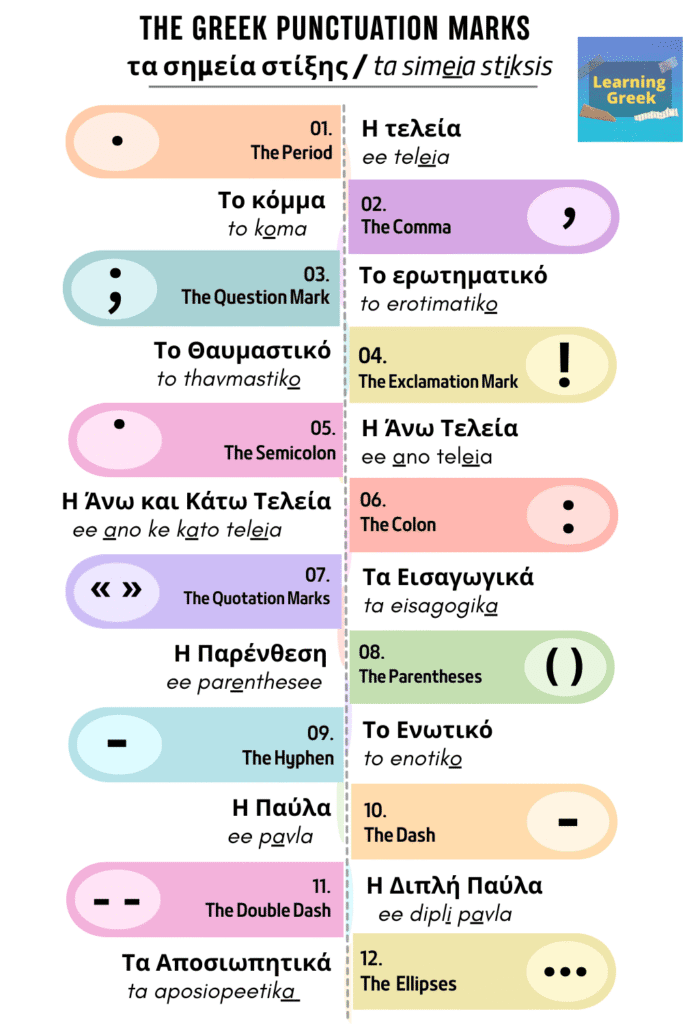
Τα Σημεία Στίξης (ta seemeia stiksis)
1. The Period – Η Τελεία (ee teleia)
The Greek period (.) is identical in appearance and function to the English period. It marks the end of a declarative sentence and signifies a full stop.
Example:
Είμαι φοιτητής. (Eeme fititis) – I’m a student.
It is also used in abbreviations,
μ.Χ. (meta Christon) – A.D. (Anno Domini)
π.Χ. (pro Christu) – BC (before Christ)
and to seperate the digits of large numbers.
1.564.000
2. The Comma – Το Κόμμα (to koma)
The comma (,) in Greek is used similarly to its English counterpart. It separates clauses, lists, and provides brief pauses within sentences.
Example:
Μιλάω αγγλικά, γαλλικά και ελληνικά. (milao agglika, galika ke ellinika – I speak English, French, and Greek.
We called the comma decimal point – υποδιαστολή (eepodiastolee)
a) When we use it to seperate the integer part from the decimal part of a number.
For example: 3,14
b) To differentiate the relative pronoun ό,τι (with no space after the decimal point) from the conjunction ότι.
For example: Θα αγοράσω ό,τι θέλω (tha agoraso oti thelo) – I’ll buy whatever I want
3. The Question Mark – Το Ερωτηματικό (to erotimatiko)
Uniquely, the Greek question mark (;) resembles the English semicolon but functions as a question mark. It is placed at the end of a direct question.
Example:
Πώς σε λένε; (pos se lene;) – What is your name?
4. The Exclamation Mark – Το Θαυμαστικό (to thavmastiko)
The Greek exclamation mark (!) is used to express strong emotions, such as surprise, excitement, or command, much like in English.
Example:
Τι υπέροχη μέρα! (tee eeperochi mera) – What a wonderful day!
5. The Semicolon – Η Άνω Τελεία (ee ano teleia)
The Greek semicolon (·) is also known as the upper dot. It indicates a pause shorter than that shown by a period, but longer than that shown by a comma.
Example:
Αυτό δεν είναι μολύβι· είναι στυλό. (afto den eene moleevee· eene steelo) – This is not a pencil; it’s a pen.
6. The Colon – Η Άνω και Κάτω Τελεία (ee ano ke kato teleia)
The Greek colon (:) is used when
a) enumerating a series of things
Τα ψηλότερα βουνά της Ελλάδας είναι: ο Όλυμπος, ο Σμόλικας, ο Βόρας. (ta psilotera vuna tis Elladas eene: o Olympos, o Smolikas, o Voras) – The highest mountains in Greece are: Olympus, Smolikas, Voras.
b)in direct speech
Η Μαρία είπε: «Θα έρθω στις επτά» (ee Maria eepe: tha ertho stis epta) – Maria said: I’ll come at seven.
7. The Quotation Marks – Τα Εισαγωγικά (ta eisagogika)
Greek quotation marks (« ») are also known as guillemets or angle quotes. They are used to denote direct speech, quotations, or titles of works.
Example:
«Ο χρόνος είναι χρήμα» είπε ο παππούς μου. (O chronos eene chreema eepe o papus mu) -“Time is money,” said my grandfather.
8. The Parentheses – Η Παρένθεση (ee parenthesee)
Parentheses ( ( ) ) are used to insert additional information, clarifications, or asides into the main text.
Example:
Ο Νίκος (ο αδελφός μου) ζει στην Αθήνα. (O Nikos (o aderfos mu) zee stin Athina.) -Nikos (my brother) lives in Athens.)
9. The hyphen – Το Ενωτικό (to enotiko)
The Greek hyphen (-) is used:
a) at the end of a line when there is not enough space for the entire word and it must be split .
For example: τηλε –
όραση (tileorasi) – television
b) to join two words.
For example: Αθήνα – Θεσσαλονίκη (athina – thesaloniki) – Athens – Thessaloniki
10. The dash – Η Παύλα (ee pavla)
The dash (-) is used in a dialogue to indicate that the speaker changes.
For example:
– Τι καιρό θα κάνει; (ti kero tha kanee;) – What the weather will be?
–Μάλλον θα βρέξει (mallon tha vreksee) – It will probably rain
– Ωχ, δεν έχω ομπρέλα (oh, then echo omprela) – Aouch, I don’t have an umbrella
11. The Double Dash – Η Διπλή Παύλα (ee dipli pavla)
The double dash (- -) is used to separate phrases.
For example:
Ο Γιώργος θα τηλεφωνήσει – ελπίζω – σήμερα. (o yiorgos tha tilefonisee – elpizo – simera) – George will call – I hope – today
12. The Ellipses – Τα αποσιωπητικά (ta aposiopitika)
Ellipses (…) are used:
a) to show that a sentence or thought is unfinished.
For example:
Τι ωραία που θα ήταν να πηγαίναμε… (tee orea pu tha eetan na pigename…) – How nice would be if we went…
b) to lead to a word or phrase that is intended to come as a surprise to the reader.
For example:
Μαγείρευα και… έπεσε το ρεύμα! (mageereva ke epese to revma) – I was cooking and…lights went off!
Conclusion
And there you have it!
Greek punctuation marks may look a little confusing at first, especially when some of them are different from what you’re used to in English. But once you know the basic rules, they become much easier to recognize and use.
I hope this guide helps you feel more confident when reading and writing in Greek.
If you’d like to keep improving your Greek, you might also enjoy my ε vs αι in Greek: A Simple Spelling Guide and my Ultimate Guide to All Greek Grammatical Terms.
Happy learning, and see you in the next lesson! ❤️


Pingback: When and Where to Put Accents in Greek - Learning Greek