

Hello, my enthusiastic Greek learners!
Have you ever wondered how Greek handles global brands and imported vocabulary? In English, it’s beautifully simple: everything is just “the.” But when you look at foreign words in Greek, ket’s just say that they face a major identity crisis.
Every single imported noun has to pick a side and be assigned a specific gender: Masculine (He), Feminine (She), or Neuter (It).
If you think we Greek speakers just pick these articles at random, think again! There are actually a few simple, brilliant patterns our grammar brain follows to decide which article fits best. Let’s solve the mystery behind how we naturally assign genders to global tech, sports teams, cars, and even your morning coffee.
The Default Rule: When Words Stay Neutral
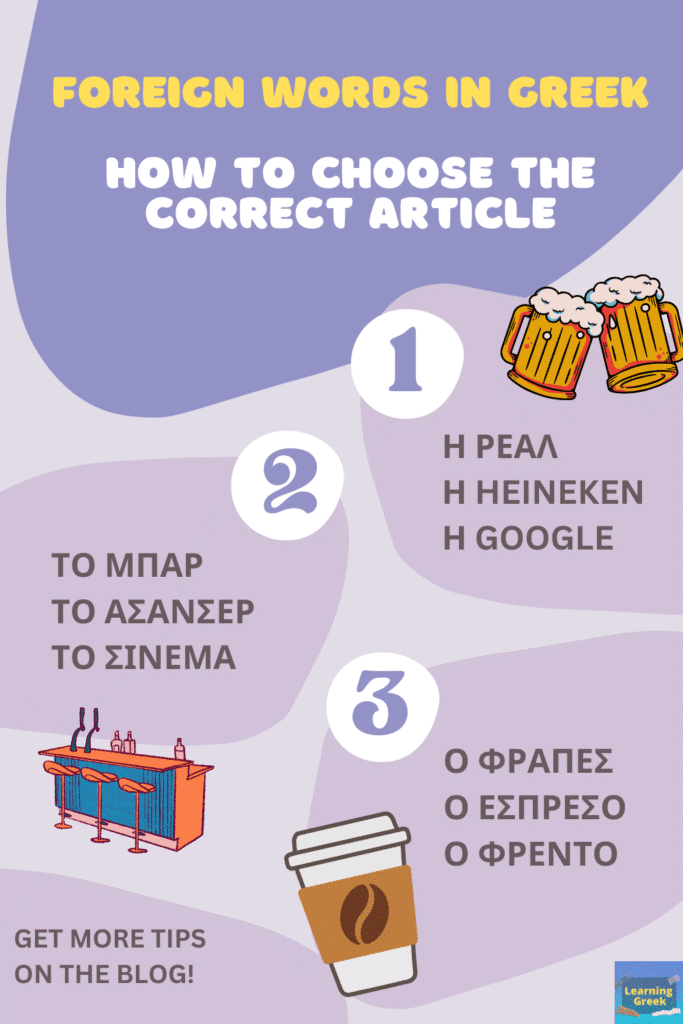
If a foreign word doesn’t fit a specific category, it falls back to our easiest option: making it neutral (το (to) / “It”). This is just our language’s lazy way of handling words that don’t end in typical Greek suffixes like -os, -is, or -a.
This is exactly why you’ll hear us use the neuter article for everyday imports:
Το μπαρ (to bar) – The bar
Το ασανσέρ (to asansér) – The elevator
Το σινεμά (to sinemá) – The cinema
Το ταξί (to taxí) – The taxi
Το πάρτι (to párti) – The party
Το μενού (to menú) – The menu
Το γκρουπ (to grup) – The group
But what happens when a word doesn’t stay neutral? That’s where things get really fun!
The Category Rule: How Foreign Words in Greek Fit In
When foreign words in Greek don’t stay neutral, it’s because our minds play a quick game of association. Instead of looking at the new word itself, we focus on the idea behind it.
Basically, in the Greek language, we naturally connect them to a broader category.
Here is how that looks in action across different everyday topics:
Sports Teams:
We say η Ρεάλ Μαδρίτης (i Reál Madrítis), η Μπαρτσελόνα (i Bartselóna), or η Λίβερπουλ (i Líverpoul) because a team is feminine: η ομάδα (i omáda).
Food and Cheeses:
We say το τσένταρ (to tséntar), το γκούντα (to gkoúnda), or το μπρι (to mpri) because cheese is neuter: το τυρί (to tyrí).
Tech and Gadgets:
We say το λάπτοπ (to láptop), το τάμπλετ (to támplet) because a device is neuter: το μηχάνημα (to michánima).
Airlines:
We say η Lufthansa because the core category is η εταιρεία (i etería).
Beer Brands:
We say η Heineken because the core category is η μπίρα (i bíra).
Digital Platforms:
We say η Google because the core category is η εταιρεία (i etería).
Newspapers:
We say η Guardian because the core category is η εφημερίδα (i efimerída).
The Brand Dilemma: Is a Peugeot a “She” or an “It?”
This category rule causes endless friendly debates in online forums and cafes when it comes to car brands. Do you say η Peugeot or το Peugeot?
The answer is actually both, and it completely depends on which hidden noun category you are pairing it with in that exact moment:
Η Peugeot: You use the feminine form when you are talking about the manufacturing company or the brand itself. This matches the category of η μάρκα (i márka) – the brand, or η εταιρεία (i etería) – the company.
Το Peugeot: You use the neuter form when you are talking about the physical vehicle parked outside. This matches the category of το αυτοκίνητο (to aftokínito) – the car, or το αμάξι (to amáxi) – the car.
The Coffee Classification
This exact same category rule is the only reason Greece’s most famous iced coffee turned into a “He!”
When foreign words in Greek belong to a super dominant, well-established food or drink category, they “steal” the article of that main category noun. In this case, the magic word is ο καφές (o kafés), which is strictly masculine.
Because a frappé is a type of coffee, the Greek brain automatically assigns it the masculine article: ο φραπές (o frapés).
In fact, we loved the word so much we even gave it a Greek masculine plural ending! You don’t order δύο φραπέ (dýo frapé) in Greece. You order δύο φραπέδες (dýo frapédes). Although, ordering δύο φραπέ (dýo frapé) isn’t totally wrong, but if you want to feel real Greek, choose the second!
The exact same category rule applies to every other imported coffee option on the menu:
Ο εσπρέσο (o espréso) – Masculine
Ο καπουτσίνο (o kaputsíno) – Masculine
Ο φρέντο (o frédo) – Masculine
The paradox: Yes, I can hear some of you think, “but we have heard the words το φραπεδάκι (frapedáki) or το εσπρεσάκι (espresáki).” Well, it’s not a paradox because they are referring to το καφεδάκι (to kafedáki), which is neuter!
See how Greek grammar, where everything must agree in noun and gender, works beautifully even with these foreign words in Greek?
Mastering Foreign Words in Greek
At the end of the day, Greek just loves to make every word feel at home. Instead of changing its own rules for new trends, the language quickly connects global words to real Greek nouns. It is an amazing trick that keeps the language alive and unified, no matter where a word comes from.
Now you can confidently order your coffee or talk about your favorite tech like a local! Have you noticed any other foreign words in Greek that use this trick? Drop a comment below and let’s discuss!


Have you any background information on these?
Some masculine loan words: ο μπάρμαν, ο ναζί, ο σεφ, ο σοφέρ, ο χάκερ.
Both masculine and feminine: ο/η μπλόγκερ, ο/η σταρ.
And here are some feminine ones: η ελίτ, η μπουτίκ, η πλαζ, η σεζόν, η σπεσιαλιτέ, η τζαζ.
Hi!
That is a fantastic addition to the discussion! You’ve actually spotted the exact same Category Rule secretly at play behind the scenes.
Here is how your great examples fit right into that grammar shortcut:
People & Roles: Words like ο μπάρμαν (o bárman) or ο σεφ (o sef) take ο because they refer to men. Modern terms like ο/η μπλόγκερ (o/i blogger) are flexible and match the actual person’s gender!
The Hidden Categories: The feminine words you mentioned perfectly mirror their Greek category nouns. For example, η τζαζ (i tzaz) takes η because of η μουσική (the music), and η πλαζ (i plaz) matches η παραλία (the beach).
Thank you so much for bringing these up—they are the perfect extension of the article!