
Hello my dear Greek learners!
If you’ve ever stopped mid-sentence wondering about πως vs πώς, don’t worry! You’re in good company.
These two words look almost identical, sound exactly the same, but that tiny accent completely changes what you’re trying to say in Greek.
The good news? The rule is straightforward. Once you understand it, you’ll instantly know which one to use.
Let’s break it down.
Πως vs πώς, The Short Version
Here’s the essence, simple and clear:
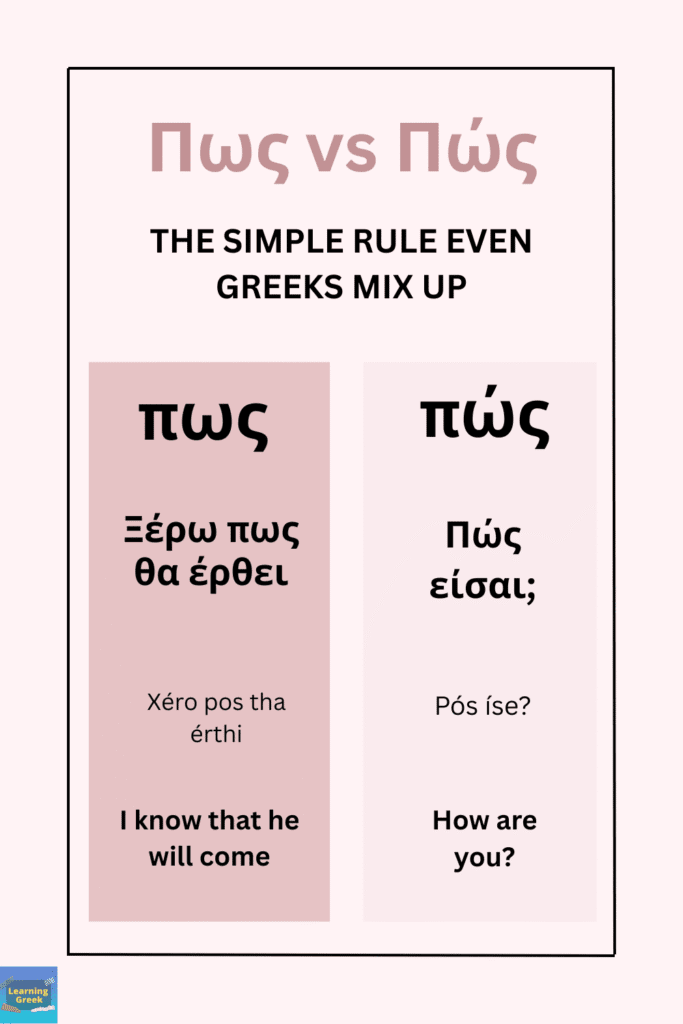
- πως (pos) no accent = that / how (in statements)
– used to connect clauses or report speech - πώς (pós) with accent = how?
– introduces a question
Think of it this way:
accent = question, no accent = statement/connector.
That’s the heart of it. Everything else is just variations on this idea.
πως (no accent)
πως is a connector.
It never asks a question. It links ideas, explains something, or introduces reported speech. Often, it can be translated as “that” or “how,” depending on context.
One easy way to spot πως is to ask yourself:
Can I rephrase this as “that” in English?
If yes, πως is probably the right choice.
Examples
- Ξέρω πως θα έρθει.
Xéro pos tha érthi.
I know that he/she will come. - Μου είπε πως είναι απασχολημένος.
Mou eípe pos íne apascholiménos.
He told me that he’s busy. - Πιστεύω πως θα τα καταφέρουμε.
Pistévo pos tha ta kataférume.
I believe that we’ll manage it. - Είναι σημαντικό να καταλάβεις πως η εξάσκηση βοηθάει πολύ.
Íne simantikó na katalávis pos i exáskisi voitháei poli.
It’s important to understand that practice helps a lot.
Notice how πως never stands alone. It always depends on another clause. Without the rest of the sentence, it wouldn’t make sense.
πώς (with accent)
πώς introduces a question.
A simple trick:
if you could replace it with “how?” in English, it’s πώς.
Examples
- Πώς είσαι;
Pós íse?
How are you? - Πώς φτάνω εκεί;
Pós ftáno eki?
How do I get there? - Ξέρεις πώς λέγεται;
Xéris pós légetai?
Do you know how it’s called?
Even when the sentence is indirect, if a question is implied, πώς keeps the accent:
- Ρώτα τον πώς νιώθει.
Róta ton pós nióthi.
Ask him how he feels. - Δεν ξέρω πώς να το λύσω.
Den xéro pós na to lýso.
I don’t know how to solve it.
Πως vs πώς, Quick Check
When in doubt, ask yourself:
Am I asking “how”?
- If yes → πώς
- If no → πως
No overthinking needed.
Fixed Expressions with πώς
There’s really only one fixed expression worth remembering:
– Πώς και πώς (pós ke pós) – eagerly, very much
Example
Περιμέναμε το καλοκαίρι πώς και πώς.
Periméname to kalokairí pós ke pós.
We were really looking forward to summer.
Everything else is just normal usage in questions or indirect questions, so no need to memorize it separately.
Spoken Greek vs Written Greek
in spoken Greek, πως and πώς sound exactly the same. You can’t hear a difference. The accent only matters when writing because it changes meaning.
So, if you’re practicing speaking, don’t stress too much about it. But in writing—essays, messages, emails—it’s important to get it right.
Mini Quiz
Choose the correct form:
- Ξέρω _ θα έρθει αύριο.
α) πως
β) πώς - _ τα καταφέρνεις;
α) πως
β) πώς - Μου είπε _ ήταν αργά.
α) πως
β) πώς - Δεν ξέρω _ να σου πω την αλήθεια.
α) πως
β) πώς - Ρώτησα τον δάσκαλο _ θα γίνει το μάθημα.
α) πως
β) πώς
Πως vs πώς, Wrap-Up
Getting πως vs πώς right instantly improves clarity in your writing. It shows that you’re not just copying forms—you actually control meaning.
And here’s the comfort: even native speakers mix these up sometimes. So if you hesitate, don’t worry. The key is understanding the rule and spotting whether a question is being asked.
If you enjoy these small grammar tips that confuse even Greeks, you’ll probably love:
– Που vs πού: The Simple Rule Even Greeks Mix Up
– ό,τι vs ότι: The Simple Rule Greeks Still Mix Up
– πολύ vs πολλή: The Simple Rule Even Greeks Get Wrong
Keep practicing, and soon these tiny details will feel automatic. Happy learning!
Answers
1) a
2) β
3) α
4) β
5) β