
Hello my lovelies!
After seeing the i sound and the o sound in Greek, it’s time to talk about the e sound, ε vs αι in Greek. We don’t want it to feel pushed aside.
Today’s lesson will be sweet and easy, I promise.
So when do we use ε and when αι in a word? Let’s solve this mystery together starting by some bad and good news.
The good news:
In Modern Greek, there’s no difference in pronunciation between the two. They are both pronounced /e/. So go ahead and speak with confidence. You don’t have to think about how to pronounce each one.
The bad news:
Unfortunately, there aren’t many rules that will help you distinguish which one to use. Some words must be memorized and as you learn Greek, this task will be easier.
But don’t worry, there are some strong rules regarding verbs that will help you a lot. They will guide you smoothly to know exactly which “e” to use and basically teach you how to write all verbs correctly. And that’s a very big deal! You’re going to use verbs all the time, so by learning these rules, you’ll be very comfortable with your words spelling.
Now let’s get started.
ε vs αι in Greek – Basic Rules
Εμείς and εσείς always ends in -ε
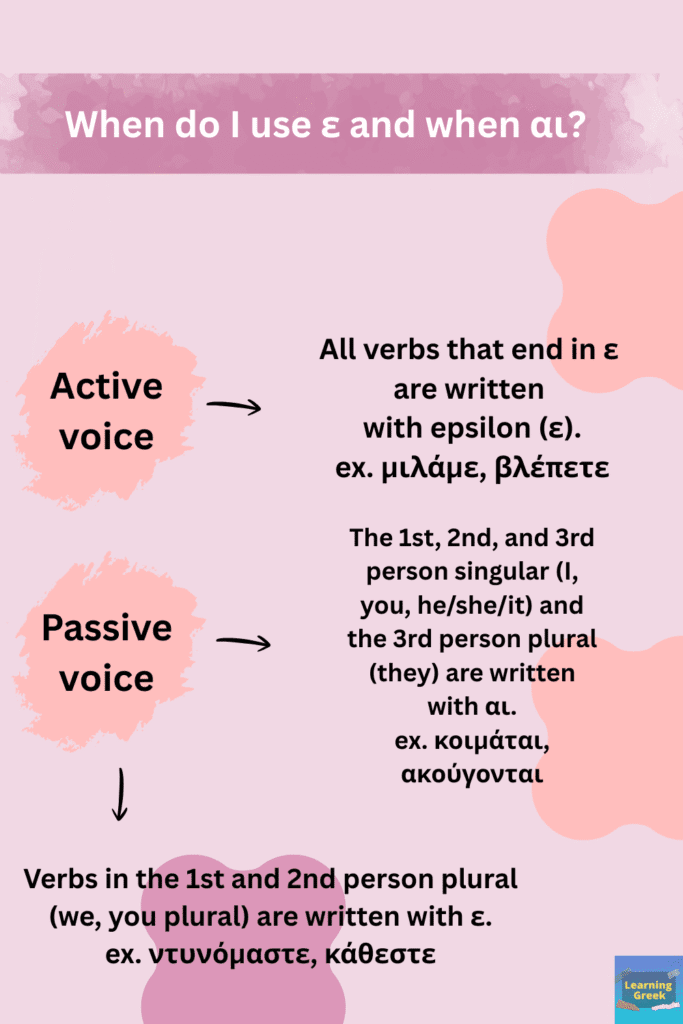
This is the most important rule. No matter the voice, active or passive, first and second persons in plural end in έψιλον (- ε).
Here’s what that looks like in practice:
εμείς μιλάμε – emís miláme – we speak
εσείς μιλάτε – esís miláte – you (plural) speak
εμείς διαβάζουμε – emís diavázume – we read
εσείς διαβάζετε – esís diavázete – you (plural) read
εμείς γράφουμε – emís gráfume – we write
εσείς γράφετε – esís gráfete – you (plural) write
εμείς παίζουμε – emís pézume – we play
εσείς παίζετε – esís pézete – you (plural) play
εμείς αγαπάμε – emís agapáme – we love
εσείς αγαπάτε – esís agapáte – you (plural) love
This rule is stable. If it’s εμείς or εσείς in present tense, you’re safe with -ε.
Passive voice endings contain -αι
Next, let’s look at passive voice. In passive voice, verbs in first, second, and third person singular and third person plural are written with -αι.
You’ll see it in these endings:
- -μαι
- -σαι
- -ται
- -νται
Let’s look at examples:
εγώ ντύνομαι – egó dínome – I get dressed
εσύ ντύνεσαι – esí dínese – you get dressed
αυτός ντύνεται – aftós dínete – he gets dressed
αυτοί ντύνονται – aftí dínonde – they get dressed
εγώ θυμάμαι – egó thimáme – I remember
εσύ θυμάσαι – esí thimáse – you remember
αυτή θυμάται – aftí thimáte – she remembers
εγώ λυπάμαι – egó lipáme – I am sorry
αυτή κοιμάται – aftí kimáte – she sleeps
αυτοί φοβούνται – aftí fovúnde – they are afraid
If you recognize passive voice endings, you’ll automatically know that αι is hiding inside them.
These are actually the two rules you’ll need to remember. Easy as I promised.
Before we move on, here’s a little visual summary to keep everything nice and clear.
But to help you on your journey in Greek, I’ll give you some very common words and patterns.
Very common function words
Some very common grammatical words use αι and must simply be memorized.
Examples with αι:
- και – ke – and
- είμαι – íme – I am
- είναι – íne – is / are
- αίμα – éma – blood
- παιδί – pedí – child
- παίζει – pézi – he/she plays
- χαίρομαι – chérume – I am glad
- καίω – ké-o – I burn
- παίρνω – pérno – I take
Note: Don’t confuse:
παίρνω – pérno – I take / I get
περνώ – pernó – I pass / I go through
Tip: Pay attention to the accent mark – it changes the meaning entirely!
These are not random. Many come from Ancient Greek roots where αι used to be pronounced differently.
Some noun and adjective patterns
Now here’s something interesting.
Some of the words you just saw actually belong to larger word families. And this is where things start becoming easier.
There are clusters where αι appears inside related words. When you recognize the base word, the spelling of the rest becomes much more predictable.
Examples:
παιδί – pedí – child
παιδιά – pediá – children
παιδικός – pedikós – childlike
παίζω – pézo – I play
παιχνίδι – pechnídi – game
See how the αι stays consistent across the family?
Let’s look at some words from another family:
καιρός – kerós – weather / time
καίριος/α/ο – kérios/a/o – crucial / timely
επίκαιρος/η/ο – epíkeros/i/o – timely / topical
επικαιρότητα – epikerótita – topicality / newsworthiness
έγκαιρα – éngera – in time
άκαιρος/η/ο – ákeros/i/o – untimely / inappropriate
καιρικός/ή/ό – kerikós/í/ó – weather-related / timely
καλοκαίρι – kalokéri – summer
You might notice that some words appear again from the previous list. That’s intentional. When a word is both common and part of a family, it’s worth seeing it more than once.
By spotting these families, you start noticing patterns instead of memorizing random words. And that helps much more than trying to learn isolated spellings.
Final thoughts on ε vs αι in Greek
So what should you remember from all this?
First, pronunciation won’t help you — ε and αι sound exactly the same in Modern Greek.
Second, verbs are your safest territory. The endings will guide you. If you understand the structure, you won’t guess — you’ll know.
And third, vocabulary becomes easier when you stop seeing words as isolated pieces and start seeing families. παιδί leads to παιδιά, παιδικός, παιχνίδι… and suddenly αι doesn’t feel mysterious anymore.
Some words will always need memorizing. That’s normal. Every language has its “just learn it” moments.
But the more you read and write, the less you’ll hesitate. Spelling will slowly move from effort… to instinct.
And that’s a very satisfying place to be. 💙