

Hello my lovely Greek learner enhtousiasts!
I know how much you love Greek idioms and today we’re gonna talk about one more! We’re gonna look at what Βρέχει καρεκλοπόδαρα means, where it came from and what other similar idioms we use in Greek.
But why this particular idiom today? Here’s the back story.
It’s been raining heavily in Athens, actually in the whole of Greece, causing a lot of problems these last few days. So I decided to post about it in the facebook group I run and make it a little educational by asking if they knew what Βρέχει καρεκλοπόδαρα means. Yes, hint, it has something to do with the rain 😛
The answers were great! Of course some people didn’t know because it’s a group for all levels. But I also got some interesting questions about the origin of the expression. Hmmm…why do Greeks use this strange phrase? Honestly, I had no idea. It’s one of those expressions you learn as a kid and you use forever without thinking.
So, I searched and searched and searched , ready for some wild ancient Greek story to be astonished… and the truth is very simple. But we’ll get to that later.. Let’s start with the actual meaning of the phrase.
By the way, if you want to join our facebook group and join a community of Greek learners from all around the world, press the link: Learning Greek Facebook Group.
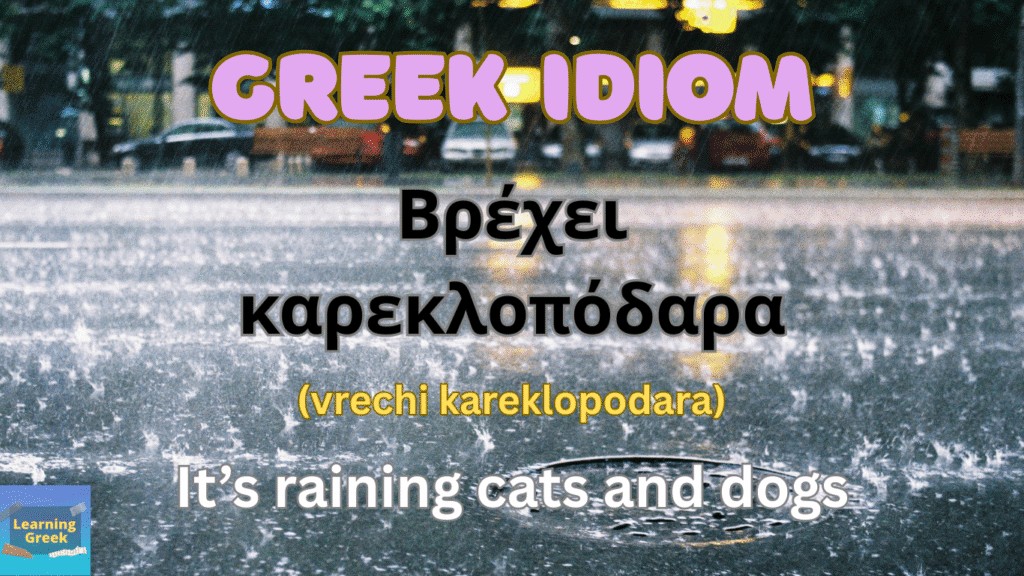
Βρέχει καρεκλοπόδαρα
(Vréchi kareklopódara)
Literal Translation:
It rains chair-legs
Actual Meaning:
No, it doesn’t really pure legchairs. We use this expression when we want to empasize how strong the rain is. It’s one of the most common Greek expressions for heavy rain. The closest English equivalent is “it’s raining cats and dogs”.
Grammatical Breakdown
Βρέχει (Vréchi)
Verb meaning it rains. It is the 3d person singular of the verb βρέχω (vrécho).
We only use this idiom in the 3d singular person.
Here’s how the verb Βρέχω works in the present tense.
| Person | Greek | Pronunciation |
|---|---|---|
| εγώ | βρέχω | vrécho |
| εσύ | βρέχεις | vréchis |
| αυτός/αυτή/αυτό | βρέχει | vréchi |
| εμείς | βρέχουμε | vréchume |
| εσείς | βρέχετε | vréchete |
| αυτοί/αυτές/αυτά | βρέχουν | vréchun |
Καρεκλοπόδαρα (Kareklopódara)
Noun in neuter gender. It’s a compound word made of καρέκλα (karékla) – chair and ποδάρι (podári) – leg. Το καρεκλοπόδαρο – τα καρεκλοπόδαρα.
And yes, I know what you’re thinking: ποδάρι?
Don’t get confused. We rarely use this word. Yes, the word πόδι (podi) -leg is the one you should know. You will hear ποδάρι mostly in this idiom or from an angry Greek mum saying:
Πάρε τα ποδάρια σου από το τραπέζι!
(Páre ta podária sou apó to trapézi!)
Take your legs off the table!
Origins
Why do Greeks use this expression when it rains heavily?
The answer is pretty simple.
When the rain is extremely strong, the drops fall so fast that your eye can’t see each drop separately.
Instead, they look like long vertical streaks, like little water sticks. And those water sticks look a bit like the long legs of a chair. It’s basically a visual illusion
So people saw this long water streaks, thought of chair legs and boom! an idiom was born.
Other Greek Expressions for Heavy Rain
Here are some other ways Greeks talk about heavy rain. They all mean pretty much the same thing. It’s pouring!
Ρίχνει καρεκλοπόδαρα (Ríchni kareklopódara)
Yes, it’s exactly the same as Βρέχει καρεκλοπόδαρα. The only differnce is the verb. Ρίχνειmeans it pours/throws.
Βρέχει/ρίχνει καρέκλες (Vréchi/Ríchni karékles)
A shorter vesrion of the same idiom. It rains/throws chairs.
Ρίχνει τουλούμια (Ríchni tulúmia)
Literally, it throws big water sucks.
Βρέχει με το τουλούμι (Vréchi me to toulúmi)
Same idea as above
Ρίχνει μπουγαδοκόφινα (Ríchni bugadhokófina)
It’s throwing laundry baskets.
Ρίχνει κουβάδες (Ríchni kuvádhes)
It’s pouring buckets
Βρέχει καλαπόδια (Vréchi kalapódhia)
It rains shoe molds
All of these simply paint a funny picture of something big and heavy falling from the sky.
Idioms in Action
Let’s see our heavy rain idioms in action! These examples will help you remember them better and practice pronunciation.
1. Σήμερα στην Αθήνα βρέχει καρεκλοπόδαρα!
(Siméra stin Athína vréchi kareklopódara!)
Today in Athens, it’s raining chair-legs!
2. Μην ξεχάσεις την ομπρέλα, ρίχνει κουβάδες έξω.
(Min xechásis tin ombréla, ríxni kuvádhes éxo.)
Don’t forget your umbrella, it’s pouring buckets outside.
3. Ευτυχώς που δεν κανονίσαμε τίποτα για σήμερα, ρίχνει τουλούμια έξω.
(Eftychós pou den kanonísame típota gia símera, ríxni toulúmia éxo.)
Luckily, we didn’t plan anything for today, it’s pouring big water sacks outside!
Love Greek Idioms?
If you love Greek Idioms there’s a whole world waiting for you!
Check out my full list of Greek idioms here and discover more funny expressions!
A little wrap-up
I just realized that for a country that doesn’t see much rain, we really do have a lot of expressions about it. Maybe that’s exactly why are our phrases so colorfull and funny. We hardly ever get heavy rain, so when it finally happens, we picture chair legs and laundry baskets falling from the sky.
How about you? What expressions do you use in your country for heavy rain?


Thanks
You’re welcome 🙂
Now I understand when to use ω or o!!
Finally!-)
Thanks a lot!
Χαιρετίσματα από Ροττερδαμ/ ΟλλανδίαΚαι καλά Χριστούγεννα.
Just FYI:
Actually, the nearest English idiom to the original is “it’s raining stair rods”, not “raining cats and dogs” 😎
Thanks for your comment! “Stair rods” is indeed very close to the Greek idiom. I chose “cats and dogs” simply because it’s more widely used and familiar to learners today. But it’s great to see “stair rods” getting some love here 😄
Actually, I would say that the closest equivalent in English is “it’s raining stair rods” though in fairness, I think that’s a little old fashioned now and you don’t hear it much. Nevertheless, the Greek idiom makes perfect sense to me in that context 😊 Σας ευχαριστώ για το άρθρο
That’s a great comparison. “Stair rods” is very close in meaning. I used “cats and dogs” because it’s more widely recognised now, but your point is spot on. Thank you so much for the comment!