
Hello, my beautiful Greek learners,
today we’re gonna talk about Greek prepositions!
Learning Greek can feel challenging at times, especially when it comes to those tricky Greek prepositions. Yes, I know the struggle!
Unlike English, Greek prepositions don’t just “sit there” — they often change the form of the noun or pronoun that follows, and the meaning can shift depending on the case.
But don’t worry!
By the end of this guide, you’ll feel much more confident using Greek prepositions in everyday conversation.
We’ll cover the most common prepositions, point out frequent mistakes, and give you practical tips to master them.
Plus, you can check out my full Greek Cases guide if you want the complete picture.
What Are Greek Prepositions?
First, let’s understand what prepositions actually do.
A preposition (πρόθεση – próthesi) is a tiny word with a big job: it shows the relationship between other words — and lucky for us, it’s άκλιτη (aklíti / indeclinable), so it never has to change shape!
It often tells you where, when, or how something happens.
Examples in English
- The book is on the table → “on” shows where the book is.
- I’m going to school → “to” shows direction.
- She came with her friend → “with” shows companionship.
Examples in Greek
In Greek, prepositions work similarly — they indicate location, direction, or relationship. Here are some examples:
- Ήρθε με τη φίλη της (Írthe me ti fíli tis) – She came with her friend.
- Μιλάω για το φαγητό (Miláo yia to fagitó ) – I’m talking about the food.
- Έρχομαι από το σπίτι (Érchomai apó to spíti) – I’m coming from the house.
- Πηγαίνω χωρίς εσένα (Pigaíno chorís eséna) – I’m going without you.
Notice how the preposition always connects two elements in a sentence — like a person and a place, or an object and its location.
Also, in Greek, the preposition often changes the form of the article or noun that follows, which we’ll explain in the next sections.
Types of Greek Prepositions
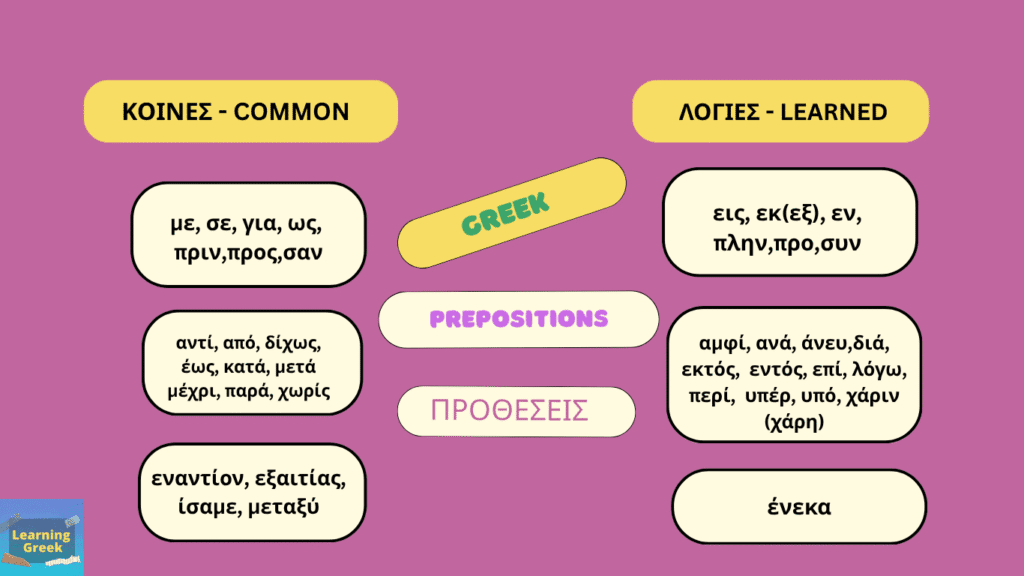
Greek prepositions today can be grouped into common (κοινές-kinés), learned/archaic (λόγιες/απαρχαιωμένες – lóyies/aparcheoménes),
and compound (σύνθετες – sínthetes) prepositions:
1. Κοινές Προθέσεις
Common Prepositions
These are the ones you’ll encounter all the time in modern Greek.
They show relationships like place, direction, cause, or time and are used in everyday speech and writing.
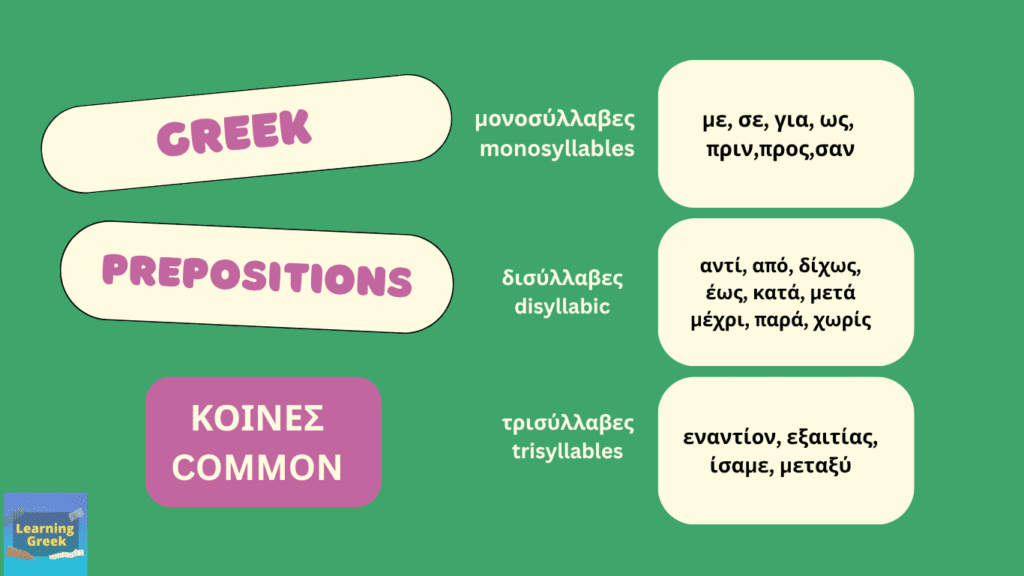
Table of Common Greek Prepositions
| Preposition | Pronunciation | Common Meanings | Example |
|---|---|---|---|
| από | apó | from, since | Έρχομαι από το σπίτι (Érchome apó to spíti) – I’m coming from the house |
| για | yia | for, about | Μιλάω για το φαγητό (Miláo yia to fayitó) – I’m talking about the food |
| με | me | with, by | Πηγαίνω με τον φίλο μου (Piyéno me ton fílo mou) – I go with my friend |
| σε | se | to, in, at | Πηγαίνω σε ένα καφέ (Piyéno se éna kafé) – I’m going to a café |
| χωρίς | chorís | without | Δεν μπορώ χωρίς εσένα (Den boró chorís eséna) – I can’t live without you |
| μεταξύ | metáxy | between, among | Μεταξύ φίλων (Metaxi fílon) – Among friends |
| κατά | katá | against, during | Μιλάει κατά του πολέμου (Milái katá tou polémou) – He speaks against the war |
| μετά | metá | after, with | Μετά τη δουλειά (Metá ti douliá) – After work |
| μέχρι | míchri | until, up to | Θα περιμένω μέχρι τις δέκα (Tha periméno méchri tis déka) – I’ll wait until ten |
| παρά | pará | beside, except | Κάθεται παρά το παράθυρο (Káthetai pará to paráthiro) – He sits by the window |
| σαν | san | like, as | Είσαι σαν άγγελος (Íse san ángelos) – You’re like an angel |
| προς | pros | towards | Πηγαίνω προς το κέντρο (Pigaíno pros to kéntro) – I’m heading toward the center |
| αντί | andí | instead of | Αντί για καφέ, ήπια τσάι (Andí gia kafé, ípia tsái) – Instead of coffee, I drank tea |
| δίχως | díchos | without | Δεν μπορώ να ζήσω δίχως εσένα (Den boró na zíso díchos eséna) – I can’t live without you |
| πριν | prin | before | Πριν το δείπνο (Prin to dípno) – Before dinner |
| εναντίον | enantíon | against | Ο παίκτης διαμαρτυρήθηκε εναντίον του διαιτητή (O péktis diamartiríthike enantíon tou diaitití) – The player protested against the referee |
| ίσαμε | ísame | as far as, up to | Περπάτησε ίσαμε το ποτάμι (Perpátise ísame to potámi) – He walked as far as the river |
| ως | os | as, up to | Έμεινε ως το βράδυ (Émine os to vrádi) – He stayed until evening |
| έως | éos | until | Θα μείνω εδώ έως το πρωί (Tha míno edó éos to proí) – I’ll stay here until morning |
| εξαιτίας | exetías | because of | Η πτήση καθυστέρησε εξαιτίας της βροχής (I ptísi kathystérise exetías tis vrochís) – The flight was delayed because of the rain |
2. Λόγιες ή Απαρχαιωμένες Προθέσεις
Learned or Archaic Prepositions
These prepositions come from Ancient Greek and are mostly used in formal writing, idiomatic expressions, or older texts.
You don’t need to memorize all of them — just focus on recognizing them when reading.

Table of Learned Greek Prepositions
| Πρόθεση | Pronunciation | Common Meanings | Example |
|---|---|---|---|
| αμφί | amfí | from both sides | It is rarely used. It is commonly found in compound words e.g. αμφι-βολία (amfivolía – doubt) |
| ανά | aná | per, each | Ανά άτομο (aná átomo) – per person |
| άνευ | ánef | without | Άνευ λόγου (ánef lógou) – without reason |
| διά | diá | through, by | Διά του νόμου (diá tou nómou) – by law |
| εις | is | to, into | Εις το όνομα (is to ónoma) – in the name (of) |
| εκ | ek | from, out of | Εκ των πραγμάτων (ek ton pragmáton) – by nature |
| εκτός | ektós | outside, except | Εκτός υπηρεσίας (ektós ypire-sías) – out of service |
| εν | en | in, at | Εν Αθήναις (en athínes) – in Athens (old-fashioned) |
| ένεκα | éneka | because of, for the sake of | Ένεκα της τιμής (éneka tis timís) – for the sake of honor |
| εντός | entós | inside, within | Εντός ορίων (entós oríon) – within limits |
| επί | epí | on, upon | Επί του παρόντος (epí tou paróntos) – for the time being |
| λόγω | lógo | due to, because of | Λόγω βροχής (lógo vrochís) – due to rain |
| περί | perí | about, around | Περί πολιτισμού (perí politismoú) – about culture |
| πλην | plin | except | Πλην του ενός (plin tou enós) – except one |
| προ | pro | before | Προ της αναχώρησης (pro tis anachórisis) – before departure |
| συν | syn | with, together | Συν άλφα (syn álfa) – plus A |
| υπέρ | ypér | for, in favor of | Υπέρ της ειρήνης (ypér tis eirínis) – in favor of peace |
| υπό | ypó | under, by | Υπό πίεση (ypó píesi) – under pressure |
| χάριν (χάρη) | chárin | for the sake of | Χάριν παραδείγματος (chárin paradeígmatos) – for example |
3. Σύνθετες Προθέσεις
Compound Prepositions
Compound prepositions combine either:
- Two simple prepositions (εκτός από – except for)
- An adverb + a preposition (μέσα σε – inside of)
They are very common in everyday speech and help you express more precise relationships of place, time, and manner.
How Greek Prepositions Are Used
Now that we’ve seen the main types of prepositions, let’s take a closer look at how they’re actually used in Greek.
Some prepositions are used only in sentences, while others are also used as prefixes in compound words.
Recognizing the difference makes reading and understanding Greek much easier.
For example:
- για (yia) – only in sentences
Την αγάπησα για τα μάτια της (Tin agápisa yia ta mátia tis) – I loved her for her eyes - προς (pros) – sentence & prefix
Πήγαινε προς την πόρτα (Píyene pros tin pórta) – Go toward the door
προσφέρω (prosféro) – to offer
προσαρμόζω (prosarmózo) – to adapt, adjust - από (apó) – sentence & prefix
Από το σπίτι ως το σχολείο (Apó to spíti os to scholío) – From the house to the school
αποβάλλω (apovállo) – to discard
αποφεύγω (apofévgo) – to avoid
Once you notice this pattern, you’ll recognize many familiar words like προσφέρω, αποφεύγω, υπογράφω, and more.
Words That Look Like Greek Prepositions (But Aren’t!)
Here’s another fun fact — some words look like prepositions, but depending on the sentence, they can actually be something else:
a pronoun, adverb, or even a conjunction.
Let’s see how this works:
- με (me)
Τι με κοιτάς; (Ti me kitás?) – Why are you looking at me? → pronoun.
Να έρθεις με τον κηδεμόνα σου (Na érthis me ton kidemóna sou) – Come with your guardian. → preposition. - μετά (metá)
Θα έρθω μετά (Tha értho metá) – I’ll come later. → adverb.
Θα έρθω μετά από το σχολείο (Tha értho metá apó to scholío) – I’ll come after school. → preposition. - πριν (prin)
Η παράσταση άρχισε πριν να έρθουν οι επίσημοι (I parástasi árchise prin na érthoun i epísimoi) – The show started before the officials arrived. → conjunction.
Προχώρα πριν από μένα (Prochóra prin apó ména) – Go ahead before me. → preposition.
So, how can you tell what a word really is?
Look at its function in the sentence — what job it’s doing. Is it connecting things, replacing a noun, or describing when something happens? That’s your clue!
Grammar Rules for Greek Prepositions
1. Match the Case
The word that comes after a preposition needs to be in the correct grammatical case.
Most prepositions use the accusative, but some take the genitive.
Pay attention to this, because it can change the meaning of the sentence.
2. Fixed Expressions
Some verbs or adjectives always go with a certain preposition.
These are like mini idioms — translating word-for-word from English might not work.
Example:
Εξαρτώμαι από κάποιον (Exartómai apó kápoion) – I depend on someone
3. Where Prepositions Go
Most of the time, prepositions come right before the word they affect.
But in poetry, songs, or more formal writing, they sometimes move around for style or rhythm.
Example:
Το δώρο ήταν για τον φίλο μου (To dóro ítan gia ton fílo mou) – The gift was for my friend
4. Watch for Contractions
Greek often combines prepositions with definite articles, creating short forms:
- σε + το → στο (to the)
- σε + την → στη (to the)
Example:
Πηγαίνω στο σχολείο (Piyeno sto scholío) – I’m going to the school
For more details on this, check the Prepositional Article guide.
Key Takeaways
1. Most Greek prepositions take the accusative, but some take the genitive.
For more on cases, see Greek Noun Cases Explained Simply
2. Always make sure the article and noun endings match the case of preposition.
3. Context can slightly change meaning, so examples are your best friend.
4. Avoid translating directly from English; focus on natural Greek phrasing..
FAQ: Greek Prepositions
1: Which prepositions take the genitive in Greek?
Mainly από and some uses of κατά and μετά. Most others take the accusative.
2: Can a preposition change meaning depending on the case?
Yes! For example, σε + accusative often shows movement, but in some contexts indicates position.
3: Do I need to memorize all prepositions and their cases?
Focus on the most common first: σε, με, για, από, χωρίς, then gradually add the rest.
Keep Going, My Greek Heroes!
Congratulations!
You’ve just navigated the maze of Greek prepositions, cases, and tricky contractions.
Remember, it’s perfectly normal to make mistakes — even native learners fumble sometimes!
The key is practice, repetition, and using examples in real life.
Soon, these little words will stop feeling “dreaded” and start feeling like your trusty sidekicks in Greek sentences.
Next Steps
Review related topics:
The Greek article – Definite and Indefinite