
Hello, dear Greek music enthusiasts!
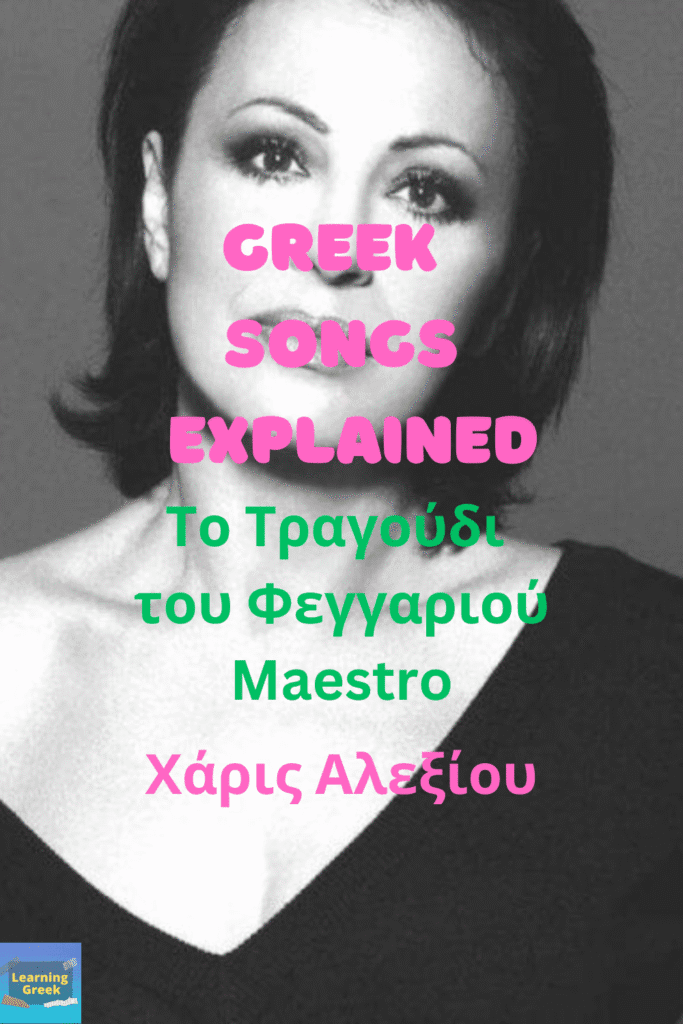
Few artists in Greek music history possess the evocative power and timeless appeal of Χάρις Αλεξίου. Her ability to weave emotion into every note has made her an enduring icon of Greek song. Among her many memorable performances, Το Τραγούδι Του Φεγγαριού stands out as a masterpiece of lyrical beauty and musical craftsmanship.
Let’s explore this iconic piece, unpacking its lyrical beauty, musical elegance, and the emotions it evokes.
A Conversation with the Moon
At its heart, Το Τραγούδι Του Φεγγαριού is a poignant dialogue between the narrator and the moon. As a symbol of mystery, solace, and unspoken truths, the moon becomes a confidant and silent observer. The song captures the narrator’s emotional vulnerability and their longing for understanding in a world that often feels distant.
Take a moment to listen to the song below and follow along as we explore its poetic beauty!
Exploring the Lyrics
Below, you’ll find the full lyrics of Το Τραγούδι Του Φεγγαριού with their English translations:
| Greek Lyrics | English Translation |
|---|---|
| Δικά σου μάτια πήρε το φεγγάρι | The moon took your eyes |
| κι ανέβηκε ψηλά στον ουρανό. | And rose high into the sky. |
| Το ασήμι του είναι αρρώστια | Its silver is a sickness |
| κι εσύ στον ουρανίσκο μου σαν όστια. | And you, on my palate, like a host. |
| Καθρέφτη μου ονείρων στοιχειωμένων | Mirror of my haunted dreams |
| υδράργυρου θεού περιφορά, | Procession of a mercury god, |
| εμένα φέξε, κοίτα | Shine on me, look at me |
| γιατί έχω στην καρδιά | Because in my heart, |
| πικρή σαΐτα. | Lies a bitter dart. |
| Τη ματωμένη αγάπη μου ανασαίνω | I breathe in my bloody love |
| σαν μια τρυγόνα που άγρια σπαρταρά. | Like a dove wildly fluttering in pain. |
| Στο στήθος σου αητός ξεχειμωνιάζει | An eagle winters in your chest |
| στα χείλη σου πλατάνι αναπολεί, | A plane tree reminisces on your lips, |
| ωραίο που είσαι φως μου | How beautiful you are, my light, |
| κλωνάρι αθανασίας κι αδελφός μου. | A branch of immortality and my brother. |
| Στην ασημένια χαίτη σου ανεβαίνω | I climb your silvery mane |
| κι όλα γεννιούνται ακόμα μια φορά. | And everything is born once more. |
| Δικά σου μάτια πήρε το φεγγάρι, | The moon took your eyes, |
| για να ‘χω ένα φανάρι ν’ αγρυπνώ. | So I have a lantern to keep vigil. |
Verse-by-Verse Analysis
Verse 1: The Moon Takes Your Eyes
Δικά σου μάτια πήρε το φεγγάρι
(Diká sou mátia píre to feggári)
The moon took your eyes
κι ανέβηκε ψηλά στον ουρανό.
(ki anévike psilá ston uranó)
And rose high into the sky.
The moon, a recurring symbol in Greek poetry, embodies mystery and emotional intensity. Here, it “takes the eyes” of a loved one, merging their essence with its celestial presence. This imagery underscores the idea of eternal beauty and longing.
Chorus: A Sickness in the Silver
Το ασήμι του είναι αρρώστια
(To asími tu íne arróstia)
Its silver is a sickness
κι εσύ στον ουρανίσκο μου σαν όστια.
(ki esi ston uranísko mu san óstia)
And you, on my palate, like a host.
The “silver sickness” reflects the bittersweet allure of the moon, while the reference to the host (a sacred wafer) gives a spiritual undertone, suggesting that the loved one is both a blessing and a source of pain.
Verse 2: Shadows and Secrets
Καθρέφτη μου ονείρων στοιχειωμένων
(Kathréfti mu oníron stichiómenon)
Mirror of my haunted dreams
υδράργυρου Θεού περιφορά,
(idrárgiru Theú periforá)
Procession of a mercury god,
εμένα φέξε, κοίτα
(eména féxe, kíta)
Shine on me, look at me
γιατί έχω στην καρδιά
(yiatí écho stin kardiá)
Because in my heart,
πικρή σαΐτα.
(pikrí saḯta)
Lies a bitter dart.
This verse blends mystical and mythological imagery, depicting the moon as a “mirror” of emotions and a “god of mercury.” The dart in the heart symbolizes unresolved pain, while the plea for light reflects a desire for healing.
Final Verse: A Lantern to Keep Vigil
Δικά σου μάτια πήρε το φεγγάρι,
(Diká su mátia píre to feggári)
The moon took your eyes,
για να ‘χω ένα φανάρι ν’ αγρυπνώ.
(giá na ‘cho éna fanári n’ agripnó)
So I have a lantern to keep vigil.
In the closing lines, the moon becomes a source of guidance, carrying the essence of the loved one to light the narrator’s path. The vigil suggests devotion, love, and eternal remembrance.
Cultural Insights and Key Vocabulary
Το φεγγάρι (To feggári) – The moon
The moon is a central symbol in Greek poetry and music, representing beauty, mystery, introspection, and the passage of time. It often serves as a companion to the lonely or a witness to deep emotions.
Το ασήμι (To asími) – The silver
Silver is associated with the moon’s ethereal glow, symbolizing purity, magic, and otherworldly qualities. Its shimmering quality often evokes feelings of calm and wonder.
Η χαίτη (I chaíti) – The mane
A mane symbolizes grace, power, and untamed beauty. In Greek literature and songs, it often connects to mythical figures, animals, or natural elements like the wind and waves.
Αγρυπνώ (Agripnó) – To keep vigil
The act of staying awake out of love, devotion, or longing. It represents unwavering attention and a refusal to let go, often tied to themes of romantic love or mourning.
Η αγάπη (I agápi) – The love
A timeless concept central to Greek culture and language, spanning from platonic affection to divine or passionate love. Greek philosophy divides love into different forms, with “agápi” representing unconditional love.
Ο αητός (O aitós) – The eagle
An eagle often symbolizes freedom, strength, and nobility. It’s used in Greek music and poetry to represent soaring emotions, higher aspirations, or the eternal soul.
Πικρή (pikrí) – bitter
Often used to describe emotions like pain or sorrow, “bitter” reflects the depth of human experience, where joy and melancholy intertwine.
Το στήθος (To stíthos) – The chest
The chest is frequently associated with the heart and emotions. In poetry, it can represent vulnerability or the core of a person’s being.
Η τρυγόνα (I trigóna) – The turtle dove
A bird often associated with love, fidelity, and mourning. The image of a turtle dove evokes a gentle and melancholic spirit.
Ο ουρανός (O uranós) – The sky
The sky in Greek culture symbolizes vastness, divinity, and the unknown. It connects human emotions to the celestial realm.
Η όστια (I όstia) – The host (religious wafer)
In Greek Orthodox symbolism, the host represents sacred communion and divine connection. In poetry, it’s used metaphorically to signify something pure and delicate.
Η αθανασία (I athanasía) – Immortality
A recurring theme in Greek literature, immortality reflects the longing for eternal life, whether through love, memory, or artistic legacy.
Το πλατάνι (To platáni) – The plane tree
A symbol of resilience and shade, the plane tree is a beloved image in Greek countryside scenes, often linked to wisdom, history, and community gatherings.
Ο Θεός (O Theós) – The God
In Greek tradition, gods are ever-present in literature and music, representing forces of nature, emotions, or human struggles.
Σπαρταράω (Spartaráo) – To struggle violently
Often used to describe a bird’s desperate flapping or a person’s intense emotional outburst, it conveys a raw and visceral sense of struggle.
Το φανάρι (To Fanári) – The lantern
Lanterns symbolize hope, guidance, and vigilance. They serve as metaphors for emotional clarity and perseverance in times of darkness.
Conclusion
Το Τραγούδι Του Φεγγαριού is a lyrical masterpiece that speaks to the human soul, blending themes of longing, introspection, and the transcendent beauty of love. The interplay of mythological and personal imagery allows listeners to lose themselves in its poetic depth, making it a truly unforgettable piece.
Have you experienced this song’s magic? What emotions does it awaken in you? Share your thoughts or suggest other Greek songs you’d like to explore—I’d love to uncover their stories with you!