
Hello, Greek learners!
After exploring the verb είμαι, today we’ll dive into the equally important verb έχω (“to have”).
Both είμαι and έχω are foundational verbs in Greek. While είμαι describes identity and existence, έχω is key for expressing possession, states, and forming complex tenses. Together, they are crucial for everyday communication and grammar.
But let’s break it down step by step!
What Does Έχω Mean?
Έχω is essential in Modern Greek, used to express possession, states, and as an auxiliary verb for perfect tenses. It means “to have” or “to possess,” but its versatility also covers expressing needs, states of being, and forming compound tenses.
Έχω means “to have”
Basic Meaning and Usage of Έχω
- Possession
The primary meaning of έχω is “to have,” expressing possession or ownership.
Έχω ένα σπίτι (Ého éna spíti) – I have a house.
- Physical States
Used to express how someone feels physically.
Έχω πονοκέφαλο (Ého ponokéfalo) – I have a headache.
- Emotional and Mental States
Describes emotional conditions.
Έχει άγχος (Éhi ánhos) – He/She is stressed.
- Idiomatic Expressions
Greek is rich in idiomatic uses of έχω. Here are some favorites:
- Έχω δίκιο (Ého dício) – I am right.
- Έχει σημασία (Éhi simasía) – It matters.
- Έχω όρεξη για… (Ého órexi ya…) – I feel like…
- Auxiliary Verb
Έχω (Ého) is crucial in forming the perfect tenses, combining with the past participle.
Έχω τελειώσει το βιβλίο (Ého teleiósi to vivlío) – I have finished the book.
- Obligations
When combined with να (na), it implies a duty or obligation.
Έχω να κάνω πολλά (Ého na káno pollá) – I have a lot to do.
Common Mistakes to Avoid
- Confusing Possession and Obligation:
Incorrect: Έχω να παίζω κιθάρα (Ého na pézo kithára).
Correct: Μπορώ να παίζω κιθάρα (Boró na pézo kithára) – I can play guitar. - Overusing Έχω in Fixed Expressions:
In English, “I have to” is common, but Greek often uses πρέπει να (prépi na). - Overusing Possession:
Beginners sometimes use έχω where other verbs, like είμαι (ím-e), are more appropriate.
Incorrect: Έχω κρύο (Ého krio).
Correct: Κρυώνω (Krióno) – I’m cold. - Forgetting Perfect Tense Construction:
Remember, έχω + participle works as in English, but not all verbs use the same participles as in English.
Conjugation of Έχω
Just like είμαι, έχω is an irregular verb but follows predictable patterns across tenses. It has both indicative and subjunctive forms in the present and past tenses, but only has an indicative form in the future tense. Additionally, έχω has an imperative form in the present tense used to give commands or requests.
To conjugate the verb έχω correctly, it’s important to understand personal pronouns. [Note that personal pronouns are often omitted in Greek, as the verb endings usually indicate the subject.]
Below are its forms:
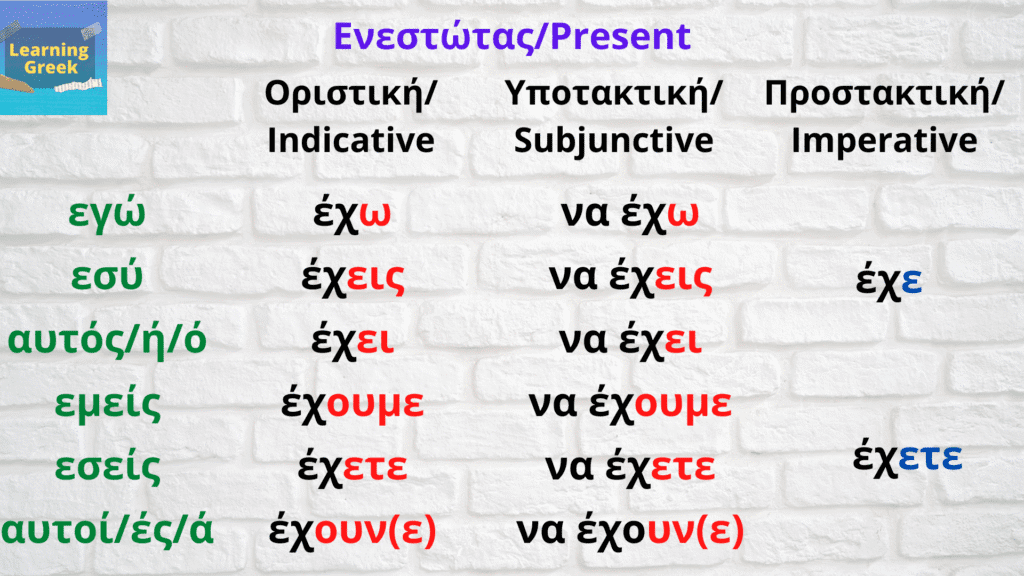
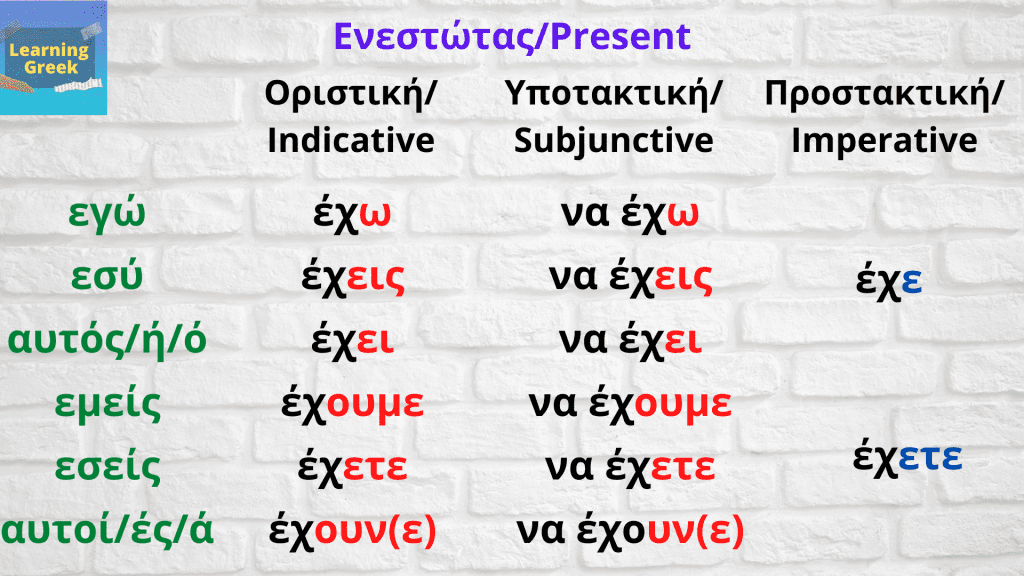
Present Tense
The present tense of έχω is used for actions or states happening now.
| Greek/Indicative | Pronunciation | English |
|---|---|---|
| Εγώ έχω | (egó ého) | I have |
| Εσύ έχεις | (esí éhis) | You have |
| Αυτός/ή/ό έχει | (aftós/í/ó éhi) | He/She/It has |
| Εμείς έχουμε | (emís éhume) | We have |
| Εσείς έχετε | (esís éhete) | You have (plural) |
| Αυτοί/ές/ά έχουν | (aftí/és/á éhun) | They have |
Examples:
- Έχω φίλους. (Ého fílus) – I have friends.
- Έχεις χρόνο; (Éhis chróno?) – Do you have time?
- Έχει πρόβλημα. (Éhi próvlima) – He/She has a problem.
| Greek/Subjunctive | Pronunciation | English |
|---|---|---|
| Να έχω | (na ého) | (that) I have |
| Να έχεις | (na éhis) | (that) you have |
| Να έχει | (na éhi) | (that) he/she/it has |
| Να έχουμε | (na éhume) | (that) we have |
| Να έχετε | (na éhete) | (that) you have |
| Να έχουν | (na éhun) | (that) they have |
Examples:
- Να έχω λεφτά. (Na ého leftá) – I hope I have money.
- Να έχεις υπομονή. (Na éhis ipomoní) – May you have patience.
- Να έχει βοήθεια. (Na éhi voíthia) – May he/she have help.
Imperative Mood
The imperative forms of έχω are rarely used in their literal sense but are common in expressions.
| Greek | Pronunciation | English |
|---|---|---|
| Έχε | (éhe) | Have (singular) |
| Έχετε | (éhete) | Have (plural/polite) |
Examples:
- Έχε υπομονή! (Éhe ipomoní) – Have patience!
- Έχετε τα πάντα έτοιμα! (Éhete ta pánta étima) – Have everything ready! (to a group)
Past Tenses: Παρατατικός & Αόριστος
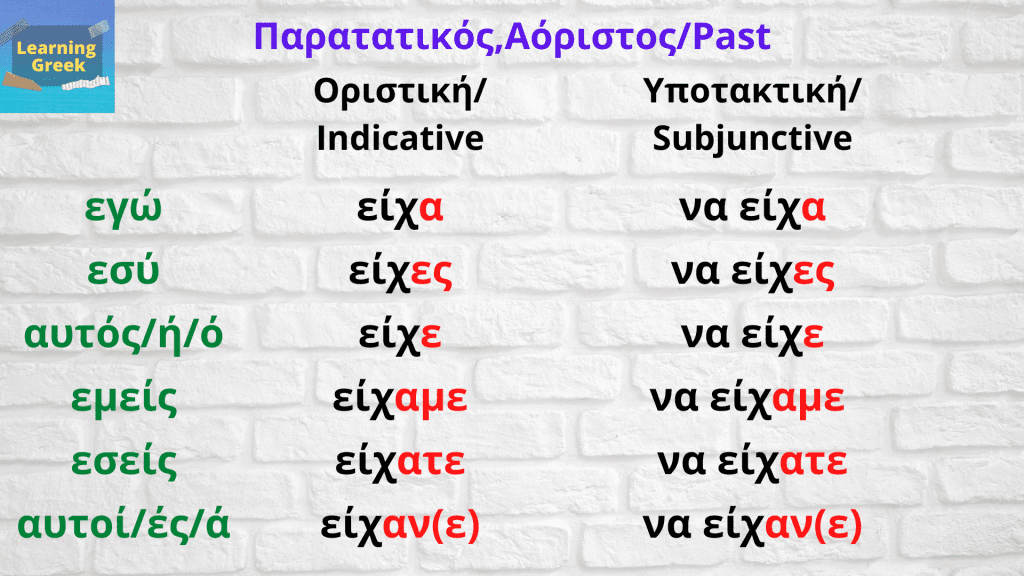
The Aorist (Αόριστος) form of έχω often overlaps with the Past Continuous (Παρατατικός) in meaning. The Παρατατικός emphasizes an ongoing or habitual state in the past, while the Αόριστος focuses on a specific or completed action.
| Greek/Indicative | Pronunciation | English |
|---|---|---|
| Εγώ είχα | (egó íha) | I had |
| Εσύ είχες | (esí íhes) | You had |
| Αυτός/ή/ό είχε | (aftós/í/ó íhe) | He/She/It had |
| Εμείς είχαμε | (emís íhame) | We had |
| Εσείς είχατε | (esís íhate) | You had (plural) |
| Αυτοί/ές/ά είχαν | (aftí/és/á íhan) | They had |
Examples:
- Είχαμε πολλή δουλειά. (Íhame pollí dulia) – We had a lot of work.
- Είχατε δίκιο. (Íhate thício) – You were right.
- Είχαν χρήματα. (Íhan chrímata) – They had money.
| Greek/Subjunctive | Pronunciation | English |
|---|---|---|
| Να είχα | (na íha) | (that) I had |
| Να είχες | (na íhes) | (that) you had |
| Να είχε | (na íhe) | (that) he/she/it had |
| Να είχαμε | (na íhame) | (that) we had |
| Να είχατε | (na íhate) | (that) you had |
| Να είχαν | (na íhan) | (that) they had |
Examples:
- Να είχα χρήματα. (Na ícha chrímata) – If only I had money.
- Να είχες χρόνο. (Na íches chrónos) – If only you had time.
- Να είχε υπομονή. (Na íchi ipomoní) – If only he/she had patience.
Future Tense
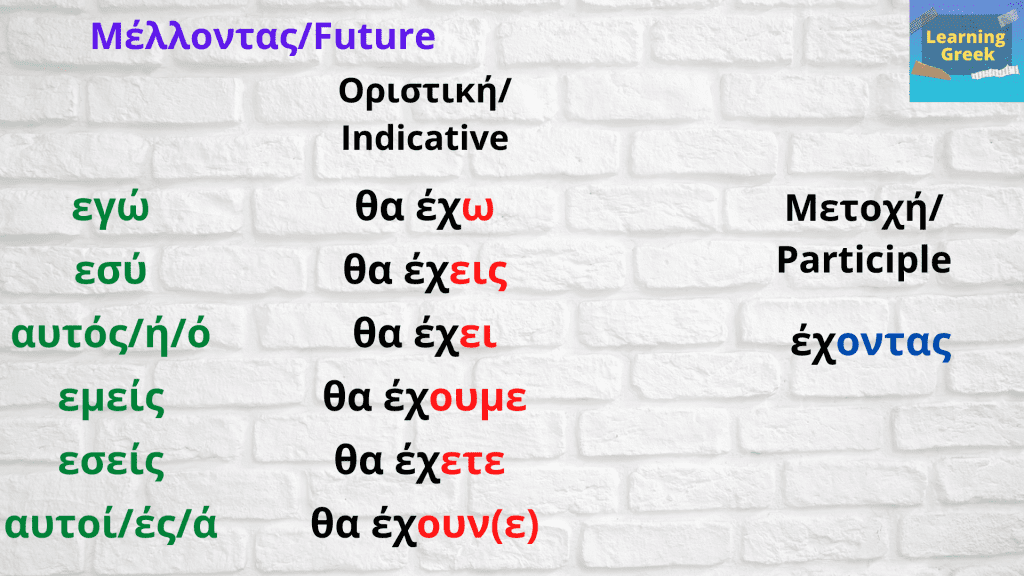
The future tense of έχω is formed with the particle θα + έχω.
| Greek/Indicative | Pronunciation | English |
|---|---|---|
| Εγώ θα έχω | (egó tha ého) | I will have |
| Εσύ θα έχεις | (esí tha éhis) | You will have |
| Αυτός/ή/ό θα έχει | (aftós/í/ó tha éhi) | He/She/It will have |
| Εμείς θα έχουμε | (emís tha éhume) | We will have |
| Εσείς θα έχετε | (esís tha éhete) | You will have |
| Αυτοί/ές/ά θα έχουν | (aftí/és/á tha éhun) | They will have |
Examples:
- Θα έχω δουλειά αύριο. (Tha ého doulia ávrio) – I will have work tomorrow.
- Θα έχεις χρόνο το απόγευμα. (Tha échis chrónos to apóyevma) – You will have time in the afternoon.
- Θα έχει καλή διάθεση. (Tha échi kalí diáthesi) – He/She will be in a good mood.
Special Uses of Έχω
Auxiliary Verb
Έχω is commonly used to form the present perfect, past perfect, and future perfect tenses with a past participle. These tenses are used to express actions related to different time frames:
- Present Perfect: έχω + past participle (Action completed in the past with relevance to the present).
- Past Perfect: είχα + past participle (Action completed before another action or time in the past).
- Future Perfect: θα έχω + past participle (Action that will be completed before another event or time in the future).
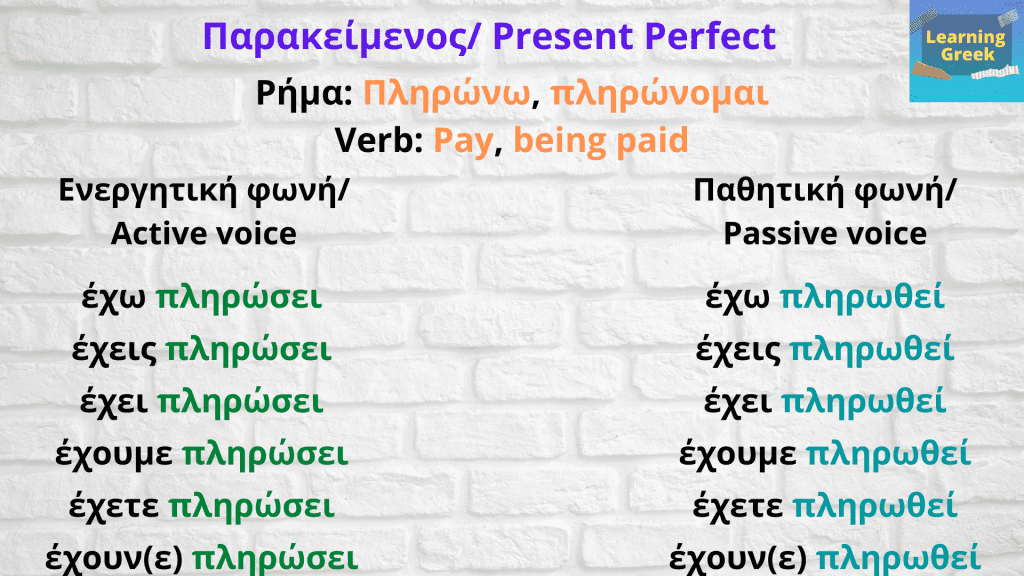
Let’s use the verb πληρώνω (to pay) in the active voice and πληρώνομαι (to be paid) in the passive voice to see how έχω helps conjugate these tenses.
Present Perfect (Έχω + Past Participle)
| Active Voice (Πληρώνω) | Passive Voice (Πληρώνομαι) |
|---|---|
| Έχω πληρώσει (Ého plirósi) | Έχω πληρωθεί (Ého plirothí) |
| Έχεις πληρώσει (Éheis plirósi) | Έχεις πληρωθεί (Éhis plirothí) |
| Έχει πληρώσει (Éhei plirósi) | Έχει πληρωθεί (Éhi plirothí) |
| Έχουμε πληρώσει (Éhume plirósi) | Έχουμε πληρωθεί (Éhume plirothí) |
| Έχετε πληρώσει (Éhete plirósi) | Έχετε πληρωθεί (Éhete plirothí) |
| Έχουν πληρώσει (Éhun plirósi) | Έχουν πληρωθεί (Éhun plirothí) |
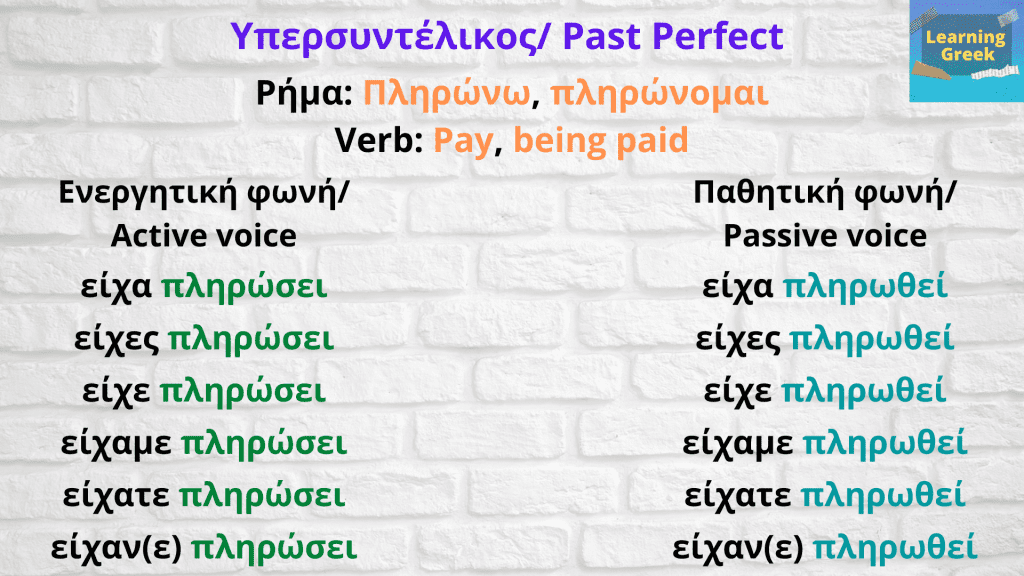
Past Perfect (Είχα + Past Participle)
| Active Voice (Πληρώνω) | Passive Voice (Πληρώνομαι) |
|---|---|
| Είχα πληρώσει (Íha plirósi) | Είχα πληρωθεί (Íha plirothí) |
| Είχες πληρώσει (Íhes plirósi) | Είχες πληρωθεί (Íhes plirothí) |
| Είχε πληρώσει (Íhe plirósi) | Είχε πληρωθεί (Íhe plirothí) |
| Είχαμε πληρώσει (Íhame plirósi) | Είχαμε πληρωθεί (Íhame plirothí) |
| Είχατε πληρώσει (Íhate plirósi) | Είχατε πληρωθεί (Íhate plirothí) |
| Είχαν πληρώσει (Íhan plirósi) | Είχαν πληρωθεί (Íhan plirothí) |
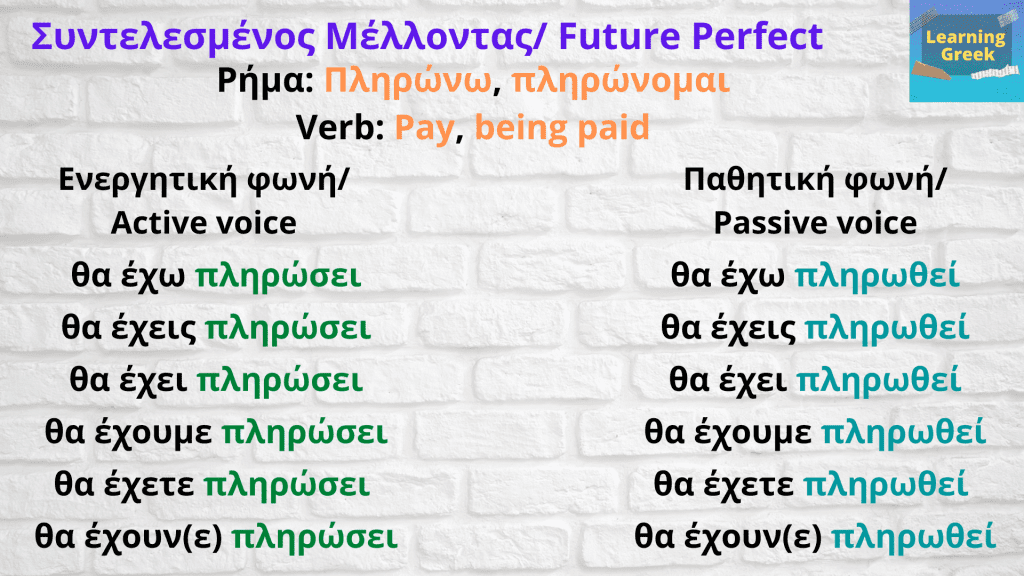
Future Perfect (Θα + Έχω + Past Participle)
| Active Voice (Πληρώνω) | Passive Voice (Πληρώνομαι) |
|---|---|
| Θα έχω πληρώσει (I will have paid) | Θα έχω πληρωθεί (I will have been paid) |
| Θα έχεις πληρώσει (You will have paid) | Θα έχεις πληρωθεί (You will have been paid) |
| Θα έχει πληρώσει (He/She will have paid) | Θα έχει πληρωθεί (He/She will have been paid) |
| Θα έχουμε πληρώσει (We will have paid) | Θα έχουμε πληρωθεί (We will have been paid) |
| Θα έχετε πληρώσει (You will have paid) | Θα έχετε πληρωθεί (You will have been paid) |
| Θα έχουν πληρώσει (They will have paid) | Θα έχουν πληρωθεί (They will have been paid) |
Participle
The participle of έχω is έχοντας (éhontas).
This participle is used in various constructions, it can function in a way similar to the English gerund or present participle and can often be translated as “having.”
Examples:
- Έχοντας χρόνο, πήγα στην αγορά.
(Éhontas chróno, píga stin agorá.)
Having time, I went to the market. - Έχοντας περάσει όλη την ημέρα στο γραφείο, αποφάσισα να ξεκουραστώ.
(Éhontas perási óli tin iméra sto grafío, apofásisa na ksekurastó.)
Having spent the whole day at the office, I decided to rest. - Έχοντας διαβάσει το βιβλίο, μπορούσα να συζητήσω για την ιστορία.
(Éhontas diavási to vivlío, borúsa na sizitíso gia tin istoría.)
Having read the book, I could discuss the story.
Practice Tips
- Drills: Practice conjugating έχω in different tenses.
- Create Sentences: Write examples using έχω in its various functions.
- Listen and Repeat: Pay attention to idiomatic phrases with έχω in Greek media or conversations.
- Practice switching between tenses in simple sentences.
- Speaking Practice
Use έχω in practical contexts. For example:
Talking about possessions: Έχω δύο αδέλφια. (I have two siblings.) - Describing emotions: Έχω άγχος για την εξέταση. (I’m anxious about the exam.)
- Listen to Greek
Notice how έχω is used in songs, movies, or conversations. For example:
“Έχω ερωτευτεί” (I have fallen in love.)
Mastering έχω gives you a vital tool for communication and a deeper understanding of Greek expressions and grammar. Though simple at first, it unlocks the complexities of possession, obligations, and advanced structures. With regular practice, έχω becomes second nature, making it a cornerstone of both everyday conversations and more complex Greek grammar. Its broad usage and consistent conjugation make it one of the most approachable verbs to learn.
If you’re looking to dive deeper into the essential verb είμαι, check out my article on είμαι for more insights.
Keep exploring Greek!
1. Greek in action – visit free museums & archaeological sites!

Thank you for sharing your info. I truly appreciate your efforts and I will be waiting for your further write ups
thank you once again.