
Hello, dear Greek music lovers!
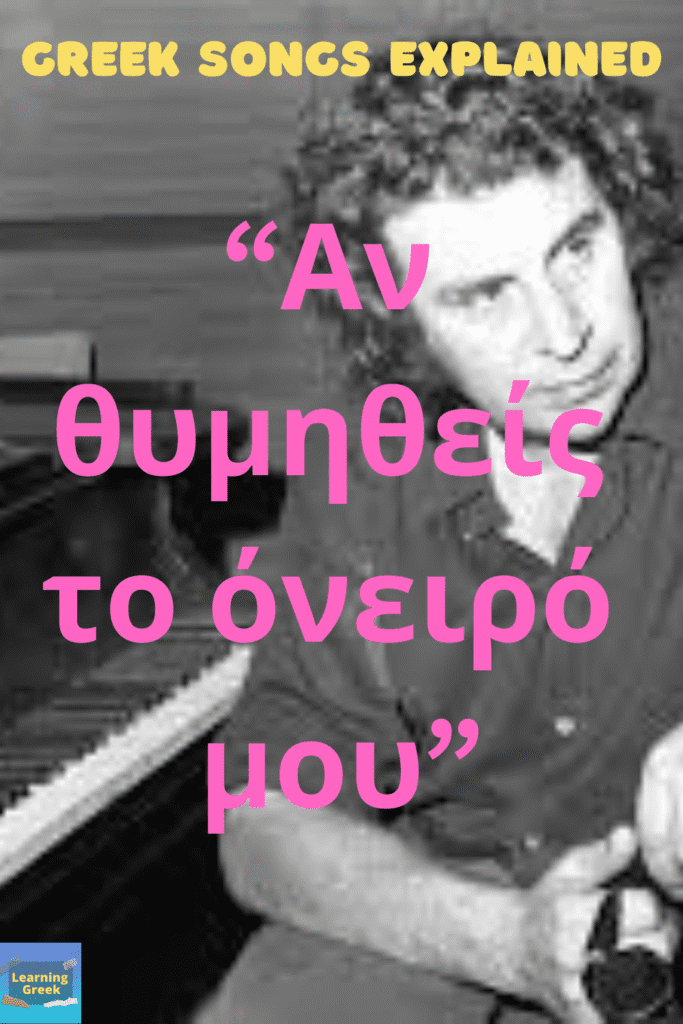
It was 1958 when the renowned Greek composer Mikis Theodorakis, wrote Αν θυμηθείς το όνειρό μου, with poetic lyrics by Nikos Gatsos. At the time, Theodorakis likely had no idea just how widely popular this song would become, reaching listeners not only in Greece but all over the world inspiring even Beatles. But we’ll talk about that later.
Many Greek artists have sung this beautiful piece, and I would like to share one of my favorites.
Now, we’re gonna dive into its lyrics because this classic song isn’t only a beautiful piece to listen to—it’s also an ideal way to improve your Greek pronunciation, learn common words, and get a deeper feel for Greek culture.
So, let’s break down the lyrics and find out what they mean—step by step!
Exploring the Lyrics
| Greek Lyrics | English Translation |
Στην αγκαλιά μου κι απόψε σαν άστρο κοιμήσου Δεν απομένει στον κόσμο ελπίδα καμιά Τώρα που η νύχτα κεντά με φιλιά το κορμί σου Μέτρα τον πόνο κι άσε με μόνο στην ερημιά Αν θυμηθείς τ’ όνειρό μου Σε περιμένω να ‘ρθεις Μ’ ένα τραγούδι του δρόμου να ‘ρθεις, όνειρό μου Το καλοκαίρι που λάμπει, τ’ αστέρι με φως να ντυθείς | In my arms tonight, sleep like a star There is no hope left in the world Now that the night is stitching your body with kisses Count the pain and leave me alone in the wilderness If you remember my dream I’m waiting for you to come With a song of the street, come, my dream In the summer when the star shines, dress in light |
Key Vocabulary
- (η) Αγκαλιά (agkaliá) – embrace, hug
- (το) Άστρο (ástro) – star
- (η) Ελπίδα (elpída) – hope
- (η) Νύχτα (néechta) – night
- (ο) Πόνος (pónos) – pain
- (το) Όνειρο (ónEero) – dream
- (το) Καλοκαίρι (kalokéri) – summer
- (το) Φως (fos) – light
By listening to the song while reading the lyrics, you’ll start recognizing the sounds of the Greek language. You’ll notice how poetic phrases like η νύχτα κεντά (the night stitches) use metaphorical language, which is common in Greek songs and poetry.
But let’s really dive into the lyrics now
Verse 1: The Language of Longing
Στην αγκαλιά μου κι απόψε σαν άστρο κοιμήσου
(Stin agkaliá mu ki apópse san ástro kimísu)
Tonight, sleep in my embrace like a star.
In this line, άστρο (ástro) means “star,” connecting the imagery of a dream with something beautiful and distant. Αγκαλιά (agkaliá) means “embrace/hug,” and it’s a term you’ll often hear in Greek love songs.
Δεν απομένει στον κόσμο ελπίδα καμιά
(Den apoméni ston kósmo elpída kamia)
There’s no hope left in the world.
This line captures a feeling of hopelessness. The word ελπίδα (elpída), meaning “hope,” is one you’ll find often in Greek music, where it conveys feelings of longing, loss, and desire.
Τώρα που η νύχτα κεντά με φιλιά το κορμί σου
(Tóra pou i níchta kentá me filiá to kormí sou)
Now that the night embroiders your body with kisses.
This line uses poetic language to convey the beauty and intimacy of the night. Νύχτα (níchta), meaning “night,” symbolizes mystery and closeness, while κεντά (kentá), meaning “embroiders,” is a delicate, expressive verb that gives the impression of gentle, loving touches. Φιλιά (filiá) means “kisses,” enhancing the tender and affectionate imagery. Together, it creates a sense of the night “stitching” or “decorating” the loved one with kisses.
Μέτρα τον πόνο κι άσε με μόνο στην ερημιά
(Métra ton póno ki áse me móno stin erimiá)
Count the pain and leave me alone in the wilderness.
This line deepens the song’s melancholy, as the narrator requests to be left alone to face emotional suffering. Πόνος (pónos), meaning “pain,” represents the inner hurt the narrator feels, while μόνος (mónos), meaning “alone,” highlights their sense of isolation. Ερημιά (erimiá) translates to “wilderness” or “desolation,” evoking an image of abandonment and loneliness. Together, the line conveys a powerful sense of solitude and sorrow.
These lines evoke deep emotions that resonate throughout the song.
Chorus: If You Remember My Dream
Αν θυμηθείς τ’ όνειρό μου
(An thimitheís t’ oniró mou)
If you remember my dream.
In this conditional phrase, Αν θυμηθείς (An thimithEes) means “If you remember,” and όνειρο (ónEero) means “dream.” It’s a common word in Greek, often symbolizing one’s hopes, aspirations, or desires.
Σε περιμένω να ‘ρθεις
(Se periméno na ‘rtheis)
I’m waiting for you to come.
Περιμένω (periméno) means “I wait,” a word often used in songs about unrequited love or longing. Adding να ‘ρθεις (na ‘rtheis) means “for you to come,” giving it a sense of anticipation and eagerness.
Μ’ ένα τραγούδι του δρόμου να ‘ρθεις, όνειρό μου
(M’ éna tragudi tou drómu na ‘rthis, ónEeró mou)
Come to me with a song of the street, my dream.
Here, the narrator expresses a desire for their loved one to return in a simple, spontaneous manner, embodied by a “song of the street.” Τραγούδι (tragudí), meaning “song,” often symbolizes feelings and memories, while δρόμος (drómos), meaning “street,” hints at a free-spirited, informal arrival. The word όνειρο (ónEero), meaning “dream,” reinforces the song’s central theme of longing and hope.
Verse 2: Imagery of Summer and Light
Το καλοκαίρι που λάμπει τ’ αστέρι με φως να ντυθείς
(To kalokaíri pou lámbi t’ astéri me fos na dythís)
The summer where the star shines, may you be dressed in light.
In this line, καλοκαίρι (kalokeri) means “summer,” a season often associated with love and warmth in Greek poetry and songs. Λάμπει (lámbi) means “shines,” describing the star’s brightness, and φως (fos) means “light,” adding a beautiful image of someone being wrapped in light—a lovely metaphor for hope or affection.
A Song that Crossed Borders
Αν θυμηθείς το όνειρό μου wasn’t just a hit in Greece. As I mentioned before, its haunting melody and universal themes of love and yearning captured the attention of musicians across the globe.
According to legend, when the Beatles visited Greece in the mid-1960s, they were intrigued by Theodorakis’ work, especially admiring his knack for blending Greek musical roots with universally appealing melodies. And here’s the result:
But perhaps the most significant boost to the song’s international fame came when English singer Petula Clark recorded a French-language adaptation titled Lune de miel. Clark’s rendition helped introduce the song to French-speaking audiences, adding a touch of British pop to its Greek soul.
Not long after, “Αν θυμηθείς το όνειρό μου” made its way into the Spanish-speaking world, where it was adapted as Luna de miel by Gloria Lasso. This adaptation helped the song gain popularity, proving that its emotional power was universally relatable.
Conclusion
Αν θυμηθείς το όνειρό μου remains a beloved song today, its legacy a testament to the power of music to connect people across languages and borders. This song not only offers a great way to learn Greek but also provides a window into the rich, intertwined histories of Greek music and global pop culture.