
Hello, my dears!
Today, we’re diving into something both fun AND educational: Greek music and how it can immerse you in the Greek language and culture.
In my own language-learning journey, songs have always helped me understand languages more deeply and connect with their cultures. It’s like a whole new world opening up right in front of my eyes—and ears, of course!
So today, I’m here to help you do the same with Greek music.
But does simply listening to Greek songs help you learn the language? The short answer is no. But don’t worry! You don’t need to do much to actually start learning from songs.
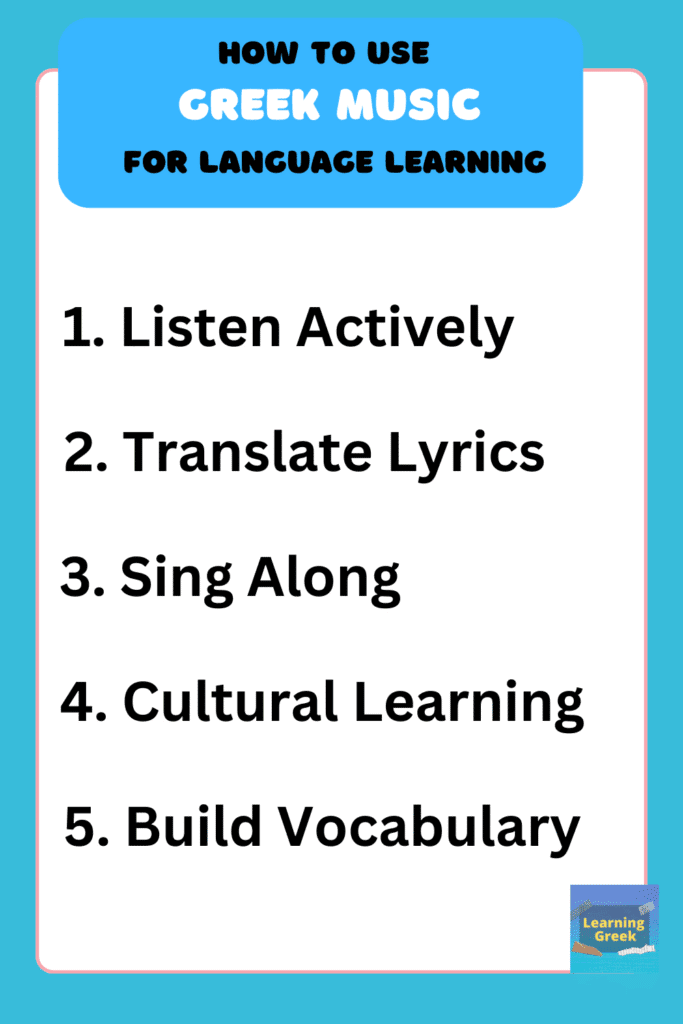
Just follow this simple 5-step guide, and you’ll start to see Greek in a whole new light!
1. Listen Actively
Instead of simply having Greek music on in the background, take some time to really dive into it. Here’s how to start:
Lyrics Search
Look up the lyrics to songs you enjoy. Many sites offer both the original Greek lyrics and English translations. Start with a slower song or ballad, as it’ll be easier to follow along.
Pronunciation Practice
As you listen, focus on how each word is pronounced. Pay attention to the accents and intonation, and try imitating the singer’s style—it’s a great way to sound more like a native!
Identify Key Phrases
Listen for words or phrases that stand out to you. Pause, repeat those phrases, and mimic the singer’s pronunciation. This will build your comprehension and speaking skills at the same time.
Make it a Routine
Active listening might feel tiring at first, but adding it to your daily routine (like on your commute or while relaxing) will make it more enjoyable—and a great habit for learning.
2. Translate Lyrics
Understanding the lyrics connects you to real-life situations and the emotions behind the words:
Initial Translation
Start with a translation into a language you know well. This gives you a feel for the song’s meaning, themes, and context.
Break Down Vocabulary
Pick out any new vocabulary from the lyrics, noting the Greek words and their translations. Using a dictionary can be helpful for accuracy here, and this process builds a personalized vocabulary list that’s meaningful to you.
Focus on Phrases
Sometimes translations can’t capture the exact nuance of the Greek. Pick up on whole phrases or expressions that don’t directly translate. These will be especially useful for conversational Greek!
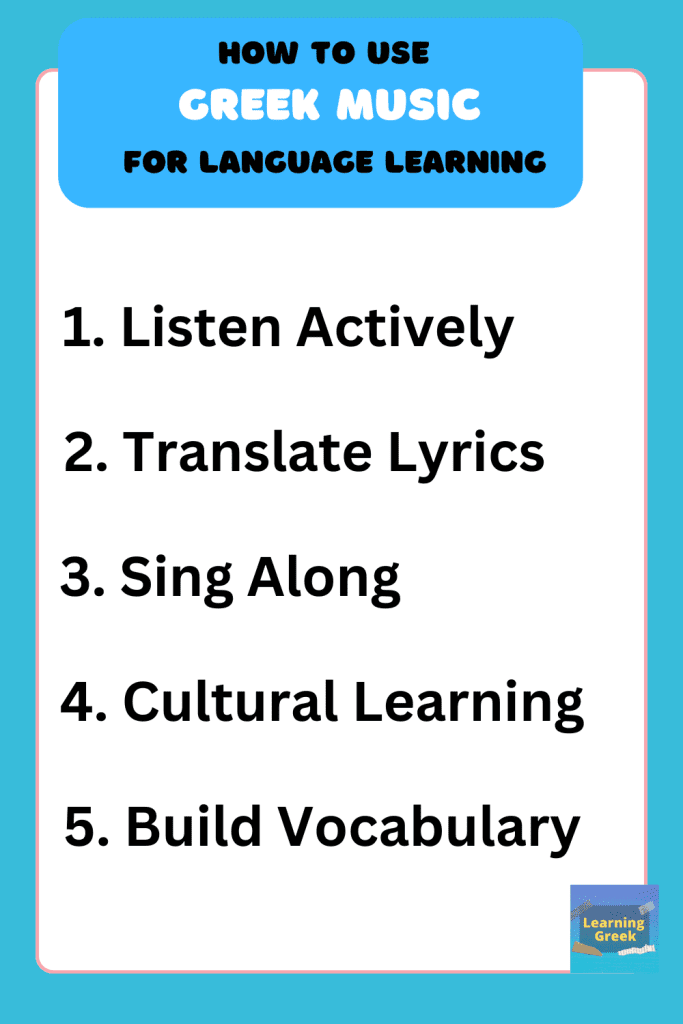
3. Sing Along
Singing along to Greek songs can do wonders for your language learning:
Pronunciation and Intonation
Mimicking the singer helps you naturally improve pronunciation and sound more like a native speaker. Singing is fantastic for mastering rhythm, intonation, and word connections.
Fluency
Repetition is key! Even if you don’t fully understand the words, singing along helps you recognize sentence patterns and structures that will pop up again in other contexts.
Confidence Boost
Singing in Greek can make you feel more comfortable with the language. If speaking Greek feels intimidating, singing is a fun way to practice without the pressure of conversation.
Memory
Music aids memory retention; melody, rhythm, and repetition make it easier to remember words and phrases than textbook study alone.
4. Cultural Learning
Greek songs are a doorway to Greek culture, each one offering a glimpse into the country’s life, history, and emo
Explore Different Genres
From traditional rebetika to modern pop, each genre reveals unique aspects of Greek society. For instance, laika songs often deal with themes of love and heartbreak, while rebetika reflects struggles, resistance, and stories of everyday life.
Contextual Learning
Songs not only teach you the language but also how specific words or expressions are used in real contexts. Lyrics are full of references to Greek customs, traditions, and historical events, helping you see Greek as it’s spoken in everyday life.
Emotional Connection
Songs convey emotions that aren’t easily captured in a classroom. Understanding how Greeks express feelings like love, sadness, happiness, and anger through music brings you closer to the language on a personal level.
5. Build Vocabulary
Greek songs are full of repetitive lyrics which makes it easy to learn and remember new words:
Frequent Repetition
Many songs repeat lines or choruses, which helps reinforce vocabulary without you even realizing it. The more you listen, the more familiar these words become.
Thematic Vocabulary
Some songs revolve around specific themes—like love, nature, or social issues—allowing you to build vocabulary in areas you’re interested in.
Create a Word Bank
Keep a notebook for jotting down new words. Try organizing them by theme (e.g., emotions, places, actions). Revisiting these words in different contexts will help cement them in your memory..
Use Vocabulary in Context
After learning new words, try using them in your own Greek conversations, writing, or language exercises. Words connected to a song and melody often stick with you longer.
Song Recommendations
This section will be updated with songs I’ll recommend to you. Together, we’ll translate the lyrics and uncover the meaning behind them.
- Αν θυμηθείς το όνειρό μου – Μίκης θεοδωράκης
- Θέλω να γυρίσω, Μαζωνάκης
- Ταξίδι, Σπανού
- Το τραγούδι του φεγγαριου, Αλεξίου
- Αστερομάτα, Κλαύδια
- Συννεφιασμένη Κυριακή, Τσιτσάνης
- Σε περίπτωση που, Βίσση
- Αγέλη, Σεργουνιώτη
Conclusion
By following these steps, you’ll not only improve your Greek language skills but also deepen your understanding of Greek culture, emotions, and the language’s unique nuances.
Music is a perfect companion for any language learner—it’s fun, memorable, and packed with opportunities to learn!