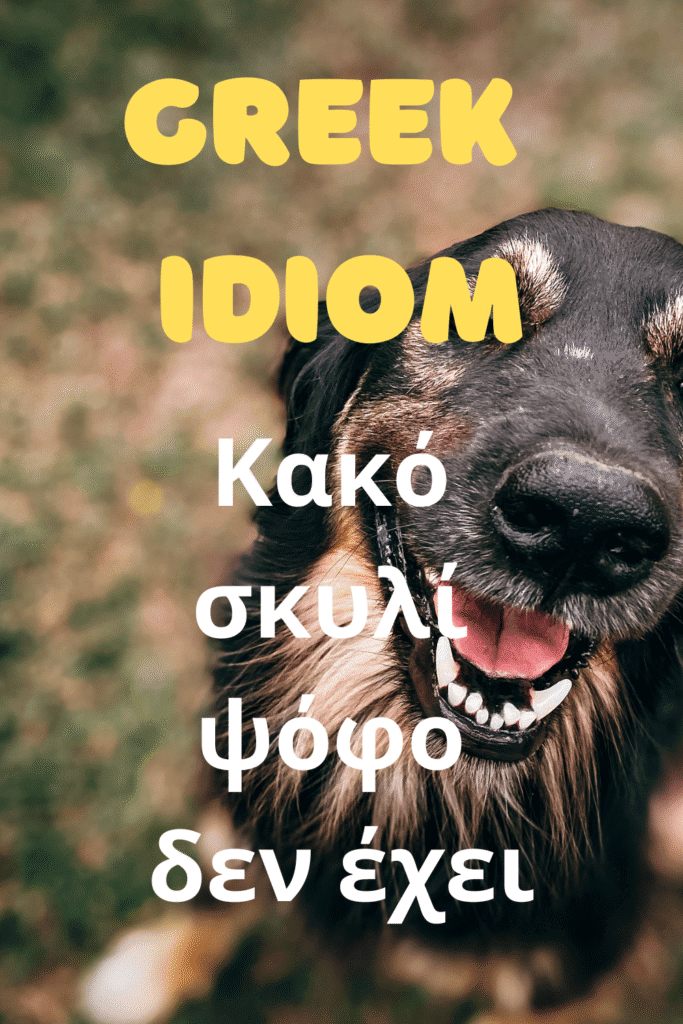

This article is presented in both English and Greek. Scroll down for the Greek section.
Greek idioms offer fascinating insights into the language and culture, often blending humor, wisdom, and life lessons. One idiom that stands out for its colorful imagery and deeper meaning is Κακό σκυλί ψόφο δεν έχει.
Let’s dive into the meaning, usage, grammatical analysis, and cultural significance behind this lively expression.
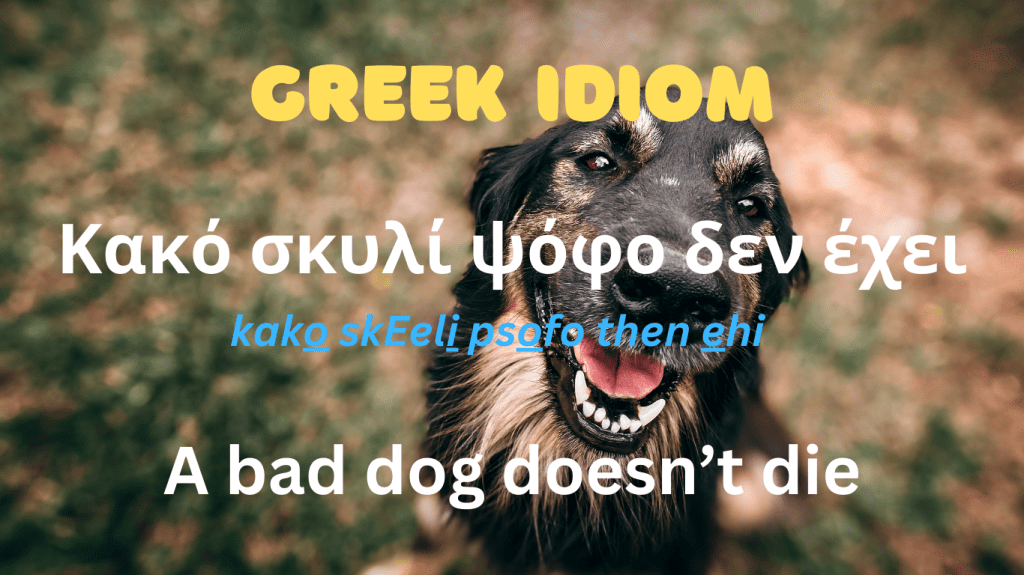
Κακό Σκυλί Ψόφο Δεν Έχει
(Kakó skEelí psófo then éhEe)
Literal Translation:
“A bad dog doesn’t die.”
Meaning:
This idiom describes a person who, despite challenges or adversity, stubbornly persists and survives. It is often said about someone who is tough or difficult to deal with—like a “bad dog” that nothing seems to stop. The phrase is frequently used humorously or ironically to emphasize resilience, particularly in those who are hard-hearted, mean, or morally questionable.
Importantly, this expression also highlights the idea that bad or tough individuals are often the ones who seem immune to life’s hardships, while more vulnerable people—whether they are soft or kind-hearted—are more susceptible to misfortune. In other words, it suggests that the mean or wicked often “hang on to life” and refuse to go down, while the good or gentle are the ones who tend to face life’s challenges more easily.
Grammatical Breakdown
Κακό (Kakó)
Adjective: “Bad” or “evil.” It describes the dog in the phrase but is used metaphorically to refer to a person who is difficult, tough, or morally questionable.
Σκυλί (SkEelí)
Noun: “Dog.” The dog here symbolizes a resilient or stubborn individual who seems to survive no matter the circumstances.
Ψόφο (Psófo)
Noun: “Death” or “fateful end.” Often used in a colloquial sense to refer to animal death, in this context, it suggests that the “bad dog” avoids its fate and keeps surviving.
Δεν (Den)
Negation: The particle “den” is used here to negate the verb, meaning “does not.”
Έχει (ÉhEe)
Verb: “Has” or “possesses.” It completes the idea that the bad dog does not meet its end easily, signifying its resilience.
Examples in Context
- Tough Person Context
Scenario: A group of friends is talking about a particularly tough and unyielding individual.
- Ο Γιώργος είναι σαν το κακό σκυλί, τίποτα δεν τον σταματάει. Κακό σκυλί ψόφο δεν έχει.
- (O Yiórgos Έenai san to kakó skEelí, típota den ton stamatáEe. Kakó skEelí psófo den éhEe.)
- George is like the bad dog; nothing stops him. A bad dog doesn’t die.
- Comment on the Difference Between the Tough and the Vulnerable
Scenario: People discussing why the most difficult or mean people seem to thrive while others struggle.
- Πώς γίνεται οι σκληροί και κακοί άνθρωποι να επιβιώνουν πάντα, ενώ οι καλοί τρώγονται από τις δυσκολίες; Κακό σκυλί ψόφο δεν έχει.
- (Pós gínete i skliri kai kakEe ánthropi na epiviónun pánta, enó oi kalEe trógonte apó tis diskolíes? Kakó skEelí psófo then éhEe.)
- How is it that the tough and mean people always survive, while the good ones suffer? A bad dog doesn’t die.
Cultural Significance and Historical Background
The idiom Κακό σκυλί ψόφο δεν έχει reflects a deeper aspect of Greek culture, which values resilience, even when it comes with a dose of irony. It points out that life sometimes favors the hard-hearted, the wicked, or those who seem undeserving of their survival. In contrast, the good and the gentle are often more vulnerable to life’s hardships.
In the rural areas of Greece, dogs were often seen as survivors of tough conditions. Over time, the image of the “bad dog” became a metaphor for tough, resilient people who refuse to be taken down by life’s adversities. The idiom carries a playful but sharp commentary on the unfairness of life, where the hardest or most difficult individuals outlast the rest.
Conclusion
Understanding idioms like Κακό σκυλί ψόφο δεν έχει provides a deeper insight into the Greek language and its embedded cultural values. This phrase humorously reminds us that some people, much like the “bad dog,” just keep going no matter what life throws at them.
Next time you encounter someone who seems unstoppable despite adversity—or perhaps someone who is difficult but keeps thriving—say Κακό σκυλί ψόφο δεν έχει. It’s a witty way to acknowledge their resilience, even if it’s a little frustrating!
The text follows in Greek:
Μια Βαθιά Ματιά στην Ελληνική Έκφραση «Κακό Σκυλί Ψόφο Δεν Έχει»
Οι ελληνικές ιδιωματικές εκφράσεις προσφέρουν συναρπαστικές ερμηνείες για τη γλώσσα και τον πολιτισμό, συνδυάζοντας συχνά χιούμορ, σοφία και μαθήματα ζωής. Μια από τις εκφράσεις που ξεχωρίζει για τη ζωντανή της εικόνα και το βαθύτερο νόημα είναι η (έκφραση) Κακό σκυλί ψόφο δεν έχει.
Ας ρίξουμε μια ματιά στο νόημα, τη χρήση, την γραμματική ανάλυση και την πολιτισμική σημασία πίσω από αυτήν τη φράση.
Κακό Σκυλί Ψόφο Δεν Έχει
Κυριολεκτική Μετάφραση:
Ένα κακό σκυλί δεν πεθαίνει.
Νόημα:
Αυτή η έκφραση περιγράφει ένα άτομο που, παρά τις προκλήσεις ή τις δυσκολίες, επιμένει και επιβιώνει. Συχνά λέγεται για κάποιον που είναι σκληροτράχηλος ή δύστροπος—σαν ένα «κακό σκυλί» που τίποτα δεν φαίνεται να το σταματά. Η φράση χρησιμοποιείται συχνά με χιουμοριστικό ή ειρωνικό τρόπο για να τονίσει την ανθεκτικότητα, ιδιαίτερα σε άτομα που είναι σκληρόκαρδα, κακοπροαίρετα ή ηθικά αμφισβητήσιμα.
Σημαντικό είναι ότι αυτή η έκφραση υπογραμμίζει επίσης την ιδέα ότι οι κακοί ή σκληροί άνθρωποι συχνά μοιάζουν να είναι άτρωτοι στις δυσκολίες της ζωής, ενώ οι πιο ευάλωτοι—είτε είναι πιο μαλακοί είτε καλοπροαίρετοι—είναι πιο επιρρεπείς στις αντιξοότητες. Με άλλα λόγια, υποδηλώνει ότι οι κακοί ή οι ανθεκτικοί συχνά «επιβιώνουν» και αρνούνται να υποκύψουν, ενώ οι καλοί ή ευαίσθητοι είναι αυτοί που τείνουν να υποφέρουν πιο εύκολα από τις προκλήσεις της ζωής.
Γραμματική Ανάλυση
Κακό (Kakó):
Επίθετο: «Κακό» ή «κακόβουλο». Περιγράφει το σκυλί στη φράση αλλά χρησιμοποιείται μεταφορικά για να αναφερθεί σε κάποιον δύστροπο, σκληρό ή ηθικά αμφίβολο άνθρωπο.
Σκυλί (SkEelí):
Ουσιαστικό: «Σκυλί». Στην έκφραση, το σκυλί αντιπροσωπεύει κάποιον ανθεκτικό, που είναι δύσκολο να τον καταβάλεις.
Ψόφο (Psófo):
Ουσιαστικό: «Θάνατος» ή «μοιραίο τέλος». Συχνά χρησιμοποιείται στην καθομιλουμένη για ζώα, αλλά σε αυτή την περίπτωση υποδηλώνει ότι το «κακό σκυλί» αποφεύγει το τέλος του και συνεχίζει να επιβιώνει.
Δεν (Then):
Άρνηση: Η λέξη «δεν» χρησιμοποιείται για να αρνηθεί το ρήμα, σημαίνοντας «δεν».
Έχει (Éhi):
Ρήμα: «Έχει» ή «κατέχει». Ολοκληρώνει την ιδέα ότι το κακό σκυλί δεν φτάνει εύκολα στο τέλος του, τονίζοντας την ανθεκτικότητά του.
Παραδείγματα Χρήσης
- Πλαίσιο Σκληρότητας
Σενάριο: Μια ομάδα φίλων συζητά για ένα ιδιαίτερα σκληροτράχηλο και ακαταμάχητο άτομο.
- Ο Γιώργος είναι σαν το κακό σκυλί, τίποτα δεν τον σταματάει. Κακό σκυλί ψόφο δεν έχει.
- Σχόλιο για τη Διαφορά Ανάμεσα στους Σκληρούς και στους Ευάλωτους
Σενάριο: Άτομα συζητούν γιατί οι πιο δύστροποι ή κακοί άνθρωποι φαίνεται να ευημερούν, ενώ άλλοι πασχίζουν.
- Πώς γίνεται οι σκληροί και κακοί άνθρωποι να επιβιώνουν πάντα, ενώ οι καλοί τρώγονται από τις δυσκολίες; Κακό σκυλί ψόφο δεν έχει.
Πολιτισμική Σημασία και Ιστορικό Υπόβαθρο
Η έκφραση Κακό σκυλί ψόφο δεν έχει αντανακλά μια βαθύτερη πτυχή της ελληνικής κουλτούρας, που εκτιμά την ανθεκτικότητα, ακόμη και όταν συνοδεύεται από μια δόση ειρωνείας. Υποδεικνύει ότι η ζωή κάποιες φορές ευνοεί τους σκληρόκαρδους, τους κακούς, ή αυτούς που φαίνονται ανάξιοι για την επιβίωσή τους. Αντιθέτως, οι καλοί και ευαίσθητοι είναι συχνά πιο ευάλωτοι στις δυσκολίες της ζωής.
Στις αγροτικές περιοχές της Ελλάδας, τα σκυλιά συχνά θεωρούνταν επιζήσαντες δύσκολων συνθηκών. Με τον καιρό, η εικόνα του «κακού σκυλιού» έγινε μεταφορά για σκληρούς, ανθεκτικούς ανθρώπους που αρνούνται να καταβληθούν από τις αντιξοότητες της ζωής. Η έκφραση φέρει έναν παιχνιδιάρικο αλλά αιχμηρό σχολιασμό για την αδικία της ζωής, όπου οι πιο σκληροτράχηλοι ή δύσκολοι άνθρωποι ζουν περισσότερο από τους άλλους.
Συμπέρασμα
Η κατανόηση ιδιωμάτων όπως το Κακό σκυλί ψόφο δεν έχει παρέχει βαθύτερη γνώση της ελληνικής γλώσσας και των ενσωματωμένων πολιτισμικών αξιών της. Αυτή η φράση μάς υπενθυμίζει με χιούμορ ότι κάποιοι άνθρωποι, όπως το «κακό σκυλί,» συνεχίζουν να επιβιώνουν ό,τι κι αν τους συμβεί.
Την επόμενη φορά που θα συναντήσετε κάποιον που φαίνεται ασταμάτητος παρά τις δυσκολίες—ή ίσως κάποιον που είναι δύστροπος αλλά συνεχίζει να ευημερεί—πείτε Κακό σκυλί ψόφο δεν έχει. Είναι ένας έξυπνος τρόπος να αναγνωρίσετε την ανθεκτικότητά τους, ακόμη κι αν είναι λίγο ενοχλητικό!


I enjoy reading an article that will make people think.
Also, many thanks for allowing for me to comment!
Thank you for your kind words!
You’re welcome 🙂
Valuable info. Lucky me I discovered your web site accidentally, and
I’m surprised why this coincidence did not came about earlier!
I bookmarked it.
Hello! I understand this is somewhat off-topic but I needed to ask.
Does managing a well-established blog such as yours
take a large amount of work? I am completely new to writing a blog
but I do write in my journal everyday. I’d like to start a blog so I will be able to share my own experience and feelings online.
Please let me know if you have any ideas or tips for new aspiring blog owners.
Thankyou!
Pretty great post. I simply stumbled upon your weblog and wished to mention that I’ve really loved browsing your blog posts.
In any case I will be subscribing to your feed and I’m hoping you write
once more soon!
Thank you! 🙂