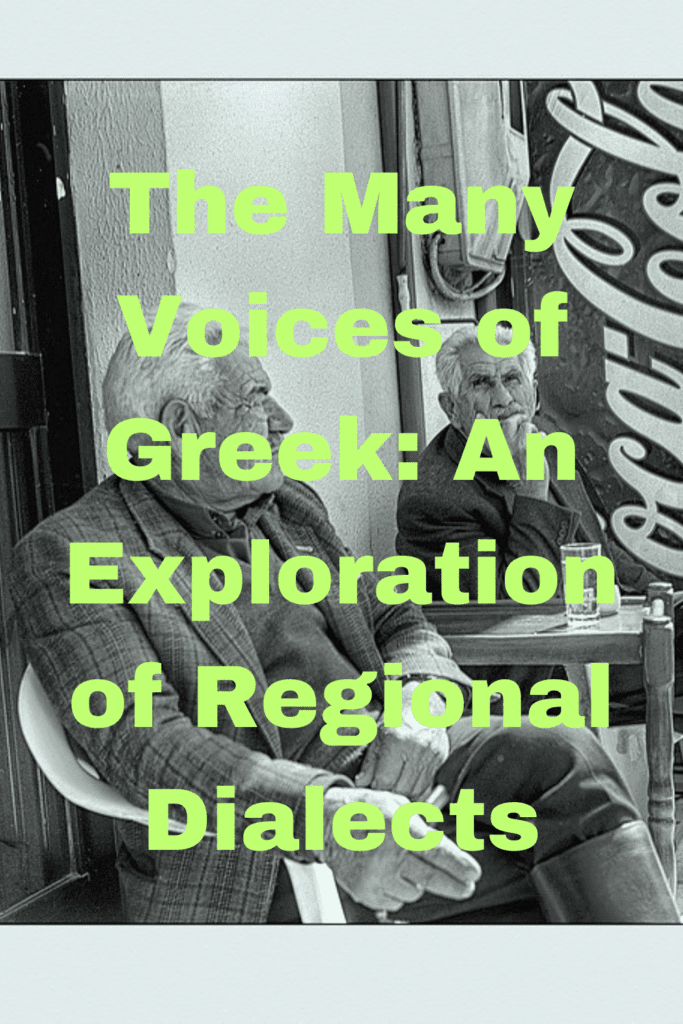

Greek, one of the world’s oldest living languages, has evolved into several dialects over centuries, with regional varieties still spoken today.
These dialects often show significant differences from Standard Modern Greek (SMG), which is based on the Demotic form of the language spoken in the capital, Athens.
The dialects reflect historical, geographical, and social influences and can vary in terms of pronunciation, grammar, vocabulary, and even some syntax.
Below is an overview of some key Greek dialects.
Overview of Greek Dialects
1. Cypriot Greek (Κυπριακά)
Region: Cyprus
Classification: Hellenistic/Byzantine origin
Characteristics:
- Pronunciation:
- Strong phonological distinctions, including the softening of certain consonants (e.g., [t] becomes [ts], [k] becomes [ch]).
- The “gemination” of consonants is prevalent, meaning double consonants are pronounced more strongly than in SMG.
- Vocabulary:
- Cypriot Greek retains many archaic words from Ancient Greek and has borrowed heavily from Italian and Turkish due to historical occupations.
- Unique words like halia (meaning “poor quality”) or pousta (meaning “hard”).
- Grammar:
- Cypriot Greek uses different verb endings compared to SMG, especially in past tense.
- Personal pronouns are more frequently used before verbs, and there are extra pronoun forms that don’t exist in SMG.
Examples:
Modern Greek: Σε αγαπώ. (se agapό) – I love you
Cypriot Greek: Αγαπώ σε. (agapό se)
Modern Greek: Με πονάει το κεφάλι μου. (me ponάee to kefάli mu) – My head hurts
Cypriot Greek: Πονώ το κεφάλι μου. (ponό to kefάli mu)
Modern Greek: Αύριο θα λείπω όλη μέρα από το σπίτι. (άvrio tha lÉepo όli méra apό to spίti) – Tomorrow I will be away all day from home
Cypriot Greek: Αύριο εν να λείπω ούλη μέρα που το σπίτι. (άvrio en na lÉepo όuli méra pu to spίti)
Modern Greek: Δεν είναι γλυκό το κέικ, γιατί δεν έβαλα ζάχαρη μέσα. (den Éene ylikό to kéik, yiatί den évala zάchari mésa) – The cake is not sweet because I didn’t put any sugar in it
Cypriot Greek: Εν εν γλυκό το κέικ, γιατί εν έβαλα ζάχαρη μέσα. (en en ylikό to kéik, yiatί en évala zάchari mésa)
2. Pontic Greek (Ποντιακά)
Region: Historically the Pontus region (modern northeastern Turkey, Georgia, Russia, Greece)
Classification: Hellenistic origin, preserved by Greek communities in the Black Sea
Characteristics:
- Pronunciation:
- Pontic retains certain ancient Greek sounds and vocabulary.
- The sound “e” (epsilon) is pronounced as “ie” or “ia” in many cases, distinguishing it from SMG pronunciation.
- Vocabulary:
- Pontic preserves many archaic Greek words and is influenced by Turkish and Caucasian languages.
- Grammar:
- Pontic Greek uses older forms of verbs and nouns, which differ considerably from SMG.
- The use of double negation is common in Pontic, which is rare in SMG.
Examples:
Modern Greek: Μιλάω Ποντιακά. (milάο Pontiakά) – I speak Pontian
Pontic: Καλατσέβω Ποντιακά. (kalatsévo Pontiakά)
Modern Greek: Τι κάνεις; (Ti kάnees;) – How are you?
Pontic: Ντέ φτάς; (Nte ftas;)
Modern Greek: Δεν καταλαβαίνω τίποτα. (den katalavéno tίpota) – I do not understand anything
Pontic: Τιδέν κι γρικό. (tithén ki yrikό)
Modern Greek: Κάνε την δουλειά σου. (kάne ti duliά su) – Do your work
Pontic: Πίσον τι δουλίας. (pίson ti dulίαs)
3. Cretan Greek (Κρητικά)
Region: Crete
Classification: Byzantine origin with some Venetian influence
Characteristics:
- Pronunciation:
- The accent is notably different, often sounding more sing-song or musical.
- There is a frequent lengthening of vowels and diphthongs, and fricatives like [θ] and [δ] tend to be replaced with [t] and [d].
- Vocabulary:
- Many words in Cretan Greek stem from Venetian (from Crete’s Venetian occupation) and Turkish influences. For instance, koumara (berries) is of Venetian origin.
- Grammar:
- Cretan dialect often uses older forms of verbs and displays unique syntactical constructions.
- The past tense forms can be different, and Cretan speakers sometimes omit articles more frequently than in SMG.
Examples:
Modern Greek: Δείξε λίγο σεβασμό. (dίxe lίgo sevasmό) – Show some respect
Cretan: Σέβου ένα ψιχάλι. (sévu éna psichάli)
Modern Greek: Ακολούθα την καρδιά σου. (akolútha tιn kardiά su) – Follow your heart
Cretan: Μπατόνιαρε τη λογική. (mpatόniare ti loyikί)
Modern Greek: Τι κάνεις; (τι κάnis;) – How are you?
Cretan: Ίντα κάνεις; (ίnta κάnis;)
Modern Greek: Ζεσταίνομαι. (zesténome) – I’m hot
Cretan: Καψώνομαι. (kapsόnome)
4. Griko (Greko)
Region: Southern Italy (Apulia, Calabria)
Classification: Ancient Doric Greek origin
Characteristics:
- Pronunciation:
- Griko has a distinct phonetic system influenced by Italian but retains elements of ancient Doric Greek.
- Vocabulary:
- It contains a mixture of Greek and Italian words, some of which are no longer used in Greece.
- Grammar:
- Griko grammar shows Italian influence in word order and the use of prepositions but preserves certain ancient Greek grammatical features.
- Word endings and verb tenses can differ significantly from both SMG and other Greek dialects.
Examples:
Modern Greek: Πεινάω. (Peenáo) – I’m hungry
Griko: Penéo.
Modern Greek: Πώς σε λένε; (Pós se léne?) – What’s your name?
Griko: Pósse leísse?
Modern Greek: Πού πας; (Pú pas?) – Where are you going?
Griko: Addò pate?
Modern Greek: Θα σε βοηθήσω. (Tha se voithíso) – I will help you
Griko:Thá sso boithíso.
5. Tsakonian Greek (Τσακωνικά)
Region: Eastern Peloponnese (Tsakonia)
Classification: Descended from Doric Greek, one of the most ancient Greek dialects
Characteristics:
- Pronunciation:
- Tsakonian preserves Doric phonological features, making it one of the most distinctive and hardest-to-understand Greek dialects.
- Some consonants are dropped, and vowels are pronounced differently compared to SMG.
- Vocabulary:
- Many words in Tsakonian are either archaic or uniquely local.
- Grammar:
- Tsakonian grammar is markedly different from SMG, retaining elements that have otherwise disappeared in Greek. For instance, the infinitive still exists in Tsakonian.
Examples:
Modern Greek: Δεν καταλαβαίνω. (den katalavéno) – I don’t understand
Tsakonian: Μου κάτ’ λάμπανω. (mu kat’lάmpano)
Modern Greek: Καλημέρα. (kaliméra) – Good morning
Tsakonian: Ιά μέρα. (Iá méra)
Modern Greek: Πώς σε λένε; (pós se léne;) – What is your name?
Tsakonian: Πός λένσε; (pós lénse;)
Modern Greek: Θέλω νερό. (thélo neró) – I want water
Tsakonian: Θέλκο ύο. (thélko ίo)
6. Northern Greek Dialects
These include dialects from Macedonia, Thessaly, Epirus, Thrace, and parts of Central Greece.
Characteristics:
- Pronunciation:
- Vowel reduction, where unstressed vowels (especially “i” and “e”) tend to merge or disappear.
- Vocabulary:
- Northern dialects tend to be more conservative and maintain many archaic forms, but also feature Slavic and Turkish loanwords due to historical interactions.
- Grammar:
- The Northern dialects feature simpler verb conjugations and sometimes the use of different prepositions than in SMG.
Examples:
Modern Greek: Πώς σε λένε; (pós se léne;) – What is your name?
Northern Greek: Πώς σ’ λεν; (pós s’ len;)
Modern Greek: Τι ώρα είναι; (ti óra íne;) – What time is it?
Northern Greek: Τι ώρα ι; (ti óra e;)
Modern Greek: Θα σε βοηθήσω. (tha se voithíso) – I will help you
Northern Greek: Θα σε βοήσω. (tha se voíso)
Modern Greek: Ο καιρός είναι ωραίος. (o kerós íne oréos) – The weather is nice
Northern Greek: Ο καιρός είναι καλαί. (o kerós íne kalé)
Key Differences Between Greek Dialects and Standard Modern Greek (SMG)
- Pronunciation: Regional dialects often have distinct sounds. For example, Cypriot Greek has softer consonants, while Northern Greek dialects reduce vowels.
- Vocabulary: Dialects frequently use words that have either fallen out of use in SMG or are borrowed from neighboring languages. For example, Cypriot Greek borrows from Italian and Turkish, while Griko is influenced by Italian.
- Grammar: Differences in verb forms, pronoun usage, and sentence structure are prominent across dialects. For example, Cretan Greek uses older verb forms, while Pontic Greek retains more archaic grammar overall.
- Intelligibility: While dialects like Cretan or Northern Greek may be fairly intelligible to speakers of SMG, dialects like Pontic, Tsakonian, and Griko may be difficult to understand without specific knowledge of them.
Conclusion
Greek dialects offer a fascinating window into the historical, cultural, and social development of the Greek language.
Each dialect preserves elements from ancient forms of Greek and exhibits influences from foreign powers that ruled Greece.
While SMG is used as the formal and unifying language, dialects still play a vital role in regional identity and heritage, with some dialects like Tsakonian even at risk of extinction.
Understanding these dialects enriches one’s appreciation of the diversity within the Greek linguistic tradition.