
Greek idioms provide a fascinating insight into the language’s cultural and historical layers. One particularly intriguing idiom is Πλήρωσε τη νύφη.
Let’s explore its meaning, usage, and the historical significance behind this phrase.
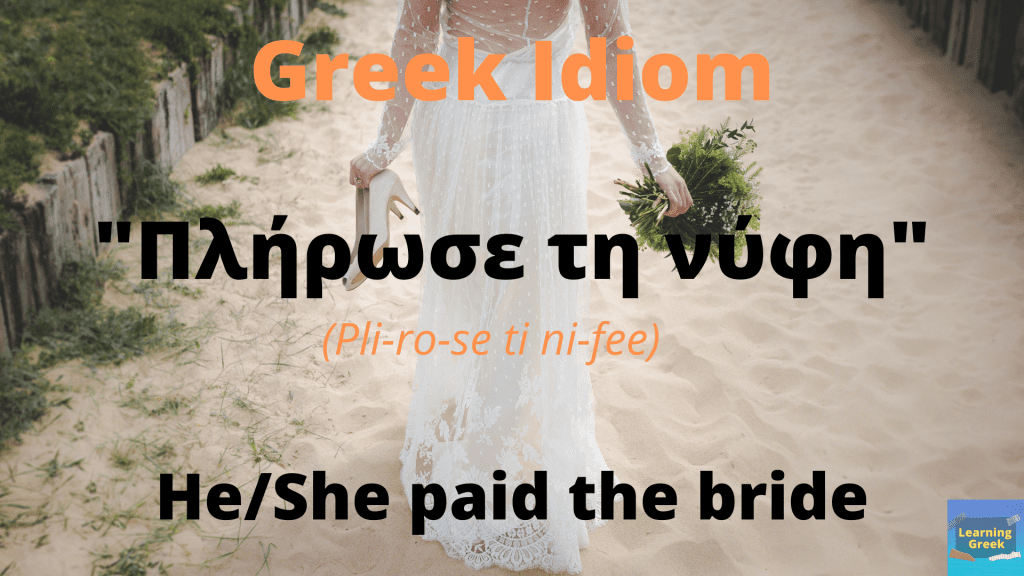
Πλήρωσε τη νύφη
(plίrose ti nίfee)
- Literal Translation: He/She paid the bride
- Meaning: This idiom refers to someone unfairly bearing the consequences or paying the price for someone else’s mistakes or actions. The person ends up shouldering the burden, often without deserving it.
Examples in context
1. Workplace Context
Scenario: A project goes awry, and one team member takes the blame even though the mistake was collective.
Example:
- Όλοι κάναμε λάθη, αλλά στο τέλος η Μαρία πλήρωσε τη νύφη.
- (Óli káname láthi, allá sto télos i María plírose ti nífee.)
- We all made mistakes, but in the end, Maria paid the price.
2. Family Context
Scenario: A parent has to fix a mess caused by their children, even though they weren’t responsible for it.
Example:
- Τα παιδιά έκαναν την αταξία, αλλά εγώ πλήρωσα τη νύφη καθαρίζοντας.
- (Ta pediá ékanan tin ataxía, allá egó plírosa ti nífee katharízontas.)
- The kids made the mess, but I ended up paying the price by cleaning it up.
3. Social Context
Scenario: At a group dinner, one person is left to cover the bill because the others either didn’t contribute enough or forgot their wallets.
Example:
- Όλοι παραγγείλαμε, αλλά τελικά εγώ πλήρωσα τη νύφη.
- (Oli parangeílamé, allá teliká egó plírosa ti nífi.)
- We all ordered, but in the end, I was the one who paid the bill.
Historical Development of the Idiom
While the idiom Πλήρωσε τη νύφη seems puzzling at first glance, its origins are tied to the traditions of Greek weddings. Historically, weddings in Greece were elaborate and expensive affairs, often leading to tensions over who would bear the financial burden. In this context, “paying the bride” initially referred to the costs the groom’s family (or sometimes another party) was expected to cover, including dowries and wedding expenses.
Over time, the phrase shifted away from this literal meaning, becoming a metaphor for any situation where someone unjustly ends up paying the price—whether financially or emotionally—for a situation they didn’t directly cause. Today, it signifies someone unfairly shouldering the burden of a problem, often through no fault of their own.
The Story Behind the Idiom
The idiom Πλήρωσε τη νύφη is also connected to a historical event that took place in 1843. A grand wedding was arranged between the children of two noble families: Georgios Flamis, the father of the bride, and Sotiris Talianis, the father of the groom. As was common during that period, the marriage was the result of matchmaking, meant to unite the families and strengthen social and financial ties.
However, the story took an unexpected turn. Despite the elaborate preparations, the bride did not love her intended groom. She had fallen for another man and secretly decided to run away with him—on her wedding day, no less. The guests, the groom, and both families gathered at the Church of Agia Irini in Plaka, eagerly awaiting the ceremony. But the bride never showed up.
Upon learning the truth, the groom was furious. Not only had he been jilted, but he also demanded reimbursement for the significant expenses he had incurred leading up to the wedding. He approached his father-in-law, Georgios Flamis, insisting that all the gifts and money he had given should be returned.
However, Georgios had been shrewd. In the dowry agreement between the two families, he had included a clause stating that if, for any reason, the wedding did not take place, nothing would be returned. Whether the father-in-law had foreseen his daughter’s intentions or had simply been lucky remains unknown. What is certain, though, is that young Talianis “paid the bride” without ever marrying her, and his unfortunate experience turned into a proverb.

Similar Idioms in Other Languages
In English, a similar idiom might be “to take the fall” or “to bear the brunt”, both of which indicate that someone suffers the consequences of an action, often unfairly. While these phrases carry similar meanings, the Greek version carries a more vivid and culturally specific metaphor rooted in traditional family and societal structures.
Conclusion
Understanding idioms like Πλήρωσε τη νύφη provides more than just a linguistic lesson; it offers a window into Greek culture and the ways in which history and tradition shape language. The next time you hear this phrase, you’ll recognize its deeper meaning: someone, often unjustly, is bearing the cost of a problem they didn’t create.