
Hello, my dear friends!
Have you ever thought about how important colors are in our lives? How often do we use them in our everyday conversations? Learning the colors in Greek and how to use them properly will bring you one step closer to deepening your relationship with the Greek language and culture.
So, let’s talk about colors in Greek today!

But before we start, let’s see what the Greek word for color is.
In Greek, the word for color is χρώμα. It is neuter gender and pronounced as hro-ma, with the “h” sound similar to the “h” in the word “happy”.
- Το χρώμα (to hroma) – The color
- Τα χρώματα (ta hromata) – The colors
The most common question you can ask someone that includes the word χρώμα, is the following:
- Ποιο είναι το αγαπημένο σου χρώμα; (Pio ine to agapimeno su hroma?) – Which is your favorite color?
And you can start your answer with:
- Το αγαπημένο μου χρώμα είναι το… (To agapimeno mu hroma ine to…) – My favorite color is…
Adding one of the colors we will see next.
The most common colors in Greek

As we’ve already mentioned, colors are neuter gender in Greek. So, the article that accompanies them is always “το” for singular and “τα” for plural.
If you want to learn more about the Greek articles, you can find all the information you need, here΄΄: The Greek article – Definite and Indefinite
But now let’s see some of the most common Greek colors, shall we?
List of colors in Greek:
- μπλε (ble) – blue
- κόκκινο (kokeeno) – red
- κίτρινο (keetreeno) – yellow
- πράσινο (praseeno) -green
- καφέ (kafe) – brown
- ροζ (roz) – pink
- μωβ (mov) – purple
- γκρι (gree) – grey
- μαύρο (mavro) – black
- άσπρο (aspro)/ λευκό (lefko) – white
- πορτοκαλί (portokalee) – orange
- γαλάζιο (galazio) – light blue
- λαχανί (lahanee) – lime green
- φούξια (fuchsia) – fuchsia
- λαδί (lathee) – olive green
- μπορντό (bordo) – maroon
- εκρού (ecru) – ecru
- ώχρα (ohra) – ochre
- χρυσό (hreeso) – gold
- ασημί (asemee) – silver
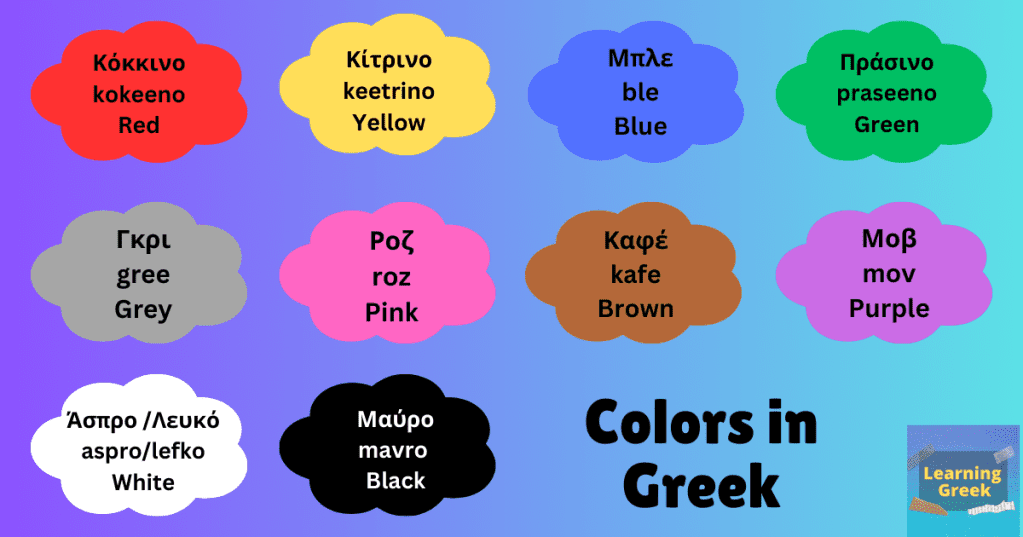
The pictures below, will help you remember Greek colors easily.

Rules about Greek Colors
Until now, we’ve said that colors, when used as nouns, are always neuter gender.
BUT keep in mind that Greek colors are mostly used as adjectives that follow the Greek grammar rule of agreeing with the noun they modify.
This means that is not enough to know that κόκκινο means red. If, for example a noun is masculine, then κόκκινο becomes κόκκινος and if it’s feminine then it becomes κόκκινη.
But let’s see the adjectives of the most common colors:
| Επίθετο / Adjective | Ουσιαστικό / Noun |
| Masc: ο άσπρος (o aspros) / οι άσπροι Fem: η άσπρη (ee aspree) / οι άσπρες N: το άσπρο (to aspro) / τα άσπρα | το άσπρο, τα άσπρα / white |
| Masc: ο μαύρος (o mavros) / οι μαύροι Fem: η μαύρη (ee mavree) / οι μαύρες N: το μαύρο (to mavro) / τα μαύρα | το μαύρο, τα μαύρα / black |
| Masc: ο κόκκινος (o kokeenos) / οι κόκκινοι Fem: η κόκκινη (ee kokeenee) / οι κόκκινες N: το κόκκινο (to kokeeno) / τα κόκκινα | το κόκκινο, τα κόκκινα / red |
| Masc: ο πράσινος (o praseenos) / οι πράσινοι Fem: η πράσινη (ee praseenee) / οι πράσινες N: το πράσινο (to praseeno) / τα πράσινα | το πράσινο, τα πράσινα / green |
And some examples:
- Έχω μία κίτρινη τσάντα (Eho Mia keetreenee tsanta) – I’ve got a yellow bag
- Ο φάκελος είναι πράσινος (O fakelos eine praseenos) – The envelope is green
- Μπορείς να μου δώσεις σε παρακαλώ το κόκκινο βιβλίο; (Boreis na mu dosees se parakalo to kokeeno vivlio?) – Can you please give me the red book?

Exceptions
Some Greek colors are indeclinable.
They keep the same form in both noun and adjective.
This happens because they come from foreign words.
The most common indeclinable colors are: το μπλε, το ροζ, το μωβ.
For example:
- H Ελένη έχει ροζ μαλλιά (Εe Eleni ehee roz malia) – Helen has pink hair
But we do have some colors that, although they come from a foreign language, can also be declinable.
In other words, we can use both declinable and ideclinable forms.
The most common of them are το καφέ and το γκρι.
Lets’ see some examples:
- Τα παπούτσια μου είναι καφέ (Ta paputsia mu eene kafe) – My shoes are brown
- Τα παπούτσια μου είναι καφετιά (Ta paputsia mu eene kafetia) – My shoes are brown
- Ο ουρανός είναι γκρι (Ο uranos eene gri) – The sky is grey
- Ο ουρανός είναι γκρίζος (O uranos eene greezos) – The sky is grey
The Significance of Colors in Greek Culture

Until now, we’ve analyzed the linguistic significance of colors in Greek. But like all cultures, Greeks attribute symbolic meanings to certain colors.
If there are two colors that most characterize Greece, they can be none other than blue and white. We find them on the Greek Flag, and they are literally everywhere.
Blue is associated with the sky and, of course, with our endless sea. The Aegean blue is the most characteristic color of Greece. Blue also symbolizes freedom. The blue stripes on the Greek flag are 5 because they represent the word freedom. which in Greek has 5 syllables ε – λευ – θε – ρί -α.
White is the most common color you’ ll find while travelling to the islands. Most houses are white, especially in the Cyclades. Islands residents keep the glamorous white vivid by painting their houses every year before Easter. It has become a tradition. White symbolizes cleanliness and purity and it is the color of bribes. It is the dominant color in Baptisms as well.
Apart from those two iconic colors for Greece, Greeks have a special bond with red. It is connected with Ancient Greece and symbolizes bravery and heroism because red was the color of warriors.
Green also holds a special place in our hearts because…olives and the endless landscapes of olive trees. It symbolizes fertility and renewal and it is associated with nature and growth.
Video
You can watch this video I have made to see how colors are pronounced in Greek. Enjoy!
And before we close, let’s remember the most basic rule regarding colors in Greek!
Colors in Greek are adjectives of which the neuter gender can be used as a noun.
And now that you have learned everything about colors can you tell me which is your favorite color and why? You can leave a comment in Greek below.