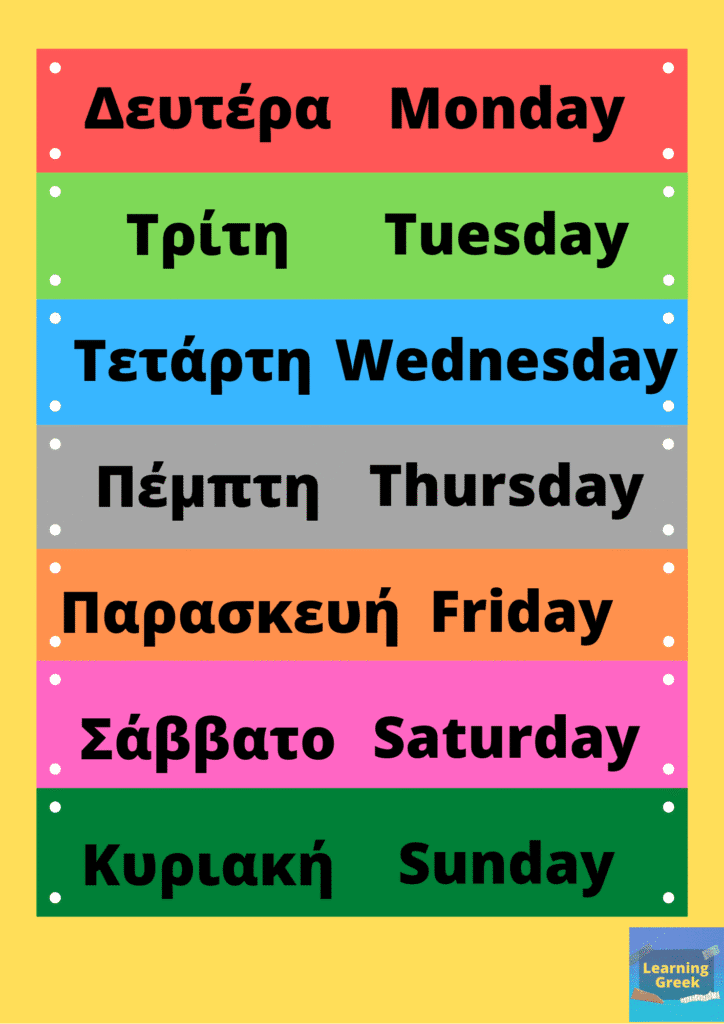

The days of the week in Greek are not very hard to remember because most of them follow a numerical pattern.
Nowadays in Greece, the first day of the week is considered to be Monday but this was not always the case.
Sunday was considered to be the first day of the week and this detail along with the numerical pattern will help you memorize Greek days easily.
The Greek Days of the Week Explained
The Numerical Pattern
Monday in Greek is called Δευτέρα (Deftera) which means second day —> δεύτερη ημέρα (defteri imera)
Tuesday in Greek is called Τρίτη (Triti) which means third day —> τρίτη ημέρα (triti imera)
Wednesday is called Τετάρτη (Tetarti) which means fourth day —> τέταρτη ημέρα (tetarti imera)
Thursday is called Πέμπτη (Pempti) which means fifth day —> πέμπτη μέρα (pempti imera)
So far, we have the days that follow a clear numerical pattern.
Δευτέρα, Τρίτη, Τετάρτη, Πέμπτη.
The Remaining Days
The next three days don’t follow this rule so you’ll need to remember them. But it’s only three days, right? So yay!
Ok, so after Πέμπτη, we have Παρασκευή (Paraskevi) – Friday, Σάββατο (Savato) – Saturday and Κυριακή (Kiriaki) – Sunday.
Tip: The word Κυριακή derives from Κύριος (Kirios) meaning Lord — the “Lord’s Day,” dedicated to God.
Here is a list of all the Greek days of the week:
Full List: Greek Days of the Week
- Δευτέρα (Deftera) – Monday
- Τρίτη (Triti) – Tuesday
- Τετάρτη (Tetarti) – Wednesday
- Πέμπτη (Pempti) – Thursday
- Παρασκευή (Paraskevi) – Friday
- Σάββατο (Savato) – Saturday
- Κυριακή (Kiriaki) – Sunday
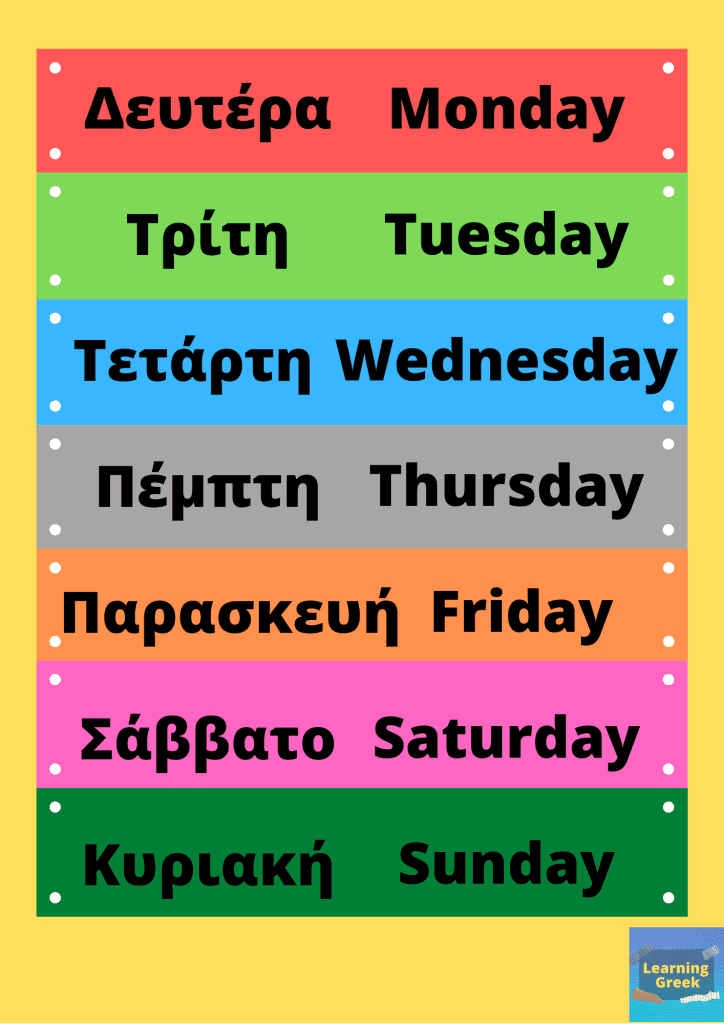
And here is an image of the days of the weeks in Greek. I do believe that colors always help you memorize things easier. Don’t you?
Grammar Notes and Tips
Before moving on to vocabulary and to some interesting facts related to the Greek days of the week, let me state three important things:
- Days of the week are proper nouns so they must always start with a capital letter.
- All days of the week are feminine except Σάββατο which is neuter. So the articles that accompany the days are formed as follow: η Δευτέρα, η Τρίτη, η Τετάρτη, η Πέμπτη, η Παρασκευή, το Σάββατο, η Κυριακή.
- You can see the word day represented in Greek either with the word μέρα (mera) or the word ημέρα (imera). Both forms are correct. The word ημέρα is considered to be slightly more formal but you can use both freely.
Now, we are ready to continue!
Useful Greek Vocabulary and Phrases
Asking What Day It Is
- Τι μέρα είναι σήμερα; (Ti mera ine simera?) – What day is today?
- (Σήμερα είναι) Δευτέρα (Simera ine Deftera) – Today is Monday
- Τι μέρα της εβδομάδας είναι; (Ti mera tis evdomadas ine?) – What day of the week is it?
- (Είναι) Πέμπτη (Ine Pempti) – It’s Thursday
- Τι μέρα είναι; (Ti mera ine?) – What day is it?
- (Είναι) Τετάρτη (Ine Tetarti) – It is Wednesday
- Τι μέρα έχουμε; (Ti mera ehoume?) – What day is it?
- (Έχουμε) Τρίτη (Ehume Triti) – It is Tuesday
As you can see in the above examples we don’t use any article before the days. But we do use them when we are referring to a specific thing on a certain day as the examples below.
Talking About Specific Days
- Τι μέρα είναι η συναυλία; (Ti mera ine i sinavlia?) – What day is the concert?
- (Είναι) την Παρασκευή (Ine tin Paraskevi) – It is on Friday
- Θέλεις να πάμε για καφέ το Σάββατο; (Thelis na pame ya kafe to Savato?) – Would you like to go for a coffee on Saturday?
- Θέλεις να συναντηθούμε την Κυριακή; (Thelis na sinantithume tin Kiriaki?) – Would you like to meet on Sunday?
- Πότε θέλεις να βρεθούμε; (Pote thelis na vrethume?) – When would you like to meet up?
- Την Παρασκευή (Tin Paraskevi) – On Friday
The parenthesis on all the above examples indicates that if we answer with just the name of the week, we will still be correct. Easy, right? 😉
Other Useful Words
- Σαββατοκύριακο (Savatokiriako) – Weekend
- Καθημερινή (Kathimerini) – Weekday
- Σήμερα (Simera) – Today
- Αύριο (Avrio) – Tomorrow
- Μεθαύριο (Methavrio) – Day after tomorrow
- Χθες ή Χτες (Xthes or htes) – Yesterday
- Προχθές ή Προχτές (Prohthes or prohtes) – The day before yesterday
It is very common for Greeks to wish to each other every Monday for the rest of the week. They say:
- Καλή εβδομάδα! (Kali evdomada) – Have a nice week!
We also wish for a great weekend:
- Καλό Σαββατοκύριακο! (Kalo Savatokiriako) – Have a nice weekend!
Interesting facts About Greek Days
Ancient Greek Origins
Ancient Greeks named the days after planets:
Monday: Ημέρα Σελήνης (Imera Selinis) – Moon day
Tuesday: Ημέρα Άρεως (Imera Areos) – Ares day
Wednesday: Ημέρα Ερμού (Imera Ermu) – Hermes day
Thursday: Ημέρα Διός (Imera Dios) – Zeus day
Friday: Ημέρα Αφροδίτης (Imera Afroditis) – Aphrodite day
Saturday: Ημέρα Κρόνου (Imera Kronu) – Saturn day
Sunday: Ημέρα Ηλίου (Imera Iliu) – Sun day
But as Christianity spread, the clergy no longer wanted the days of the week to be named after pagan gods, so they changed them to the form we know today.
Famous Greek Mondays & Traditions
Καθαρά Δευτέρα (Kathara Deftera) – Clean Monday. The first day of Σαρακοστή (Sarakosti), the big Greek lent before Easter.
Δευτέρα του Πάσχα (Deftera tu Pasha) – Easter Monday.
- Tuesday is considered to be an unlucky day because it is the day of the fall of Konstantinoupolis
- Thursday of the second week of the Greek Carnival is called Τσικνοπέμπτη (Tsiknopempti) and everyone eats great quantities of meat.
- Παρασκευή and Κυριακή are also Greek female names. The masculine equivalents are Παρασκευάς (Paraskevas) and Κυριάκος (Kiriakos).
- If you are born on a Saturday in Greece you’re considered to have really good or really bad luck. Depends on the traditions of different Greek areas.
Learn Greek with Songs
Well, that was it for today. I will say goodbye with one of my favorite kid songs which still amuse me when I hear it today and guess what? It can help you learn the days of the week! You can find the lyrics in the description. Enjoy the Smurfs or στρουμφάκια (strumfakia) as we call them!
Test Your Knowledge!
Now that you’ve learned the days of the week in Greek (and even had some fun with the Smurfs song), why not challenge yourself?
Take the Greek Days of the Week Quiz and see how much you’ve remembered!
When you’re done, don’t stop there — keep your Greek learning journey going with more fun topics below.
What Can You Do Next?
Learn the Months in Greek
Discover how to say and pronounce all 12 months in Greek, plus tips to remember them easily.
Greek Seasons Vocabulary and Expressions
Learn how to talk about the four seasons in Greek, weather expressions, and what each season represents in Greek culture.
How to Say and Write Dates in Greek
Master how to ask “What’s today’s date?”, say dates correctly, and understand how Greeks express time and days in everyday conversations.


Hi!
I do like and appreciate your explanation for the days in greek, it helps a lot to learn and memorize.
One of my dearest wish is to succeed in learning greek language and speak fluently… I would like to finish my life in Greece for many personal reasons …
I’m glad you found my article helpful 🙂
I hope your dream comes true and you get to live in Greece!
Εφόσον παρα πολι
>>Ancient Greeks named the days after planets
Is this the same principle that is used in modern Romance and Germanic languages?