
Hello, Greek learners! 😊
Today, we’re exploring one of the most important verbs. The Greek verb είμαι (íme). It’s the Greek equivalent of “to be” and an essential building block for expressing who you are, where you are, and so much more. Mastering είμαι will help you describe yourself, talk about others, and even form complex sentences in Greek. Similarly, another key verb to explore is έχω (‘to have’), which complements είμαι in many expressions. Learn more about έχω here.
This guide includes all the forms of είμαι across tenses, common uses, cultural tips, and examples to help you make the most of it in your conversations!
Let’s get started.
What Does Είμαι Mean?
At its core, είμαι means “I am.” It’s a fundamental verb that helps us talk about identity, characteristics, states, and existence. Think of it as your go-to verb for expressing who, what, where, and how you are!
Είμαι means “I am”
Basic Usage and Applications of Είμαι
The verb είμαι is used to indicate existence, identity, condition, or state. It plays a vital role in Greek and appears in various contexts:
- Indicating Existence:
- Είμαι εδώ. (Íme edó.) – I am here.
- Describing Identity or Characteristics:
- Είμαι Έλληνας. (Íme Éllinas.) – I am Greek.
- Είναι καλός μαθητής. (Íne kalós mathitís.) – He is a good student.
- Είμαι δάσκαλος. (Íme dáskalos.) – I am a teacher.
- Stating Location:
- Είμαι στην Αθήνα. (Íme stin Athína.) – I am in Athens.
- Είναι στο σχολείο. (Íne sto scholío.) – She is at school.
- Expressing State, Condition, or Feelings:
- Είμαι καλά. (Íme kalá.) – I am well.
- Είμαι κουρασμένος. (Íme kurasménos.) – I am tired.
- Ήταν χαρούμενη. (Ítan charúmeni.) – She was happy.
- Είμαι πεινασμένος. (Íme pinasménos.) – I am hungry.
- Ήμουν θυμωμένος. (Ímun thimoménos.) – I was angry.
- Asking and Answering Questions:
- Πού είσαι; (Pú íse?) – Where are you?
- Είμαι εδώ. (Íme edó.) – I am here.
Because of its versatility, είμαι is one of the first verbs learners encounter in Greek.
Conjugating Είμαι in All Tenses
The verb είμαι has indicative and subjunctive forms in the present and past tenses, but it only has an indicative form in the future tense. To conjugate είμαι effectively, understanding personal pronouns is essential, as the verb endings in Greek align closely with these pronouns. [Learn more about personal pronouns here.]
Below is a breakdown of how to conjugate είμαι across various tenses, along with examples.
1. Present Tense (Ενεστώτας)
The present tense of είμαι is used for actions happening now or general truths.
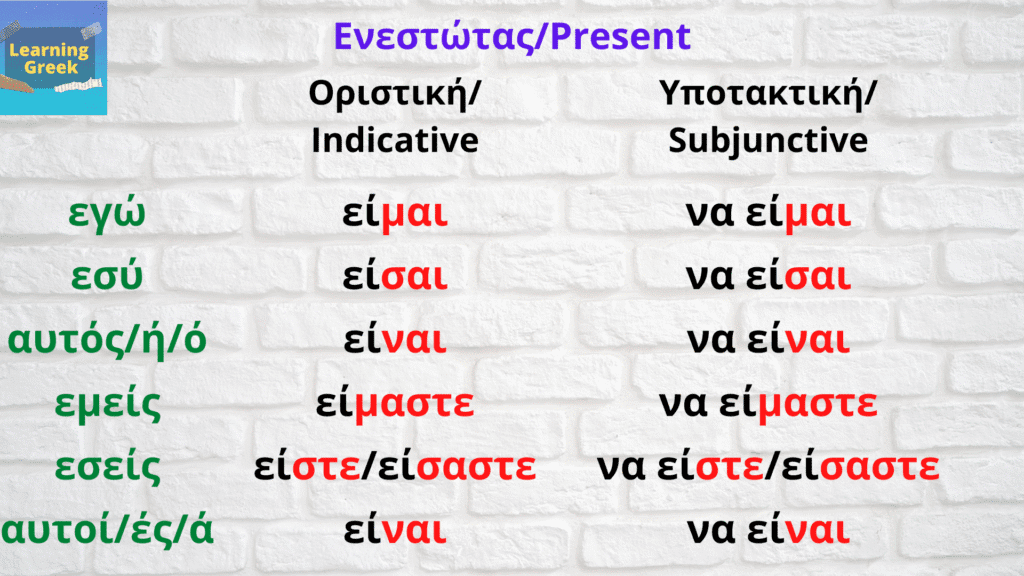
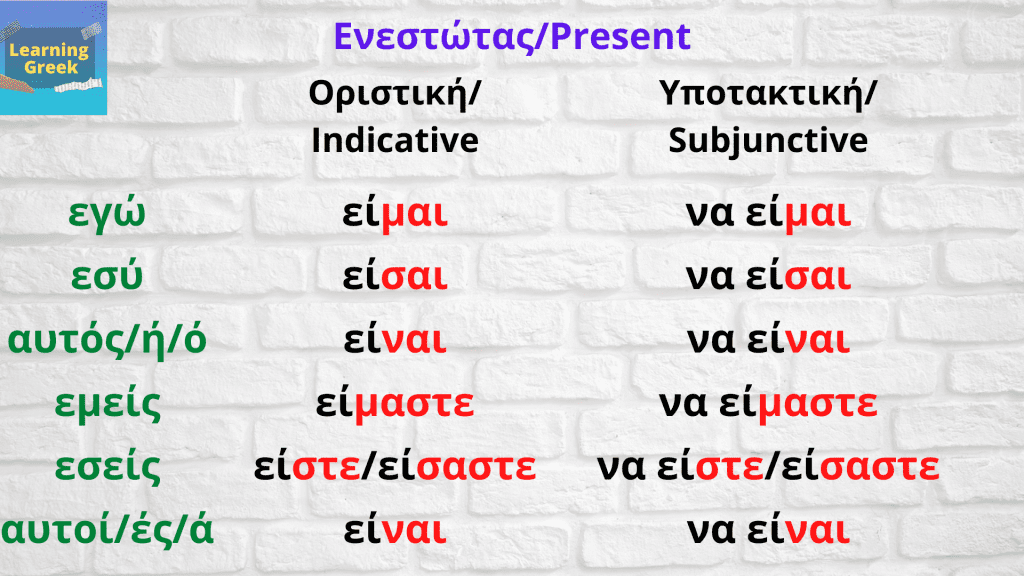
| Greek/ Indicative | Pronunciation | English |
|---|---|---|
| Εγώ είμαι | (egó íme) | I am |
| Εσύ είσαι | (esí íse) | You are |
| Αυτός/ή/ό είναι | (aftós/tí/tó íne) | He/She/It is |
| Εμείς είμαστε | (emís ímaste) | We are |
| Εσείς είστε/είσαστε | (esís íste / ísaste) | You are |
| Αυτοί/ές/ά είναι | (aftí/tés/tá íne) | They are |
Examples:
- Εγώ είμαι στην πόλη.
(Egó íme stin póli.)
I am in the city. - Εσύ είσαι πολύ έξυπνος.
(Esí íse polí éksipnos.)
You are very smart. - Αυτή είναι η καλύτερη ιδέα.
(Aftí íne i kalίteri idéa.)
This is the best idea..
| Greek/Subjunctive | Pronunciation | English |
|---|---|---|
| Εγώ να είμαι | (egó na íme) | I may be / I should be |
| Εσύ να είσαι | (esí na íse) | You may be |
| Αυτός/ή/ό να είναι | (aftós/tí/tó na íne) | He/She/It may be |
| Εμείς να είμαστε | (emís na ímaste) | We may be |
| Εσείς να είστε/είσαστε | (esís na íste / ísaste) | You may be |
| Αυτοί/ές/ά να είναι | (aftí/tés/tá na íne) | They may be |
Examples:
- Πρέπει να είμαι έτοιμος αύριο.
(Prépi na íme étimos ávrio.)
I must be ready tomorrow. - Εσύ πρέπει να είσαι στην τάξη την ώρα του μαθήματος.
(Esí prépi na íse stin táxi tin óra tu mathímatos.)
You should be in class during the lesson. - Αυτή πρέπει να είναι εκεί όταν φτάσουμε.
(Aftí prépi na íne ekí ótan ftásume.)
She may be there when we arrive.
2. Past Tenses: Παρατατικός & Αόριστος
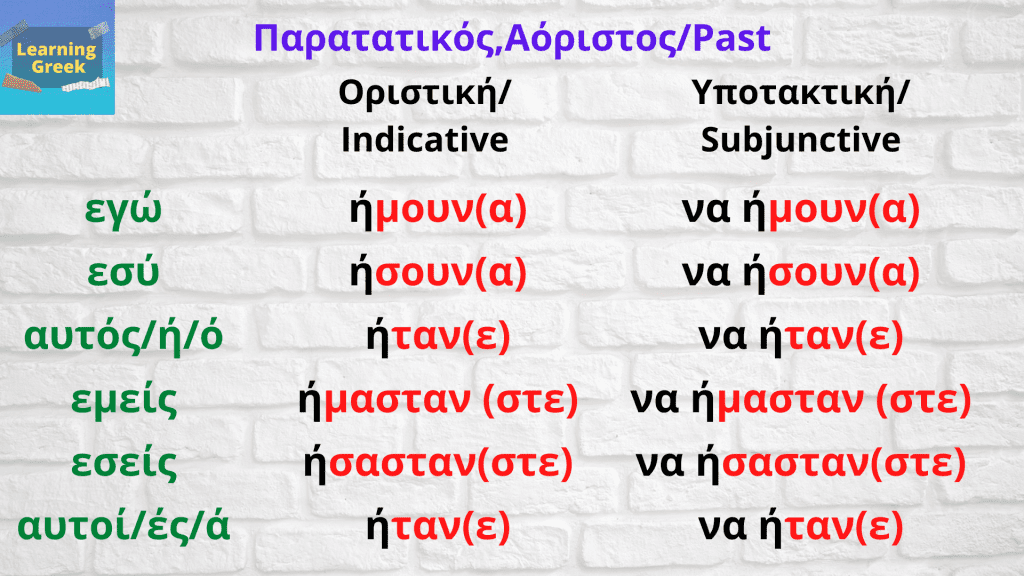
The Aorist (Αόριστος) form of είμαι often overlaps with the Past Continuous (Παρατατικός) in meaning. The Παρατατικός emphasizes duration or repetition in the past, while the Αόριστος highlights a specific or completed action.
| Greek/Indicative | Pronunciation | English |
|---|---|---|
| Εγώ ήμουν / ήμουνα | (egó ímun / ímuna) | I was |
| Εσύ ήσουν / ήσουνα | (esí ísun / ísuna) | You were |
| Αυτός/ή/ό ήταν / ήτανε | (aftós/tí/tó ítan / ítane) | He/She/It was |
| Εμείς ήμασταν / ήμαστε | (emís ímastan / ímaste) | We were |
| Εσείς ήσασταν / ήσαστε | (esís ísastan / ísaste) | You were |
| Αυτοί/ές/ά ήταν / ήτανε | (aftí/tés/tá ítan / ítane) | They were |
Note on the Two Forms:
Both forms (ήμουν/ήμουνα, ήσουν/ήσουνα, etc.) are correct and interchangeable.
- Shorter form ήμουν is often used when the following word starts with a vowel:
- Ήμουν εκεί. (Ímun ekí.) – I was there.
- Longer form ήμουνα is commonly used when the following word starts with a consonant:
- Ήμουνα καλός φίλος. (Ímuna kalós fílos.) – I was a good friend.
However, this is not a strict rule. Both forms are correct and can be used interchangeably in many situations. The choice of form is often based on personal preference, rhythm, or style, rather than grammatical necessity.
Examples:
- Εγώ ήμουν στο σπίτι χθες.
(Egó ímun sto spíti hthes.)
I was at home yesterday. - Εσύ ήσουν στο σχολείο την ώρα της επίσκεψης.
(Esí ísun sto scholío tin óra tis epískepsis.)
You were at school during the visit. - Αυτοί ήταν στο πάρκο το πρωί.
(Aftí ítan sto párko to proí.)
They were at the park in the morning.
| Greek/Subjunctive | Pronunciation | English |
|---|---|---|
| Εγώ να ήμουν / ήμουνα | (egó na ímun / ímuna) | I may have been |
| Εσύ να ήσουν / ήσουνα | (esí na ísun / ísuna) | You may have been |
| Αυτός/ή/ό να ήταν / ήτανε | (aftós/tí/tó na ítan / ítane) | He/She/It may have been |
| Εμείς να ήμασταν / ήμαστε | (emís na ímastan / ímaste) | We may have been |
| Εσείς να ήσασταν / ήσαστε | (esís na ísastan / ísaste) | You may have been |
| Αυτοί/ές/ά να ήταν / ήτανε | (aftí/tés/tá na ítan / ítane) | They may have been |
Examples:
- Εγώ έπρεπε να ήμουν εκεί την ώρα που ήρθες.
(Egó éprepe na ímun ekí tin óra pou írthes.)
I must have been there when you came. - Εσύ έπρεπε να ήσουν εκεί όταν άρχισε η βροχή.
(Esí éprepe na ísun ekí ótan árchise i vrochí.)
You may have been there when it started raining. - Αυτοί πρέπει να ήταν στην αγορά όταν περάσαμε.
(Aftí prépi na ítan stin agorá ótan perásame.)
They may have been at the market when we passed by.
3. Future Continuous (Εξακολουθητικός Μέλλοντας)
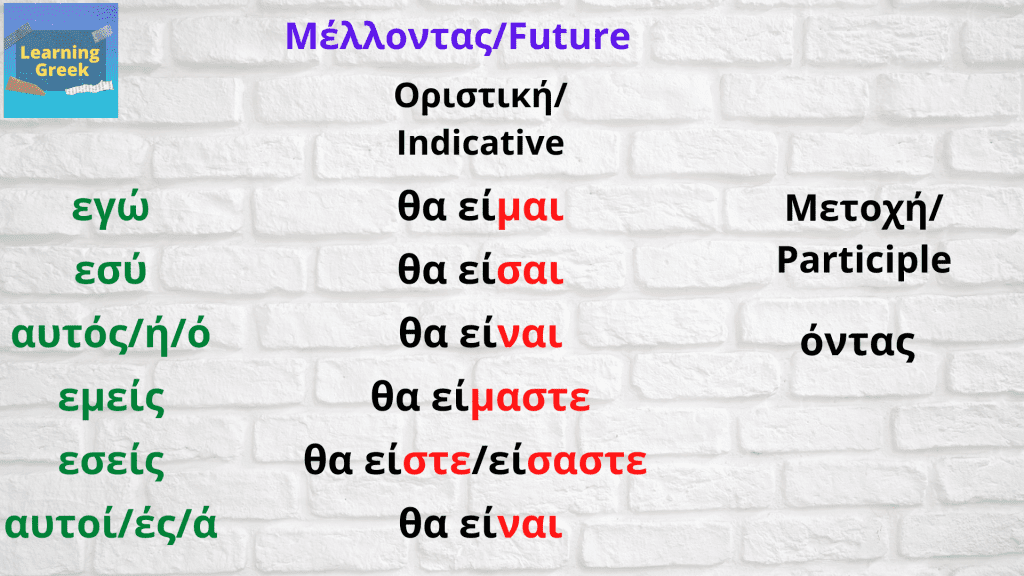
| Greek/Indicative | Pronunciation | English |
|---|---|---|
| Εγώ θα είμαι | (egó tha íme) | I will be |
| Εσύ θα είσαι | (esí tha íse) | You will be |
| Αυτός/ή/ό θα είναι | (aftós/tí/tó tha íne) | He/She/It will be |
| Εμείς θα είμαστε | (emís tha ímaste) | We will be |
| Εσείς θα είστε/είσαστε | (esís tha íste/ísaste) | You will be |
| Αυτοί/ές/ά θα είναι | (aftí/tés/tá tha íne) | They will be |
Examples:
- Θα είμαι έτοιμος.
(Tha íme étimos.)
I will be ready. - Θα είστε χαρούμενοι.
(Tha íste charúmeni.)
You will be happy. - Θα είναι εδώ.
(Tha íne edó.)
They will be here.
Participle
The present participle of είμαι is όντας, which indicates an ongoing state or action.
It is often translated into English as “being” and it is used when describing someone while in the middle of an action or state, or when expressing simultaneous conditions. This participle is often used with the subject already stated and can imply additional context or a background condition for another action.
Examples:
- Εγώ όντας απασχολημένος, δεν μπόρεσα να απαντήσω.
(Egó óntas apascholiménos, den bóresa na apantíso.)
I, being busy, couldn’t answer. - Εσύ όντας νέος, αποφάσισες να ταξιδέψεις.
(Esí óntas néos, apofásises na taxidépsis.)
You, being young, decided to travel. - Αυτοί, όντας εργατικοί, κατάφεραν να ολοκληρώσουν το έργο.
(Aftí, óntas ergatikí, katáferan na oloklirósun to érgo.)
They, being hardworking, managed to finish the project.
Important Notes:
- Όντας is used to emphasize that the state of being is happening simultaneously with the action.
- It is commonly used in written or more formal language but can also appear in everyday speech.
- In certain contexts, it can act similarly to an adjective to describe the subject’s state while other events unfold.
- In Greek, this form is often found in complex sentences or when there is a focus on one action occurring during another.
Describing States and Conditions with Είμαι
The verb είμαι is frequently used with a past participle to describe states or conditions in different tenses. This construction expresses a subject’s condition or state in the present, past, or future. Here’s how it works:
- Present Indicative + Past Participle
Example: Είμαι πεινασμένος. (Íme pinasménos.) – I am hungry. - Past Indicative + Past Participle
Example: Ήμουν θυμωμένος. (Ímun thymoménos.) – I was angry. - Future Indicative + Past Participle
Example: Θα είμαι πεινασμένος. (Tha íme pinasménos.) – I will be hungry.
This structure is versatile and can be used to describe emotions, physical states, or conditions across timeframes.
Key Points About Είμαι
- Contractions in Speech
In spoken Greek, είμαι often contracts:
Είμαστε → Είμαστ’ εδώ! (“We’re here!”)
Contractions are informal and frequent in everyday speech.
- Politeness and Formality
Use είστε/είσαστε when addressing someone formally or when speaking to a group.
3. Negation
Use δεν before είμαι:
- Δεν είμαι καλά.
(Den íme kalá.)
I am not well. - Δεν ήταν εδώ.
(Den ítan edó.)
He was not here
Practice Tips
- Memorize the Conjugations: Make flashcards to drill them daily.
- Use it in Sentences: Practice forming statements, questions, and negations.
- Pair it with Adjectives and Nouns:
- Είμαι καλός/ή μαθητής/μαθήτρια.
(Íme kalós/i mathitís/mathítria.)
I am a good student.
- Είμαι καλός/ή μαθητής/μαθήτρια.
- Recognize Irregularities: Pay attention to past tense forms like ήμουν, which differ significantly from the present tense.
- Personal Pronouns are helpful for clarity, but in Greek, they’re often dropped because the verb endings indicate the subject.
- Practice all tenses to get comfortable expressing yourself in different contexts.
- Pair είμαι with adjectives, nouns, and locations to describe identity, state, or place.
Conclusion
As you can see, mastering είμαι is a crucial step toward fluency in Greek. It forms the foundation for describing states, identities, and locations, helping you express yourself in countless ways.
To further expand your skills, be sure to explore another essential verb: έχω (‘to have’). Understanding έχω will help you talk about possessions, relationships, and more, complementing your use of είμαι perfectly. Discover everything you need to know about έχω here!
Keep practicing, and don’t hesitate to reach out with any questions or for more examples. Καλή επιτυχία! 😊